相比蜜雪做幸运咖,投资者更认可古茗做咖啡的方式Compared to Meixue making lucky coffee, investors are more accepting of Guming's way of making coffee
中报过后,蜜雪集团(02097.HK,下称“蜜雪”)和古茗(01364.HK)的股价走势出现分化,截至9月2日收盘,蜜雪股价自中报下跌16.17%,古茗股价微涨0.95%。两家新茶饮公司在市值上的差距也进一步缩小,蜜雪市值791亿港元,古茗595亿港元。
「明亮公司」此前已对蜜雪冰城、古茗和瑞幸的财务数字进行了对比分析,直观来看,蜜雪股价的下挫,是因为其在营收、利润和同店GMV增速上的不及预期。其中,蜜雪上半年的归母净利润同比下降了14.7%、券商测算的蜜雪单店的营收下滑约17%。
而古茗的财报数字则被认为是超预期的。出了上述主要指标之外,古茗在同店上的表现更值得关注,据财报计算,古茗单店日均GMV为7800元,同比增长2.6%;单店日均杯量440杯,基本持平;杯单价17.8元,同比增长3.1%。
针对这种门店层面的变化的一个原因,是古茗咖啡“第二曲线”带来的变化。公司CFO孟海陵在业绩会上表示:"如果没有咖啡和早时段,我们很难维持上半年的增长。”而从披露的数字来看,截至6月末,古茗约13500家门店已配备咖啡机,覆盖了94%的门店。
古茗在业绩会上还给出了一个数字,公司非促销期咖啡占门店销售稳定 20% 以上、活动期超 25%。而据中金的研报预测,古茗的咖啡当前杯量占比约为20%。以上数字充分反映出,第二曲线对于公司增长、利润带来的变化。
同做“第二曲线”,蜜雪和古茗采取了不同的打法。蜜雪是通过打造独立的咖啡品牌「幸运咖」,而古茗则是在现有门店拓展咖啡SKU的品类。现阶段看来,古茗的路线似乎更加有效,蜜雪也似乎意识到了,选择在主品牌「蜜雪冰城」的门店增加咖啡品类,但目前的主品牌咖啡机的覆盖率仍处于较低区间(约7%)。
同样地,瑞幸( LKNCY.US )也选择在咖啡门店卖茶饮产品(轻乳茶),同样取得了不错的效果。而霸王茶姬(CHA.US)此前曾尝试独立品牌「茶姬现萃」,后来也以失败告终。
由此来看,在当下 “增加新品类”似乎要比“做第二品牌”更容易成功,依靠新开店拉升增长事实上已经遇到行业的瓶颈,而提升同店还有空间。
同样是一个增长的故事,但怎么讲这个故事,市场给出了不同反馈。
费用差异,反映效率
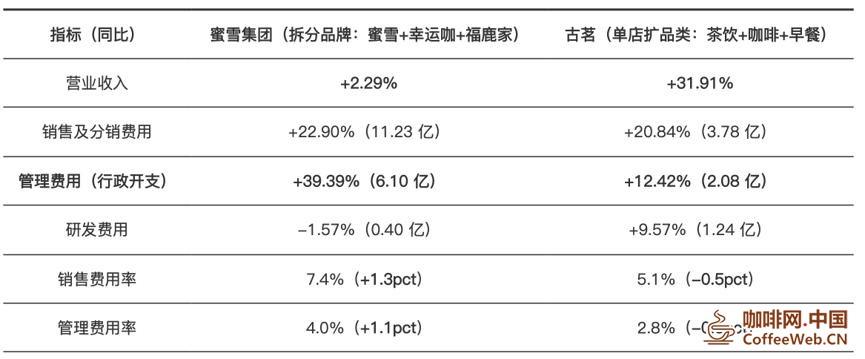
理解蜜雪和古茗的在“第二曲线”上的差异,首先要看费用结构。蜜雪的费用增速明显高于营收增速,而古茗正相反。
来源:财报、AlphaEngine整理
2026年上半年,蜜雪营收同比增长2.29%,但销售及分销费用同比增长22.90%,达到11.23亿元;行政开支同比增长39.39%,达到6.10亿元;研发费用同比下降1.57%,为0.40亿元。对应费用率看,销售费用率为7.4%,同比提升1.3个百分点;管理费用率为4.0%,同比提升1.1个百分点。
这意味着,蜜雪在收入低个位数增长的情况下,销售和管理费用仍在增长。费用增速明显高于收入增速。
古茗的方向相反。2026年上半年,古茗营收同比增长31.91%,销售及分销费用同比增长20.84%,为3.78亿元;管理费用同比增长12.42%,为2.08亿元;研发费用同比增长9.57%,为1.24亿元。销售费用率为5.1%,同比下降约0.5个百分点;管理费用率为2.8%,同比下降约0.5个百分点。
也就是说,古茗收入增速高于费用增速,费用率在下降。蜜雪收入增速低于费用增速,费用率在上升。
「明亮公司」认为:这与两家公司做咖啡的路径有关。
蜜雪的「幸运咖」需要独立品牌、独立门店网络、加盟管理体系、产品体系和营销投入。即便供应链可以复用蜜雪体系,品牌运营和加盟管理仍然会产生组织成本。
此外,蜜雪还在推进“真鲜纯”三年计划,包括短保原料、冷链三温配送、供应链代际升级、生产基地扩建等。这些投入与主品牌升级有关,也与咖啡、鲜奶、冷链果汁等新品类有关。
古茗则不是重建一个咖啡品牌,而是在已有门店里增加咖啡品类。它的成本曲线更接近“复用”——同一套门店、同一批加盟商、同一套督导体系、同一套仓储物流,可以服务更多SKU。
从资本开支看,加盟商的压力也小很多。据市场相关资料,古茗咖啡设备主要由加盟商承担,并采取分期形式。市场资料还显示,古茗的一台全自动咖啡机约7万至10万元(雪莱或Eversys),加盟商也可分期支付,只需付先押金约1.5万元且分期返还。对加盟商来说,这不是开一家新店,而是在老店中增加一台设备,而且,这台设备后面也可以继续回收或在市场中二手方式流通。
这带来的差异很直接——加咖啡设备的边际租金几乎为零,新增人工有限,门店原有水电、仓储、员工、线上渠道都可以复用。但单独开一家幸运咖,加盟商要承担的是完整门店投入。
这或许解释了市场对两种路径的估值反应不同的原因。
而且,咖啡产品则进一步平衡了古茗不同时段的消费,特别是早餐这一场景的消费,拉高了店效率。
在门店扩张期,独立品牌可以带来新的门店数、新的GMV和更大的想象空间。但在单店承压、加盟商现金流变紧的阶段,独立品牌也会放大运营成本和资本开支压力。
第二曲线:蜜雪靠新店,古茗靠同店
古茗和蜜雪的差异(来源:AlphaEngine)
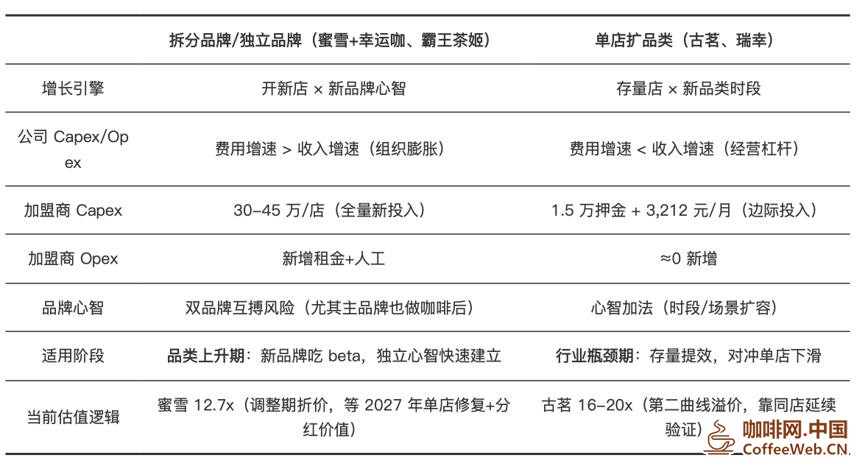
蜜雪和古茗都把咖啡视为第二曲线,但增长方式不同。
蜜雪的咖啡增长主要来自新开店和独立品牌扩张。市场上没有蜜雪官方披露的幸运咖的收入和利润,但极海的数据显示,目前幸运咖的门店约在7900-8000家,且今年以来,幸运咖的新开店数量已经明显放缓,8月的新增门店数仅为14家,而去年8月新增门店数达892家。
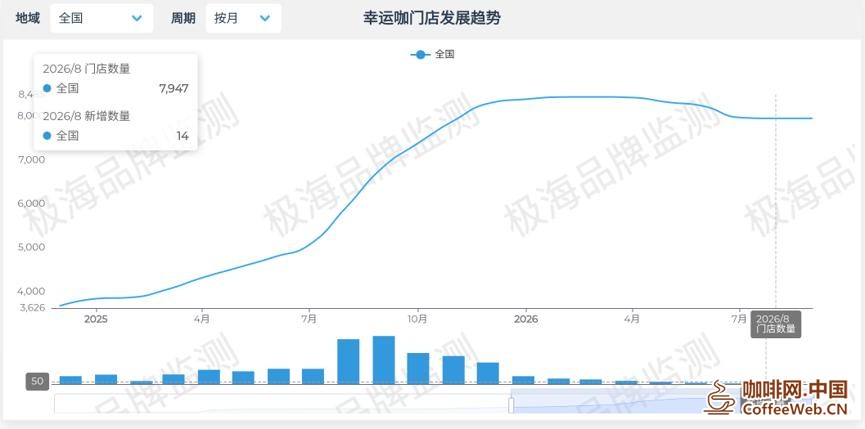
来源:极海品牌监测数据
与此同时,蜜雪冰城主品牌也在铺设现磨咖啡,也会造成“分流”的问题。
两者价格带接近,客群重合度较高,点位也都集中在下沉市场。幸运咖主力产品价格约在5至10元,蜜雪主品牌现磨咖啡也处于低价带。
对加盟商来说,这个问题更重要。开一家幸运咖需要完整投入,而在蜜雪冰城门店里加咖啡,投入更低。如果两个品牌覆盖同一客群,加盟商会重新计算回报周期。这会影响幸运咖开店速度,也会影响蜜雪咖啡第二曲线的增量预期。
蜜雪似乎意识到了这个问题,在业绩会上,公司管理层提出2026年公司将重点放在门店经营质量提升上,持续投入基础设施和运营体系,同时稳步、审慎地拓展门店规模
再来看古茗。
正如前文所述,截至2026年上半年,古茗约13500家门店配备咖啡机,覆盖率约94%。目前,古茗的咖啡在门店销售中的占比已稳定在20%以上,活动期超过25%。中金公司预计,古茗当前咖啡杯量占比约20%。管理层目标是,到2026年底至2027年上半年,咖啡占比稳定在25%至30%。目前来看,古茗咖啡购买用户中超过50%是新客,且单杯到手价约10元,与瑞幸部分产品接近。咖啡既带来新客,也补充早时段消费。
加盟商利润也在财报后成为市场关注点。
古茗管理层在业绩会上对加盟商利润做了逐月拆解,一季度加盟商利润超过去年同期;5月承压,主要受天气、去年外卖高基数、外卖占比较高影响;6月至8月销售数据和加盟商利润大幅改善。
而且,古茗上半年净增门店只有797家,低于去年同期的1,265家,也低于市场对全年开店的线性预期。公司表示,放缓开店是主动管控,较差门店开业后会稀释存量加盟商生意,最终损害加盟生态。
古茗的逻辑是,在门店数量已经接近饱和的情况下,不通过新品牌让加盟商继续开店,而是让同一家店获得更多时段和更多品类,进而能在盈利上有更好的表现。咖啡、早营业时段,都服务于这个目标。
这可能也是古茗中报后股价上涨的原因之一。市场看到的不是单纯的咖啡“第二曲线”故事,而是咖啡要反映到单店层面的GMV、杯单价、加盟商利润和公司利润率中。
开新店的Beta消失,需要单店创造Alpha
在行业上行期,独立品牌是更容易讲增长故事的方式。一个新品牌意味着新的门店网络、新的市场空间和新的收入曲线。蜜雪过去能孵化幸运咖,依赖的是低价供应链、加盟商网络和下沉市场覆盖。这套能力在开店红利期有效。
但到2026年,行业进入另一个阶段。
茶饮门店密度提高,咖啡赛道有瑞幸、库迪、幸运咖、肯悦等品牌竞争,低线市场也在被不断开发。外卖补贴退坡后,单店收入开始承压。此时,加盟商更关心单店利润。
在这个环境下,独立品牌会面临两个约束:一是新开店质量下降(比如受点位的影响),二是加盟商资金回报周期变长。若主品牌和新品牌又存在价格带、点位和客群重叠,开店意愿会进一步受到影响。
机构观点也反映了这种差异。JPM对古茗中报评价为“超预期”,认为经调整核心利润超其预估15%、超买方共识8%。
这也解释了市值定价叙事的变化:过去市场看门店增速,现在市场看单店产出。或者说,以往门店数的增长是一个更大的Beta,但在行业的Beta消失后,目前需要门店和品牌创造自己的Alpha。
至少从现在来看,古茗的路线更受市场认可。
本文来自微信公众号 “明亮公司”(ID:suchbright),作者:主编24小时在线,36氪经授权发布。
After the interim report, there was a divergence in the stock price trends of Meixue Group (02097.HK, hereinafter referred to as "Meixue") and Guming (01364. HK). As of the close on September 2, Meixue's stock price fell 16.17% from the interim report, while Guming's stock price rose slightly by 0.95%. The gap in market value between the two new tea beverage companies has further narrowed, with Meixue's market value of HKD 79.1 billion and Guming's market value of HKD 59.5 billion.
Bright Company has previously conducted a comparative analysis of the financial figures of Meixue Bingcheng, Guming, and Luckin Coffee. Intuitively, the decline in Meixue's stock price is due to its lower than expected revenue, profit, and same store GMV growth rate. Among them, Meixue's net profit attributable to the parent company in the first half of the year decreased by 14.7% year-on-year, and the brokerage calculated that Meixue's single store revenue declined by about 17%.
And Gu Ming's financial report figures are considered to be beyond expectations. In addition to the above main indicators, the performance of Guming in the same store is more worthy of attention. According to financial reports, the daily GMV of Guming's single store is 7800 yuan, a year-on-year increase of 2.6%; The daily average cup volume of a single store is 440 cups, which is basically the same; The unit price of the cup is 17.8 yuan, a year-on-year increase of 3.1%.
One reason for the changes at the store level is the changes brought about by the "second curve" of Guming Coffee. The company's CFO Meng Hailing said at the performance meeting, "Without coffee and early morning hours, it would be difficult for us to maintain growth in the first half of the year." According to the disclosed figures, as of the end of June, about 13500 stores of Guming had been equipped with coffee machines, covering 94% of the stores.
Gu Ming also gave a number at the performance meeting, stating that the company's non promotional coffee accounted for over 20% of stable store sales and over 25% during promotional periods. According to a research report by CICC, the current cup volume of coffee in Guming accounts for about 20%. The above numbers fully reflect the changes brought by the second curve to the company's growth and profits.
Mi Xue and Gu Ming adopted different strategies when working on the 'second curve' together. Mixue is building an independent coffee brand called "Lucky Coffee", while Guming is expanding the coffee SKU categories in existing stores. At present, Gu Ming's route seems to be more effective, and Mi Xue seems to have realized that it has chosen to increase the coffee category in the stores of the main brand "Mi Xue Ice City". However, the coverage rate of the main brand coffee machines is still in a relatively low range (about 7%).
Similarly, Luckin Coffee (LKNCY. US) has also chosen to sell tea beverage products (light milk tea) in coffee shops, achieving good results. CHA. US, on the other hand, had previously attempted an independent brand called "Cha Ji Xian Cui", but ultimately failed.
From this perspective, it seems that "adding new categories" is easier to succeed than "becoming a second brand" at present. Relying on opening new stores to boost growth has actually encountered industry bottlenecks, and there is still room for improving same store performance.
It is also a story of growth, but the market has given different feedback on how to tell this story.
Cost differences reflect efficiency
To understand the difference between Meixue and Guming on the "second curve", one must first look at the cost structure. Mixue's expense growth rate is significantly higher than its revenue growth rate, while Guming is the opposite.
Source: Financial report, compiled by AlphaEngine
In the first half of 2026, Meixue's revenue increased by 2.29% year-on-year, but sales and distribution expenses increased by 22.90% year-on-year, reaching 1.123 billion yuan; Administrative expenses increased by 39.39% year-on-year, reaching 610 million yuan; Research and development expenses decreased by 1.57% year-on-year to 40 million yuan. In terms of corresponding expense ratio, the sales expense ratio is 7.4%, an increase of 1.3 percentage points year-on-year; The management expense ratio is 4.0%, an increase of 1.1 percentage points year-on-year.
This means that despite low single digit income growth, sales and management expenses are still increasing for Mixue. The cost growth rate is significantly higher than the income growth rate.
Gu Ming's direction is opposite. In the first half of 2026, Guming's revenue increased by 31.91% year-on-year, and sales and distribution expenses increased by 20.84% year-on-year, reaching 378 million yuan; Management expenses increased by 12.42% year-on-year to 208 million yuan; The research and development expenses increased by 9.57% year-on-year to 124 million yuan. The sales expense ratio was 5.1%, a year-on-year decrease of about 0.5 percentage points; The management expense ratio is 2.8%, a year-on-year decrease of about 0.5 percentage points.
That is to say, the income growth rate of Guming is higher than the expense growth rate, and the expense ratio is decreasing. Honey Snow's income growth rate is lower than the expense growth rate, and the expense ratio is increasing.
Bright Company believes that this is related to the coffee making paths of the two companies.
Meixue's' Lucky Coffee 'requires an independent brand, independent store network, franchise management system, product system, and marketing investment. Even if the supply chain can reuse the Meixue system, brand operation and franchise management will still incur organizational costs.
In addition, Meixue is also promoting the "True Fresh Pure" three-year plan, including short-term guarantee of raw materials, cold chain and three temperature distribution, intergenerational upgrading of the supply chain, and expansion of production bases. These investments are related to the upgrading of the main brand, as well as new categories such as coffee, fresh milk, and cold chain juice.
Guming is not rebuilding a coffee brand, but adding coffee categories to existing stores. Its cost curve is closer to "reuse" - the same set of stores, the same batch of franchisees, the same supervision system, and the same warehousing logistics can serve more SKUs.
From the perspective of capital expenditure, franchisees also face much less pressure. According to market related information, the equipment for Guming Coffee is mainly borne by franchisees and adopts a phased approach. Market data also shows that a fully automatic coffee machine from Guming costs about 70000 to 100000 yuan (Shelley or Eversys), and franchisees can also pay in installments by paying a deposit of about 15000 yuan and returning it in installments. For franchisees, this is not about opening a new store, but adding a device to an old store, and this device can also be recycled or circulated in the market as a second-hand item.
The difference brought about by this is very direct - the marginal rent of coffee adding equipment is almost zero, the addition of new labor is limited, and the store's existing water and electricity, warehousing, employees, and online channels can all be reused. But opening a lucky coffee shop alone, franchisees have to bear the full investment of the store.
This may explain why the market responds differently to the valuation of the two paths.
Moreover, coffee products further balance the consumption of Guming at different times, especially in the breakfast scene, which increases the efficiency of the store.
During the store expansion period, independent brands can bring new store numbers, new GMV, and greater imagination space. But in the stage of single store pressure and tight cash flow for franchisees, independent brands will also amplify operational costs and capital expenditure pressure.
Second curve: Meixue relies on new stores, Guming relies on same store
The difference between Gu Ming and Mi Xue (source: AlphaEngine)
Mixue and Guming both consider coffee as the second curve, but their growth patterns are different.
Mixue's coffee growth mainly comes from new store openings and independent brand expansion. There is no official disclosure of the revenue and profit of Lucky Coffee on the market, but according to data from Jihai, there are currently about 7900-8000 Lucky Coffee stores. Since the beginning of this year, the number of new Lucky Coffee stores has significantly slowed down, with only 14 new stores added in August, compared to 892 new stores added in August last year.
Source: Monitoring data of Jihai brand
At the same time, the main brand of Meixuebing City is also laying freshly ground coffee, which will also cause the problem of "diversion".
The price bands of the two are close, with a high degree of overlap in customer groups, and the points are also concentrated in the sinking market. The main products of Lucky Coffee are priced at around 5 to 10 yuan, and the main brand of freshly ground coffee, Honey Snow, is also in the low price range.
For franchisees, this issue is even more important. Opening a lucky coffee shop requires a full investment, while adding coffee to the Meixue Ice City store requires even lower investment. If two brands cover the same customer base, franchisees will recalculate the return period. This will affect the speed of opening Lucky Coffee stores and also affect the expected increase in the second curve of Honey Snow Coffee.
Mixue seems to have realized this issue. At the performance meeting, the company's management proposed that in 2026, the company will focus on improving the quality of store operations, continuously investing in infrastructure and operational systems, while steadily and prudently expanding store scale
Let's take a look at Gu Ming again.
As mentioned earlier, as of the first half of 2026, approximately 13500 stores of Guming will be equipped with coffee machines, with a coverage rate of about 94%. At present, the proportion of Guming's coffee in store sales has remained stable at over 20%, with over 25% during the promotional period. China International Capital Corporation predicts that the current coffee cup volume of Guming accounts for about 20%. The management's goal is to maintain a stable coffee proportion of 25% to 30% by the end of 2026 to the first half of 2027. Currently, over 50% of the customers who purchase Guming Coffee are new customers, and the price per cup is about 10 yuan, which is similar to some products from Luckin Coffee. Coffee not only brings new customers, but also supplements early morning consumption.
Franchise profits have also become a market focus after the financial report.
The management of Guming conducted a monthly breakdown of franchisee profits at the performance meeting, and in the first quarter, franchisee profits exceeded the same period last year; May is under pressure, mainly due to weather conditions, a high base of takeaway orders from last year, and a high proportion of takeaway orders; Sales data and franchisee profits have significantly improved from June to August.
Moreover, Guming's net increase in stores in the first half of the year was only 797, lower than the 1265 stores in the same period last year, and also lower than the market's linear expectation for opening stores throughout the year. The company stated that slowing down the opening of stores is proactive control, and the opening of poor quality stores will dilute the business of existing franchisees, ultimately damaging the franchise ecosystem.
Gu Ming's logic is that, in a situation where the number of stores is close to saturation, instead of allowing franchisees to continue opening stores through new brands, the same store can gain more time slots and more categories, thereby achieving better profitability. Coffee and morning business hours serve this goal.
This may also be one of the reasons why the stock price of Guming rose after the mid year report. What the market sees is not simply a coffee "second curve" story, but rather a reflection of coffee's GMV, cup price, franchisee profit, and company profit margin at the individual store level.
The Beta of opening a new store has disappeared, and a single store needs to create an Alpha
In the upward trend of the industry, independent brands are a easier way to tell growth stories. A new brand means a new network of stores, new market space, and a new revenue curve. In the past, Meixue was able to incubate lucky coffee by relying on a low-priced supply chain, a network of franchisees, and coverage in lower tier markets. This set of abilities is valid during the store opening bonus period.
But by 2026, the industry will enter another stage.
The density of tea beverage stores has increased, and there is competition from brands such as Luckin Coffee, Kudi Coffee, Lucky Coffee, and Kenyue in the coffee market. The low-end market is also constantly being developed. After the subsidy for food delivery was reduced, the revenue of individual stores began to come under pressure. At this point, franchisees are more concerned about individual store profits.
In this environment, independent brands will face two constraints: first, the quality of newly opened stores will decline (such as due to the impact of location), and second, the return cycle of franchisees' funds will become longer. If the main brand and the new brand have overlapping price bands, locations, and customer groups, the willingness to open a store will be further affected.
The institutional perspective also reflects this difference. JPM evaluated the interim report of Guming as "exceeding expectations", stating that the adjusted core profit exceeded its estimate by 15% and exceeded the buyer's consensus by 8%.
This also explains the change in market value pricing narrative: in the past, the market looked at store growth rate, but now the market looks at single store output. Or, in the past, the growth of store numbers was a larger Beta, but after the industry's Beta disappeared, it is now necessary for stores and brands to create their own Alpha.
At least for now, Guming's route is more recognized by the market.
This article is from WeChat official account "Suchbright" (ID: suchbright). The author: editor in chief is online 24 hours a day. 36 krypton is authorized to release.