Seesaw咖啡启示录:“体面的小”也挺好Seesaw Coffee Revelation: 'A decent little' is also good
(本文作者为 晓枫说,钛媒体经授权发布)
文 | 晓枫说
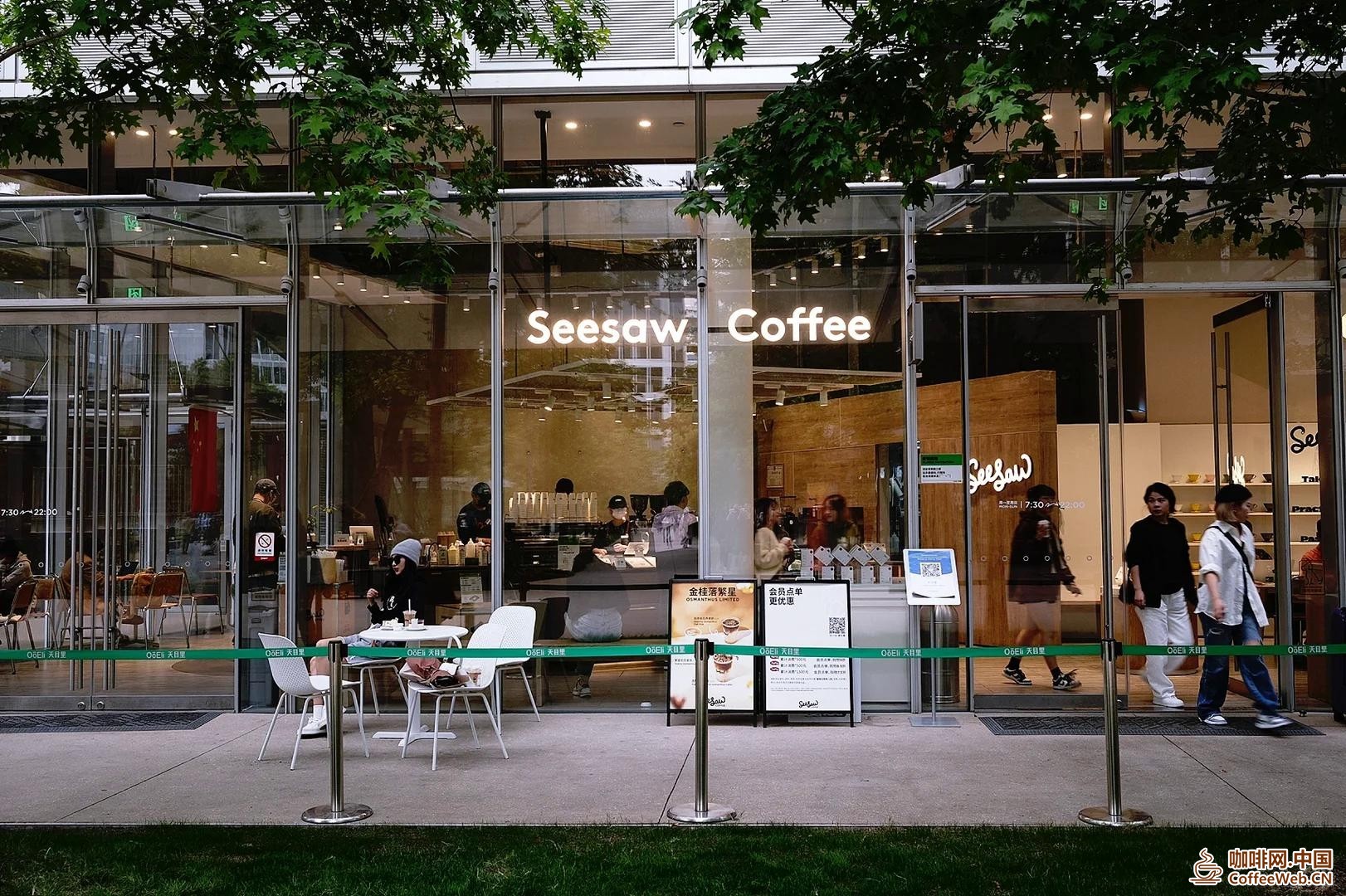
Seesaw要倒下了,很多人都在喊精品咖啡不行了。真正值得追问的是另一个问题:为什么有些品牌一拿钱就死,有些品牌拒绝扩张反而活得好好的?
这不是规模的问题,是“边界感”的问题。
一、一个生意到底能做到多大而不变形?
作为早期顶流的精品咖啡品牌,Seesaw巅峰期有135家店,如今只剩不到30家,且正在被申请破产。
它为什么非得开到135家?
答案很简单——拿了资本的钱,就得上资本的牌桌。
Seesaw的融资路径很典型:2017年百福控股4500万元,2021年喜茶领投超亿元,2022年黑蚁资本、基石资本数亿元。每一轮融资背后,都藏着对赌条款、增长承诺、退出预期。
创始人的算盘是:拿钱,扩张,做大,上市,套现;资本的算盘是:投钱,催肥,退出,翻倍。
没有人算的是:这个生意到底能做到多大而不变形?
Seesaw的“精品”人设,本质上建立在一组脆弱的假设上:100平以上的大店、一店一设计的高昂装修、咖啡师的人文调性、30元以上的客单价。这套模型在10家店的时候是成立的,在50家店的时候开始吃紧,到135家店的时候——崩了。
不是精品咖啡不行了,是Seesaw式的精品咖啡,规模上限大概也就是五六十家,超过这个数,就可能面临管理成本失控、品控下滑、品牌稀释、单店模型失效。它被资本推着越过了自己的“能力天花板”,然后摔得粉身碎骨。
这类模型的核心矛盾在于:单店盈利模型和规模化扩张,在逻辑上是冲突的。我们可以算一笔粗账:一家Seesaw大店,假设月租金8-10万(A类商圈核心位置),装修摊销按5年算每月2-3万,人力成本3-5万,加上物料、运营、总部摊销,单月固定成本保守也要15-20万,这大概需要日均200杯的销量才能打平。
Seesaw巅峰时期的日均出杯量是多少?行业里流传的数据是100-150杯,远低于盈亏平衡线。这不是Seesaw一家的问题,是所有“重空间、重人工”的精品连锁的共同困境。
那么问题来了:为什么在10家店的时候能活,到100家店就崩了?
答案是,10家店的时候,你可以在每个城市只挑最核心的一两个商圈,把店开在最黄金的位置,靠“稀缺性”维持高客流和高客单。但到100家店的时候,好位置已经被占完了,你只能退而求其次,开在次核心商圈甚至社区底商——客流下降,但租金没降多少,单店模型立刻失效。
从这个逻辑倒推,Seesaw这类模型,精选商圈里的优质点位总数是有限的。全国能支撑30元精品咖啡的一线和新一线城市,满打满算也就10-15个,每个城市能开出3-5家“核心店”,五六十家店已经是天花板。
如果你是一个“重空间、重体验、高客单”的精品咖啡品牌,在走完一线城市的核心商圈之后,你的扩张之路就会进入“无人区”——没有现成经验可以参考,每一步都是在试探自己模型的极限。
Seesaw的问题不是“扩张”本身,而是不知道自己模型的极限在哪里。它被资本推着,从上海走向全国,从大店走向小店,从精品走向创意咖啡,每一次转型都是对原有模型的背离。到最后,它既不是精品咖啡(因为品控和服务稀释了),也不是效率咖啡(因为成本结构太重),两头不靠。
这就是我说的“边界感”——知道自己的天花板在哪里,比知道自己的野心在哪里更重要。
有人可能会说,那M Stand呢?它也做空间、也做设计,为什么还没死?那又怎样呢?相比Seesaw,M Stand的客单价更高、设计更具“打卡属性”,且拿到了小红书等战略投资,有更强的品牌势能和流量支撑。但即便如此,M Stand同样面临扩张压力——2025年初小红书退出M Stand的消息传出,也侧面反映出资本对精品咖啡的耐心正在耗尽。
没有哪个模型是永远安全的。
但是,没有人会研究“死法”。行业报告研究的是“赢家”——瑞幸怎么开到3万家,Manner怎么做到2000家。没有人会去算一个失败的模型,它的最优规模是多少。
二、为什么大家看不上“小而美”?
Seesaw不是第一个倒下的,也不会是最后一个。问题在于,为什么那么多创始人明知道扩张会死,还是义无反顾地冲进去?
可悲的恐怕是,“小而美”不是一个规模选择,而是一个欲望选择。
当你站在10家店的位置上,资本递过来一张支票,后面跟着一整套叙事:“你们是这个赛道的标杆”“我们看好你们成为下一个星巴克”“三年内做到100家店,估值翻十倍”。
这套叙事有毒。它让你觉得自己无所不能,让你觉得“不拿钱就是没有雄心”,让你觉得“守着一亩三分地就是格局小”。
但问题是,星巴克的模型和你的模型,从根上就不是一回事。星巴克从一开始就是工业化逻辑——标准化的产品、标准化的门店、标准化的供应链。它的核心竞争力是“一致性”,而不是“独特性”。
而所谓“精品”的本质,恰恰是“独特性”。是那个手冲咖啡师今天的心情,是那款季节性单品豆的稀缺性,是这家店和那家店不一样的设计。
独特性和规模化,在逻辑上是矛盾的。你可以规模化生产“还不错”的产品,但你无法规模化生产“惊喜”。精品咖啡卖的就是那个“惊喜”,一旦规模化,惊喜就变成了“标准化”——那还叫什么精品?
所以Seesaw的悲剧在于:它试图用工业化的逻辑去复制一件手工艺品。这不是“扩张”,这是“自我摧毁”。
当然,也有很多坚守“小而美”的公司,只是他们都不在聚光灯下。比如北京某精品咖啡品牌,开了15年,至今只有6家店。每家店都盈利,现金流健康,创始人没拿过一分钱融资。
不是没人找过。最疯狂的时候,2018年新消费最热的那一波,三家VC追着投,估值开到2个亿。创始人拒绝了,理由很简单:“我不知道拿钱以后怎么花。”
他的商业模式里,没有“用钱换规模”这一环。他的核心竞争力是那个跟了十年的咖啡师团队、是那个亲自去产区挑豆子的采购体系、是那个老客带新客的口碑链条——这些东西,钱买不来。
后来新消费退潮,那些当年疯狂扩张的品牌一地鸡毛,他的6家店还在,老客还在,现金流还在。这不是运气,他知道自己的生意本质是什么,也知道自己能力的边界在哪里,不是人人都要成为马云。
再比如,景德镇某陶瓷工作室,不卖咖啡,卖杯子。创始人是个陶艺师,作品在圈内小有名气。2019年有人找上门,说要投资她“打造中国版的Wedgwood”,开连锁店、做标准化生产、走电商爆款路线。
她拒绝了。她说,我的杯子贵就贵在“这是我自己捏的”,你让我量产,那还是我的杯子吗?
这个案例的关键是:她知道自己在卖什么——不是杯子,是“一个陶艺师的时间和手艺”。这个核心资产,是无法被资本化的。一旦资本介入,她就得把时间花在管理、扩张、营销上,而不是捏杯子,那她的“产品”就完了。
当然,很多业态确实是需要资本的,也不用妖魔化,这个不多讨论了。如果你要守住边界,我认为至少有三点可以讨论。
其一:融资之前,先想清楚“这笔钱用来干什么”。
大多数创始人拿钱的原因是“别人都拿了”或者“估值很诱人”,而不是“我真的需要这笔钱来做一个当前做不到的事情”。
如果这笔钱的用途是“加速”——做你已经会做的事情,只是做得更快——那要小心。加速意味着你的品控体系、管理能力、供应链必须同步提速,而这些东西不可能靠砸钱解决。
如果这笔钱的用途是“跨界”——做你从来没做过的事情——那更要小心。你连主业都没跑透,凭什么觉得副业能成?
只有一种情况值得拿钱:这笔钱能让你做一件“靠自有现金流永远做不到、但做成了能建立起长期壁垒”的事情。
其二:把“不扩张的权利”写进融资协议。
毕竟,融资协议是可以谈的,不是所有钱都要求你3年开出100家店。你可以设定“保护条款”——比如“门店数量上限由创始人决定”“重大战略决策创始人有一票否决权”。
真正的好资本会接受这些条款,因为它们是来投“人”的,不是来投“故事”的。只有那些想把你当成提线木偶的热钱,才会拒绝。
而拒绝的时候,你应该庆幸——因为这笔钱没进来,可能是你做过最正确的决定。
其三:学会“体面的小”。
这是最难的一条。“体面的小”意味着:你接受自己是一个“小而美”的品牌,而不是下一个星巴克。你接受自己的年利润只有几十万、几百万,而不是几个亿。你接受自己只有一小群忠实顾客,而不是全民皆知的国民品牌。
这不丢人。事实上,这才是大多数生意的常态。那些“万亿赛道、千亿市值”的故事,是讲给股民听的,不是讲给创业者听的。
真正的创业者,是在自己的能力边界内,把一件事做到极致。哪怕这件事很小,小到只有一条街、一个社区、一个细分人群知道。
这种“小”,是一种战略选择,而不是一种无奈妥协。这不是在教你“保守”,而是在让你“清醒”。
在资本的洪流里,清醒,可能是最稀缺的品质之一。
更多精彩内容,关注钛媒体微信号(ID:taimeiti),或者下载钛媒体App
(The author of this article is Xiaofeng, and Titanium Media is authorized to publish)
Xiaofeng said
Seesaw is about to collapse, and many people are shouting that specialty coffee is no longer good. What is truly worth asking is another question: why do some brands die as soon as they get paid, and why do some brands refuse to expand and instead live well?
This is not a matter of scale, it is a matter of 'boundary perception'.
1、 How big can a business be without deformation?
As an early top tier boutique coffee brand, Seesaw had 135 stores at its peak, but now there are less than 30 left and it is currently filing for bankruptcy.
Why does it have to open to 135 stores?
The answer is simple - if you take money from capital, you have to go to the capital table.
Seesaw's financing path is very typical: in 2017, Baifu Holdings invested 45 million yuan, in 2021, Heytea led the investment of over 100 million yuan, and in 2022, Black Ant Capital and Cornerstone Capital invested hundreds of millions of yuan. Behind every round of financing, there are gambling terms, growth commitments, and exit expectations.
The founder's plan is to take money, expand, grow, go public, and cash out; The calculation of capital is: invest money, promote growth, exit, and double.
No one can calculate: how big can this business be without deformation?
Seesaw's "boutique" persona is essentially built on a fragile set of assumptions: large stores over 100 square meters, expensive decoration with one store, one design, barista's humanistic style, and a customer price of over 30 yuan. This model was established at 10 stores, became tight at 50 stores, and collapsed at 135 stores.
It's not fine coffee, it's Seesaw style fine coffee, with a maximum scale of about 50-60. If it exceeds this number, it may face management cost control, quality control decline, brand dilution, and single store model failure. It was pushed over its' ability ceiling 'by capital and then smashed to pieces.
The core contradiction of this type of model lies in the logical conflict between the single store profit model and large-scale expansion. We can calculate a rough account: a large Seesaw store, assuming a monthly rent of 80000 to 100000 yuan (located in the core area of Class A commercial district), decoration amortization of 20000 to 30000 yuan per month over 5 years, labor costs of 30000 to 50000 yuan, plus material, operation, and headquarters amortization, the monthly fixed costs are conservatively 150000 to 200000 yuan, which requires an average daily sales volume of 200 cups to balance.
What is the average daily cup volume during Seesaw's peak period? The data circulating in the industry is 100-150 cups, far below the breakeven line. This is not a problem for the Seesaw family, but a common dilemma for all boutique chains that prioritize space and labor.
So the question is: why can it survive in 10 stores but collapse in 100 stores?
The answer is that when you have 10 stores, you can only choose one or two of the most core commercial districts in each city, open the stores in the most prime locations, and maintain high customer flow and orders through "scarcity". But by the time you reach 100 stores, the good locations have already been taken up, and you can only settle for the second best. If you open in the secondary core business district or even the community's ground floor, the customer flow will decrease, but the rent will not decrease much, and the single store model will immediately become ineffective.
From this logic, it can be inferred that models like Seesaw have a limited total number of high-quality locations in selected commercial districts. There are only 10-15 first tier and new first tier cities in China that can support 30 yuan premium coffee. Each city can open 3-5 "core stores", and 50-60 stores are already the ceiling.
If you are a boutique coffee brand that values space, experience, and high customer demand, after exploring the core business districts of first tier cities, your expansion path will enter a "no man's land" - there is no ready-made experience to refer to, and every step is testing the limits of your own model.
The problem with Seesaw is not "expansion" itself, but not knowing where the limits of their model lie. It is driven by capital, from Shanghai to the whole country, from large stores to small shops, from boutique to creative coffee, every transformation is a departure from the original model. In the end, it is neither a premium coffee (due to diluted quality control and service) nor an efficiency coffee (due to a heavy cost structure), with no reliance on either end.
This is what I call 'boundary sense' - knowing where one's ceiling is is more important than knowing where one's ambition is.
Someone may say, what about M Stand? It also does space and design, why hasn't it died yet? So what? Compared to Seesaw, M Stand has a higher average order value, a more "check-in attribute" design, and has received strategic investments from companies such as Xiaohongshu, providing stronger brand momentum and traffic support. However, even so, M Stand still faces expansion pressure - the news of Xiaohongshu's withdrawal from M Stand in early 2025 indirectly reflects that capital's patience with premium coffee is running out.
No model is always safe.
However, no one studies the 'way of death'. The industry report studies the "winners" - how Luckin Coffee opened 30000 stores and Manner achieved 2000 stores. No one will calculate the optimal size of a failed model.
2、 Why don't people like 'small and beautiful'?
Seesaw was not the first to fall, nor will she be the last. The question is, why do so many founders know that expansion will die, or do they rush in without hesitation?
Sadly, 'small and beautiful' is not a choice of scale, but a choice of desire.
When you stand at the position of 10 stores, capital hands over a check followed by a complete narrative: "You are the benchmark of this track," "We believe you will become the next Starbucks," "Achieve 100 stores within three years and increase valuation tenfold.
This narrative is poisonous. It makes you feel invincible, makes you feel that 'not taking money is not ambitious', and makes you feel that' guarding one and a half acres of land is small '.
But the problem is that Starbucks' model and yours are fundamentally different. Starbucks has always had an industrial logic from the beginning - standardized products, standardized stores, and standardized supply chains. Its core competitiveness is' consistency ', not' uniqueness'.
The essence of the so-called 'boutique' is precisely 'uniqueness'. It's the mood of the hand brewed barista today, the scarcity of that seasonal single bean, and the different designs of this store and that store.
Uniqueness and scalability are logically contradictory. You can scale up the production of 'decent' products, but you cannot scale up the production of 'surprises'. Specialty coffee sells that 'surprise', once scaled up, the surprise becomes' standardized '- what else is it called a specialty?
So the tragedy of Seesaw is that it attempts to replicate a handicraft using the logic of industrialization. This is not 'expansion', this is' self destruction '.
Of course, there are also many companies that adhere to the principle of 'small but beautiful', but they are not in the spotlight. For example, a boutique coffee brand in Beijing has been open for 15 years and currently only has 6 stores. Every store is profitable, with healthy cash flow, and the founder has never raised a penny for financing.
No one has searched for it. At the craziest time, during the hottest wave of new consumption in 2018, three venture capitalists chased after and invested, with valuations reaching 200 million yuan. The founder refused for a simple reason: "I don't know how to spend the money after receiving it
In his business model, there is no element of 'money for scale'. His core competitiveness lies in the team of baristas he has been working with for ten years, the procurement system that personally selects beans from the production area, and the reputation chain of old customers bringing new customers - these things cannot be bought with money.
Later, with the decline of new consumption, the brands that had been expanding wildly were all over the place, but their six stores were still there, their loyal customers were still there, and their cash flow was still there. This is not luck. He knows the essence of his business and the boundaries of his abilities. Not everyone wants to become Jack Ma.
For example, a ceramic studio in Jingdezhen does not sell coffee but rather cups. The founder is a ceramic artist, and his works have gained some popularity in the industry. In 2019, someone came knocking on her door and said they wanted to invest in her to "create a Chinese version of Wedgwood", open a chain store, do standardized production, and take the e-commerce hit route.
She refused. She said, 'My cup is expensive because I made it myself.' If you let me mass produce it, is it still my cup?
The key to this case is that she knows what she is selling - not cups, but "the time and craftsmanship of a ceramic artist". This core asset cannot be capitalized. Once capital intervenes, she will have to spend her time on management, expansion, and marketing instead of pinching the cup, and then her 'product' will be finished.
Of course, many business models do require capital, and there is no need to demonize them. This is not a topic for further discussion. If you want to hold the border, I think there are at least three points that can be discussed.
Firstly, before financing, think carefully about 'what will this money be used for'.
The reason why most founders take money is because "others have taken it" or "the valuation is tempting", rather than "I really need this money to do something that I can't currently do".
If the purpose of this money is to 'accelerate' - to do things you already know how to do, just to do them faster - then be careful. Acceleration means that your quality control system, management capabilities, and supply chain must be synchronized and accelerated, and these things cannot be solved by spending money.
If the purpose of this money is for "cross-border" - doing things you have never done before - then be even more careful. You haven't even mastered your main job, why do you think you can succeed in a side job?
There is only one situation worth taking money for: this money can enable you to do something that you can never do with your own cash flow, but can establish long-term barriers.
Secondly, include the "right not to expand" in the financing agreement.
After all, financing agreements can be negotiated, not all money requires you to open 100 stores within 3 years. You can set "protection clauses" - such as "the maximum number of stores is determined by the founder" and "the founder has veto power over major strategic decisions".
True good capital will accept these terms because they are here to invest in 'people', not 'stories'. Only those hot money who want to treat you like a puppet will refuse.
When you refuse, you should be grateful - because the money didn't come in, it may be the most correct decision you have ever made.
Thirdly, learn to be a 'respectable little'.
This is the most difficult one. 'Decent small' means accepting yourself as a 'small and beautiful' brand, rather than the next Starbucks. You accept that your annual profit is only a few hundred thousand or a few million, not a few hundred million. You accept that you only have a small group of loyal customers, rather than a well-known national brand.
This is not embarrassing. In fact, this is the norm for most businesses. The stories of the trillion dollar track and billion dollar market value are meant for investors, not entrepreneurs.
A true entrepreneur is someone who strives to do something to the extreme within their own capabilities. Even if this matter is small, to the point where only one street, one community, and one specific group of people know about it.
This' small 'is a strategic choice, not a helpless compromise. This is not teaching you to be "conservative", but to make you "sober".
In the torrent of capital, clarity may be one of the rarest qualities.
For more exciting content, follow the Titanium Media WeChat account (ID: taimeiti), or download the Titanium Media App