你爱喝的阿拉比卡咖啡“濒危”,科学家想了 3 招The Arabica coffee you love to drink is' endangered ', scientists have come up with 3 tricks
随着气候变化,全球的咖啡树正濒临灭绝。如今,科学家正在寻找解决方案,竭力守护咖啡这种全世界最受欢迎的饮品。
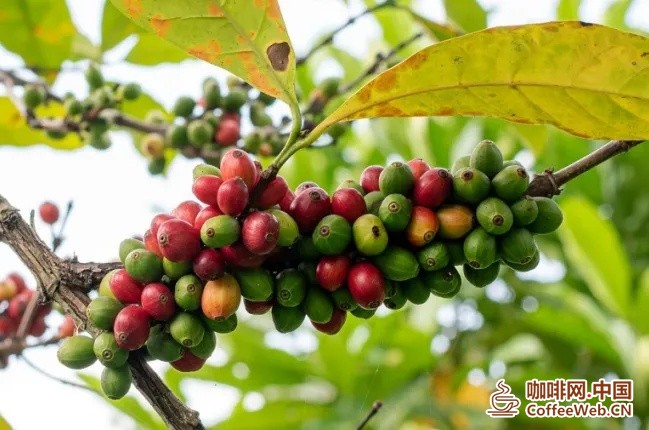
利比里卡咖啡冲泡后带有菠萝蜜、芒果等热带水果的香气。图片来源:Shutterstock
全球每年消耗的 1000 万吨咖啡豆几乎全部来自两个品种:口感醇厚但略带苦味的罗布斯塔咖啡,以及味道更细腻的阿拉比卡咖啡。遗憾的是,一旦气温上升几摄氏度,阿拉比卡咖啡树就会遭受重创甚至枯死;而罗布斯塔咖啡树需要大量的水分,一旦遭遇干旱,产量便会急剧下降。
为此,科研人员正争分夺秒地开展研究,既要让全球的咖啡爱好者保持清醒,又要保住众多低收入国家咖啡种植农户的饭碗。目前有诸多应对方案,如改良两大主要咖啡品种的适应力、驯化咖啡属近缘野生种、借助巧妙的化学工艺从咖啡豆中萃取出更多风味物质等。
埃塞俄比亚的斯亚贝巴大学的 Kassahun Tesfaye说,埃塞俄比亚是阿拉比卡咖啡的故乡,人们以此为荣,而咖啡仪式更是维系该国多元文化、社交往来的纽带。
埃塞俄比亚政府正在建立自然保护区,以保护阿拉比卡咖啡的自然遗传多样性,同时还在埃塞俄比亚生物多样性研究所、埃塞俄比亚农业研究所种植了 1.2 万多株阿拉比卡咖啡树。
该国政府寄希望于这批种质资源为培育耐高温、耐干旱的阿拉比卡咖啡提供材料。Tesfaye 指出,不同于其他咖啡物种甚至人类的两套染色体,阿拉比卡咖啡的细胞拥有 4 套完整的染色体,表明它是 5 万年前通过两个咖啡物种的自然杂交诞生的。“我们拥有充足的基因库,足以应对气候变化带来的挑战。”
随着全球气温持续升高,阿拉比卡咖啡的种植区只能不断向高海拔地区迁移,以维持适宜的温度,而这对小型咖啡种植园主来说并不容易。另一个解决方案则是种植更能适应气候变化的其他咖啡树。目前全球已知野生咖啡共134种,已有少数品种因气候适应性而被种植,包括利比里卡咖啡和高地咖啡等。
从 20 世纪 90 年代末开始,英国皇家植物园(邱园)的 Aaron Davis 便带团队深入非洲,搜寻各类野生咖啡物种。他还从邱园的古老标本馆中寻找那些早已被遗忘的标本。据他估算,该团队已完成全球约 1/3 已知咖啡物种的科学描述。
Davis 走遍全球各大咖啡产区,观察农户面临的生存难题及其应对办法。他发现,所有成功的案例,核心都是更换种植品种。
在湿润多雨的地区,农户会放弃阿拉比卡咖啡,改种罗布斯塔咖啡;而其他区域则选择利比里卡咖啡,因为该品种耐高温能力优于阿拉比卡咖啡,耗水量也更低。
但长期以来,咖啡行业对这种方法始终持怀疑态度,因为很少有野生植物能够转化为高产且美味的咖啡作物。在 Davis 看来,眼下最大的难题是培育出高产、便于农户种植的咖啡品种。
与此同时,一些研究人员则另辟蹊径,探索如何从日渐紧缺的阿拉比卡咖啡供应中获得更多收益。
“在萃取环节还有很大优化空间。”美国俄勒冈大学尤金分校的Christopher Hendon 发现,在低于冰点的温度下研磨咖啡豆能得到更小的咖啡颗粒,但并不意味着研磨得越细口感越好。过细的颗粒会因静电作用而结块,减少与水接触的表面积,从而减少进入溶液的化学物质的数量;而微调研磨工艺,比如研磨前轻微润湿咖啡豆,就能有效减少结块现象。
另一个出人意料的发现是,研磨度更粗的咖啡豆反而能萃取出更多优质风味物质,但这只在萃取压力低至 7 个标准大气压时才会发生,而商用咖啡机的常规萃取压力约为 10 个大气压。
Hendon 表示,化学分析同样是筛选替代咖啡品种、改良成品风味的关键。目前,与咖啡相关的化学研究仍处于起步阶段,科研人员正搭建可重复、标准化的风味检测体系。
“成分分析难度很大,给风味量化评分更是难题。”Hendon 说,一杯普通咖啡含有 2000 多种有机化合物,各类物质的浓度受种植产地、种植方式、烘焙程度等因素影响,差异巨大。
Tesfaye 认为,科研人员最应该关心咖啡的未来,因为“许多发现和知识都是在喝了一杯咖啡之后产生的”。
With climate change, coffee trees around the world are on the brink of extinction. Nowadays, scientists are seeking solutions to safeguard coffee, the world's most popular beverage.
After being brewed, Liberica coffee has the aroma of jackfruit, mango and other tropical fruits. Image source: Shutterstock
Almost all of the 10 million tons of coffee beans consumed globally each year come from two varieties: Robusta coffee, which has a rich but slightly bitter taste, and Arabica coffee, which has a more delicate taste. Unfortunately, once the temperature rises a few degrees Celsius, Arabica coffee trees will suffer heavy damage or even die; The Robusta coffee tree requires a large amount of water, and once it encounters drought, its yield will sharply decrease.
For this reason, researchers are racing against time to conduct research that not only keeps coffee enthusiasts around the world alert, but also preserves the livelihoods of many coffee farmers in low-income countries. At present, there are many response plans, such as improving the adaptability of the two main coffee varieties, domesticating closely related wild coffee species, and using clever chemical processes to extract more flavor compounds from coffee beans.
Kassahun Tesfaye from Addis Ababa University in Ethiopia said that Ethiopia is the birthplace of Arabica coffee, and people take pride in it. The coffee ceremony is also a bond that maintains the country's diverse culture and social exchanges.
The Ethiopian government is establishing nature reserves to protect the natural genetic diversity of Arabica coffee, and has also planted over 12000 Arabica coffee trees at the Ethiopian Institute of Biodiversity and the Ethiopian Agricultural Research Institute.
The government of the country hopes that this batch of germplasm resources will provide materials for cultivating Arabica coffee that is resistant to high temperatures and drought. Tesfaye pointed out that unlike other coffee species and even humans, Arabica coffee has four complete sets of chromosomes in its cells, indicating that it was born 50000 years ago through natural hybridization between two coffee species. We have a sufficient gene pool to address the challenges posed by climate change
As global temperatures continue to rise, the planting areas of Arabica coffee can only continue to migrate to high-altitude areas to maintain suitable temperatures, which is not easy for small coffee plantation owners. Another solution is to plant other coffee trees that are more adaptable to climate change. At present, there are a total of 134 known wild coffee species worldwide, and a few varieties have been planted due to climate adaptation, including Libirica coffee and Highland coffee.
Since the late 1990s, Aaron Davis from the Royal Botanic Gardens (Kew Gardens) in the UK has led his team deep into Africa to search for various wild coffee species. He also searched for forgotten specimens from the ancient specimen museum in Qiu Yuan. According to his estimation, the team has completed a scientific description of approximately one-third of the known coffee species worldwide.
Davis travels to major coffee producing regions around the world to observe the survival challenges faced by farmers and their corresponding solutions. He found that the core of all successful cases is the replacement of planting varieties.
In humid and rainy areas, farmers will give up Arabica coffee and switch to Robusta coffee; However, other regions choose Libirica coffee because this variety has better heat resistance than Arabica coffee and consumes less water.
But for a long time, the coffee industry has been skeptical of this method because few wild plants can be transformed into high-yield and delicious coffee crops. In Davis' view, the biggest challenge at present is to cultivate high-yielding coffee varieties that are easy for farmers to grow.
At the same time, some researchers have taken a different approach, exploring how to gain more revenue from the increasingly scarce supply of Arabica coffee.
There is still a lot of room for optimization in the extraction process. Christopher Hendon from the University of Oregon Eugene found that grinding coffee beans at temperatures below freezing can result in smaller coffee particles, but it does not necessarily mean that the finer the grinding, the better the taste. Particles that are too fine will agglomerate due to electrostatic forces, reducing the surface area in contact with water and thus decreasing the amount of chemicals entering the solution; Fine tuning the grinding process, such as slightly wetting coffee beans before grinding, can effectively reduce clumping.
Another unexpected discovery is that coffee beans with coarser grinding can actually extract more high-quality flavor compounds, but this only occurs when the extraction pressure is as low as 7 standard atmospheres, while the conventional extraction pressure of commercial coffee machines is about 10 atmospheres.
Hendon stated that chemical analysis is also crucial for screening alternative coffee varieties and improving the flavor of finished products. At present, chemical research related to coffee is still in its infancy, and researchers are building a reproducible and standardized flavor detection system.
The analysis of ingredients is very difficult, and quantifying the flavor score is even more challenging, "Hendon said. A cup of regular coffee contains over 2000 organic compounds, and the concentration of each substance is greatly affected by factors such as the place of cultivation, cultivation method, and degree of roasting, resulting in significant differences.
Tesfaye believes that researchers should be most concerned about the future of coffee, as "many discoveries and knowledge are generated after drinking a cup of coffee".