


每天喝几杯咖啡更合适?心脏专家给出“安全上限”How many cups of coffee per day are more appropriate? Cardiologists provide a "safe limit."
(来源:DOLC)咖啡到底是保护心脏,还是增加心血管负担?美国心脏协会专家在综合分析现有研究后认为,对大多数健康成年人来说,每天摄入不超过400毫克咖啡因通常是安全的。换算下来,大约相当于3至5大杯咖啡,或5至8小杯咖啡。
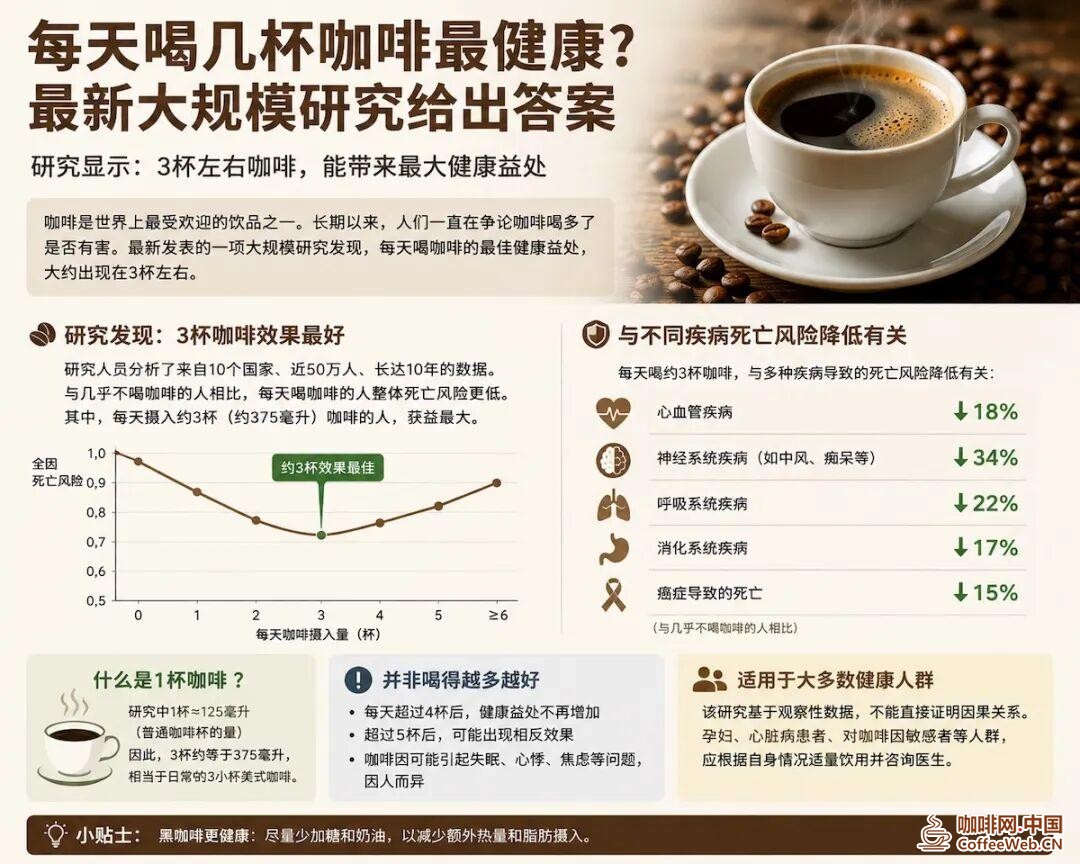
不过,真正需要关注的不是杯数,而是咖啡因总量。不同咖啡豆、冲泡方法和杯子大小,会导致咖啡因含量出现明显差异。一大杯浓咖啡所含的咖啡因,可能远高于一小杯普通滤泡咖啡。
现有研究显示,每天饮用约2至4杯含咖啡因咖啡的人,心脏病、中风和心力衰竭风险往往较低。部分观察性研究还发现,规律喝咖啡的人出现2型糖尿病和某些心律失常的概率也相对较低。
咖啡除了含有咖啡因,还含有多种具有抗氧化和抗炎作用的植物成分,这些物质可能对心血管系统产生积极影响。不过,专家同时强调,目前多数结论来自长期观察研究,尚不能完全证明是咖啡本身直接带来了健康益处。
喝得越多也不一定越好。部分研究发现,每天超过4杯咖啡后,心力衰竭风险可能再次上升。咖啡饮用后,血压、心率和血糖也可能在短时间内升高,尤其是高血压患者或对咖啡因较敏感的人,更容易出现心悸、手抖、焦虑和睡眠障碍。
在心律方面,规律饮用咖啡似乎不会增加房颤风险,个别研究甚至发现风险有所下降。但咖啡因可能引起额外心室搏动,也就是人们常说的“心脏漏跳一下”或“心脏突然重跳”。
专家特别提醒,咖啡和能量饮料不能简单相提并论。能量饮料或高浓度能量饮品中的咖啡因含量,可能达到普通咖啡的3至4倍,还常常含有糖和其他刺激性成分,可能进一步增加高血压和心律失常风险。
咖啡的制作方式也会影响健康。法压壶、土耳其咖啡及部分未经过滤的咖啡含有较多咖啡醇,这种物质可能提高不利于心血管健康的LDL胆固醇。使用纸质滤纸,则能过滤掉其中相当一部分。
此外,加入大量糖浆、奶油和糖,也可能抵消咖啡本身潜在的健康优势。因此,从健康角度看,少糖或无糖的过滤咖啡通常更合适。
专家最后指出,这项评估并不是鼓励不喝咖啡的人为了健康开始喝咖啡,也不是建议现有饮用者增加摄入量。对多数成年人而言,适量、无糖、不过度浓缩的咖啡通常无需担心,但最适合自己的饮用量仍取决于年龄、代谢速度、睡眠状况和身体反应。
(Source: DOLC) Does coffee protect the heart or increase cardiovascular burden? After comprehensive analysis of existing research, experts from the American Heart Association believe that for most healthy adults, consuming no more than 400 milligrams of caffeine per day is usually safe. Converted, it is approximately equivalent to 3 to 5 large cups of coffee, or 5 to 8 small cups of coffee.
However, what really needs attention is not the number of cups, but the total amount of caffeine. Different coffee beans, brewing methods, and cup sizes can lead to significant differences in caffeine content. A large cup of strong coffee may contain much more caffeine than a small cup of regular follicular coffee.
Current research shows that people who drink about 2 to 4 cups of caffeinated coffee per day tend to have a lower risk of heart disease, stroke, and heart failure. Some observational studies also found that people who regularly drink coffee have a relatively low probability of developing type 2 diabetes and certain arrhythmias.
Coffee not only contains caffeine, but also various plant components with antioxidant and anti-inflammatory effects, which may have a positive impact on the cardiovascular system. However, experts also emphasize that most of the current conclusions come from long-term observational studies and cannot fully prove that coffee itself directly brings health benefits.
Drinking more doesn't necessarily mean it's better. Some studies have found that the risk of heart failure may increase again after consuming more than 4 cups of coffee per day. After drinking coffee, blood pressure, heart rate, and blood sugar may also increase in a short period of time, especially for hypertensive patients or those who are sensitive to caffeine, who are more likely to experience palpitations, hand tremors, anxiety, and sleep disorders.
In terms of heart rhythm, regular coffee consumption does not seem to increase the risk of atrial fibrillation, and some studies have even found a decrease in risk. But caffeine may cause additional ventricular beats, commonly known as "heart skip beats" or "sudden cardiac arrest".
Experts remind us that coffee and energy drinks cannot be simply compared. The caffeine content in energy drinks or high concentration energy drinks may reach 3 to 4 times that of regular coffee, and often contain sugar and other irritating ingredients, which may further increase the risk of hypertension and arrhythmia.
The way coffee is made can also affect health. French press pot, Türkiye coffee and some unfiltered coffee contain more caffeinated alcohol, which may increase LDL cholesterol that is not conducive to cardiovascular health. Using paper filter paper can filter out a considerable portion of it.
In addition, adding a large amount of syrup, cream, and sugar may also offset the potential health benefits of coffee itself. Therefore, from a health perspective, filtered coffee with low or no sugar is usually more suitable.
Experts ultimately point out that this assessment does not encourage non coffee drinkers to start drinking coffee for the sake of health, nor does it recommend existing drinkers to increase their intake. For most adults, moderate, sugar free, and not overly concentrated coffee is usually not a concern, but the most suitable amount for oneself still depends on age, metabolic rate, sleep status, and physical reactions.