千年古镇,一杯咖啡融入中非双向奔赴A millennium old town, a cup of coffee blends into the two-way journey between China and Africa
今年5月1日,我国对53个非洲建交国全面实施零关税政策首日,这家体验中心正式迎客。一杯醇香咖啡,一头连接非洲咖啡产区,一头对接国内广大消费者,在引进非洲优质农产品的同时,助力“重庆造”走向海外,推动中非经贸合作与人文交流走深走实。
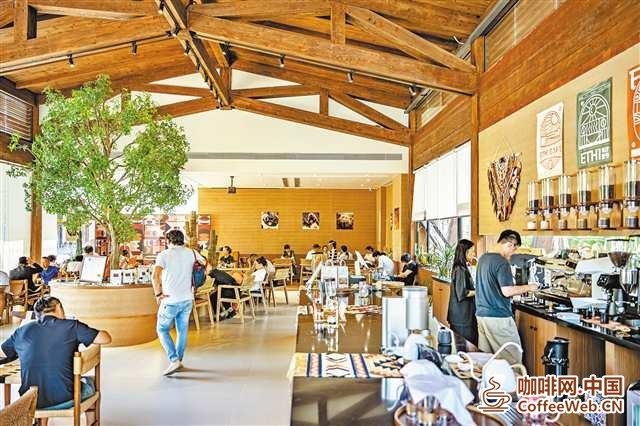
磁器口,埃塞俄比亚咖啡国家推广体验中心店内。记者 何庆渝 摄视觉重庆
On the morning of August 26th, at Ciqikou Ancient Town Square in Shapingba.
After 9 o'clock in the morning, before the peak of passenger flow arrived at Ciqikou, the Ethiopian Coffee National Promotion and Experience Center called "Esha-1" had already welcomed its first batch of customers. Ms. Yang, a Jiangsu tourist who came specifically to taste Ethiopian coffee, gave a thumbs up and said, "The price is affordable, but the flavor is particularly pure
This is the true 'first store' of Ethiopian coffee nationwide, with a mission to surpass ordinary coffee shops, "said Wu Chao, director of the Shapingba District Commerce Commission.
On May 1st of this year, the first day of China's comprehensive implementation of zero tariff policy towards 53 African countries with diplomatic relations, this experience center officially welcomed guests. A cup of fragrant coffee connects African coffee producing areas on one end and domestic consumers on the other. While introducing high-quality agricultural products from Africa, it also helps "Made in Chongqing" go overseas, promoting deeper and more practical economic and trade cooperation and cultural exchanges between China and Africa.
Magnetic mouth, inside the Ethiopian Coffee National Promotion Experience Center store. Reporter He Qingyu's Photo of Visual Chongqing
The 'First Store' in the Millennium Ancient Town
The drumming of Africa and the rich aroma of coffee attract visitors to enter the Ethiopian Coffee National Promotion and Experience Center at Ciqikou.
During peak hours, a cup of coffee can be sold in just a few minutes, and the store's sales exceeded 100000 yuan in May, "said Wang Cihang, the operator of the Experience Center and the general manager of the Land Port Hub (Chongqing) Economic and Trade Co., Ltd. In addition to coffee drinks, coffee beans, cultural and creative cups, and souvenirs here are also popular.
On August 7th, the experience center expanded from the initial 75 square meters to 200 square meters.
The landing of this national level experience center is an innovation and exploration of Shapingba District's layout for opening up to the outside world.
On October 31, 2025, six projects for China Africa economic and trade cooperation were signed, with a total purchase and sales contract amount of 5 billion yuan.
Ethiopia (hereinafter referred to as Ethiopia) is very optimistic about the western Chinese market, "said Wang Cihang. Ethiopia is the birthplace of coffee and is known as the" hometown of coffee ". In October 2023, China will allow the import of Ethiopian unbaked coffee beans that meet the requirements, and a large number of high-quality coffee beans will begin to enter the Chinese market.
With the support of the Embassy of Ethiopia in China, Shapingba District Committee, District Government, and the China Africa Friendship and Economic Development Foundation, the Experience Center has been established. Starting from the "national business card" of Ethiopian coffee, it promotes high-quality Ethiopian products to Chongqing consumers and builds a two-way economic and trade exchange bridge.
During the site selection phase, the team visited multiple commercial districts within the area and ultimately selected Ciqikou.
The 'bidirectional circulation' in coffee beans
Among the customers who come to experience check-in on the "Esha-1", young people make up the majority.
Ethiopian coffee has a rich aroma and is deeply loved by young consumers, "said Wang Cihang. In the past, when coffee beans arrived in Chongqing, they needed to be transferred at coastal ports, with long transportation cycles, multiple circulation links, and high terminal prices.
Nowadays, Ethiopian coffee enters western China through the railway sea intermodal route of the Western Land Sea New Corridor, which saves about a week compared to traditional routes and can also save 15% in overall costs.
On August 5th of this year, the first batch of G1 grade premium green beans from the core production areas of Guji, Yejia Xuefei, and Xidamo were collected and shipped by sea to Chongqing. The Ethiopian "national treasure level" coffee, which has been distributed in multiple countries in the past, will directly reach the taste buds of mountain city residents.
Small coffee beans have become a link to promote economic and trade exchanges between Chongqing and Africa.
In order to establish a direct procurement link from the source, Wang Cihang and his team traveled to the capital of Ethiopia to participate in a trade fair. They conducted in-depth inspections of the planting scale and green bean quality in the main coffee producing areas, and had face-to-face negotiations with local agricultural enterprises to establish stable cooperative relationships.
During the communication process, we also actively promoted Chongqing's intelligent manufacturing industry and introduced Chongqing's automobiles, consumer electronics, and daily consumer goods to local partners, "said Wang Cihang.
Relying on the channels built by coffee trade, the company's procurement list continues to expand, and products such as African cassava flour, sesame, chili, cashew nuts, etc. are expected to achieve the first batch of imports within the year.
The two-way circulation of Chongqing manufacturing and African agricultural products can optimize trade structure, balance imports and exports, and enable more African countries to share China's development opportunities, "said Wu Chao.
The 'people to people connection' in a coffee cup
On August 7th, the experience center became popular after reinstalling and expanding. As a 'showcase' for economic and cultural exchanges between China and Africa, the experience center also needs a larger 'stage', "said Wang Cihang.
On the same day, the reporter saw at the scene that the experience center was filled with a wide variety of products such as African wood carvings, handmade textiles, and wooden drum shaped stools. A display table of about 10 square meters was also placed with a complete set of traditional Ethiopian coffee utensils.
Ethiopian international student Mihelet performed traditional coffee making on site, stir frying beans in an iron pot, pounding powder with a stone mortar, and slow boiling in a pottery pot. Tourists who stopped to watch came in a continuous stream.
In my country, coffee is not just a beverage, but also an important element of hospitality etiquette, representing warmth and enthusiasm, "Mihelet introduced in slightly stiff Chinese.
Since its opening, cultural events have been held almost every week here: inviting Ethiopian students to perform traditional coffee making ceremonies, hosting regular China Africa coffee culture salons, attracting African businessmen, trade enterprises with Africa, and university teachers and students to gather here, transforming grand international cooperation into a tangible daily experience for ordinary people.
Coffee is a seed, "sighed Wu Chao." Planting it in the mouth of a magnet is to hope that it will take root, sprout, bloom, and bear fruit, making cultural and economic exchanges between Chongqing and Africa closer. "(New Chongqing Chongqing Daily reporter Luo Yun)