
杭州这家社区咖啡馆5个月“喝”出9家科创企业 周国辉:让创新从实验室走到居民身边This community coffee shop in Hangzhou has "drunk" 9 science and technology innovation enterprises in 5 months. Zhou Guohui: Let innovation go from the laboratory to the residents' side
潮新闻客户端 编辑 吴盈秋


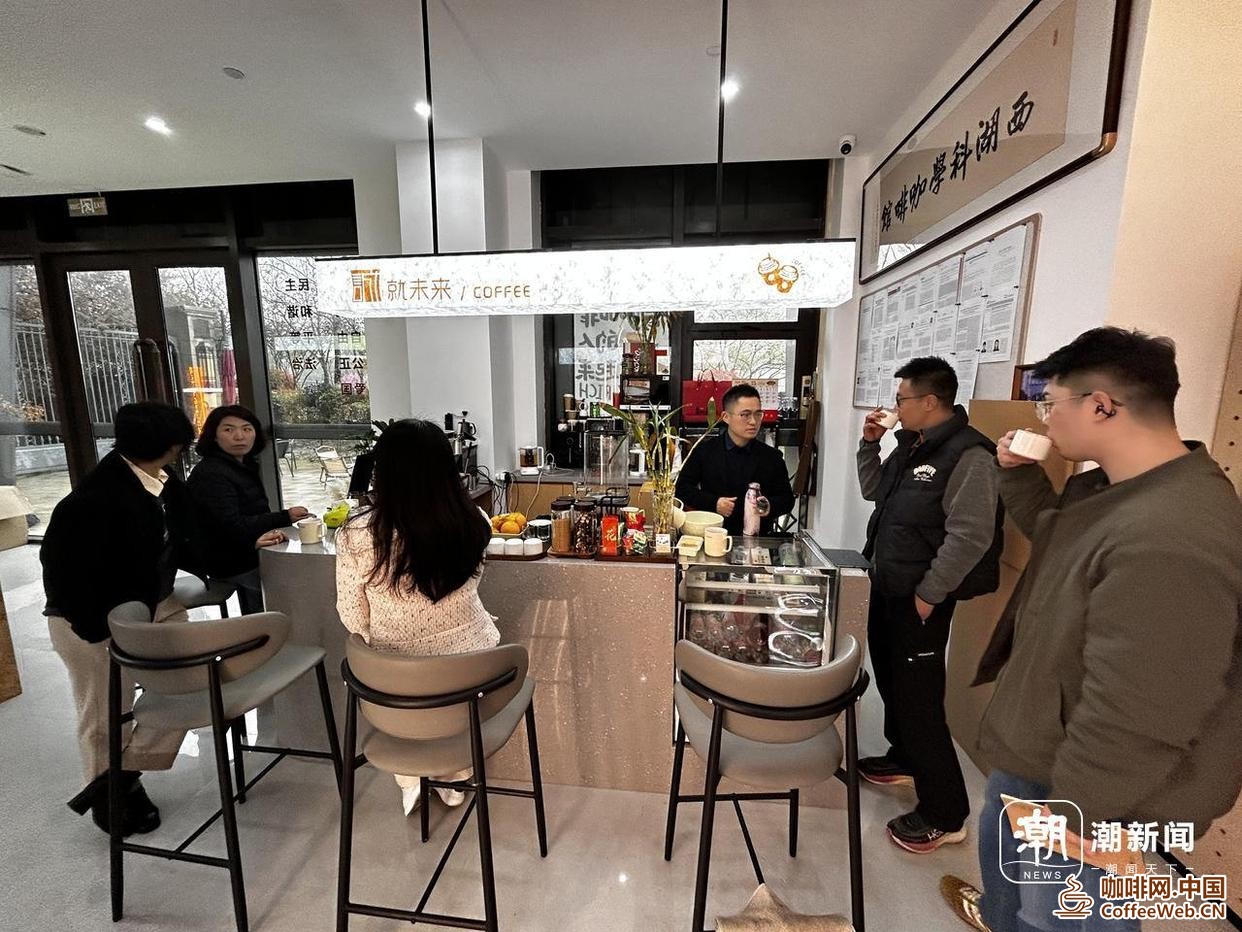
记者 陈朴风 摄
春雨淅淅沥沥,打湿了浙江大学紫金港南门的街巷,也为毗邻校园的杭州西湖区蒋村街道添了几分温润。雨幕下的西湖科学咖啡馆,透出暖橘色灯光,屋内交谈声此起彼伏,咖啡杯轻响,浙江省海创科技交流研究院执行院长、浙大硕士、西湖科学咖啡馆联合创始人邱国良正与客人围坐。
“一项针对早期科研合作的调查显示,超过70%的突破性想法产生于非正式交流。”邱国良说,咖啡馆特意选址社区而非产业园、科研院所,就是为打破科研与生活的壁垒,“一杯咖啡,资本和技术能在一张桌子上聊透。”
出入社区咖啡馆的不乏院士、科学家、科创者或是行业投资人,烟火气和科创正在悄然碰撞并深度链接。
喝出了些什么?咖啡馆诞生5个月来,这里已经“喝”出了9家科创企业。
详情点击>>

让创新从实验室走到居民身边
一个空间不大的咖啡馆5个月“喝”出了9家科创企业,确实够神乎的,其实不然。
科学咖啡馆是省科协打造的一个科学交流平台,我参加过几次活动,颇有意思。现在基层科协干脆把它开进社区,直接面向大众,而且没有选择科普讲座厅和科技馆的叙事方式,却选择了一个看似平常、实则意味深长的空间载体。在我看来,这一选择背后,隐藏着科学传播乃至创新范式变革的深层密码,其内在逻辑与启示,名和形不能说不重要,但更重要的是内在功能和氛围。
一是从知识普及到创新连接的功能重塑。传统科学传播往往遵循“知识瀑布”模型,即科学共同体作为上游,通过大众媒介向下游的公众进行单向输送。这种模式虽有其价值,却难以避免两个困境:其一是公众的被动性,其二是科学与生活的疏离感。“科学咖啡馆”的创新在于,将自身定位为一个“连接器”,而非“宣讲台”。它要完成三重连接:连接科学家与公众,让实验室里的研究者与社区里的居民能在同一张桌子前平等对话;连接创新与生活,将抽象的前沿技术翻译为与日常息息相关的可讨论议题;连接问题与资源,让社区居民的真实困惑有机会反向进入科学界的视野,形成“需求牵引创新”的微循环。这意味着,科学传播的目标从“让公众理解科学”,转变为“让科学与公众相互理解”。前者预设了知识的位阶差,后者则承认科学创新与生活智慧之间可以形成互补。
二是平等、安全与临场感的氛围再造。如果说功能决定了一个空间“做什么”,那么氛围则决定了它“能否做好”。科学咖啡馆的设计,恰恰在于着力营造一种高信任度、低防御性的社交场域。平等感首先来自物理空间的去层级化。撤除讲台与观众席的落差,消除“台上宣讲、台下记录”的紧张感,咖啡的香气与随意的座椅布局在无形中瓦解了权威与受众的二元对立。更重要的是心理层面的平等:在这里,“外行问题”被允许甚至被鼓励,“不知道”可以被坦然接受,科学家不再是遥不可及的“大咖”,而更像是邻桌一位愿意分享的伙伴。
安全感则体现在对话规则的重新定义。这不是一场需要达成共识的学术研讨,也不是一次需要检验效果的知识考试。交流可以是探索性的、碎片化的,甚至允许沉默和犹疑。当公众不再担心自己的问题“太傻”,当科学家不必时刻维护“全知全能”的形象,真正的对话才可能发生。临场感可能是氛围中最具魅力的维度。精彩的对话常常发生在咖啡香里、在递纸巾的瞬间、在活动正式结束后三三两两的闲聊中。这种非正式互动的价值,往往远超精心准备的正式环节。科学传播中那些最宝贵的时刻,往往是不可设计的,但可以被氛围所激发。
三是创新需要“第三空间”。创新生态的构建,既需要实验室、研究所这样的“第一空间”,也需要家庭、社区这样的“第二空间”,还需要介于两者之间的“第三空间”,一个既不同于正式机构、也不同于私人领域的公共场域,让跨界交流可以低门槛地发生。咖啡馆在西方启蒙运动时期就曾是科学思想传播的重要场所。伦敦的格雷沙姆学院周边咖啡馆、巴黎的普罗可佩咖啡馆,都见证了科学从精英圈层走向公共领域的历程。今天的“科学咖啡馆”不是简单复制历史,而是在数字化时代重新激活物理空间的独特价值,那种即时的、具身的、有温度的面对面交流,至今无法被线上社区完全替代。让创新从实验室走到居民身边,需要的不是更响亮的喇叭,而是一张更舒服的沙发。当科学家愿意放下讲稿,当公众敢于举起手来,当两个群体可以在同一个空间里共享一杯咖啡,科学与社会的距离便在这日常的仪式中悄然消弭。
四是咖啡馆不必是咖啡馆。理解“科学咖啡馆”的内在逻辑,最终会引向一个开放性的结论:它不必拘泥于“咖啡馆”的名称或形态。它可以藏在书店里、开在菜市场旁、设在社区长廊中,甚至可以是一场流动的街头对话。关键不在于它叫什么、长什么样,而在于它能否实现“连接”的功能,能否营造“平等、安全”的氛围。这可能是这一模式最具生命力的地方。它提供的不是一套固定的运营模板,而是一种可迁移的理念,科学传播需要从“教育逻辑”转向“生活逻辑”与“社交逻辑”,需要从“让人来听”转向“在人的身边发生”。当这一理念内化为社区科学传播的自觉意识,每一个公共空间都可能成为创新的孵化器。
在科技加速迭代、科学与社会关系日益紧密的今天,“科学咖啡馆”的探索具有超越个案的意义。它让我们看到:科学传播的深层目标,不只是让公众掌握更多科学知识,更是让科学真正成为一种可以触碰、可以对话、可以参与的生活方式。
“转载请注明出处”
Trendy News Client Editor Wu Yingqiu
Photo by journalist Chen Pufeng
The drizzling spring rain moistened the streets and alleys of the south gate of Zijingang, Zhejiang University, and added a touch of warmth to Jiangcun Street in Xihu District, Hangzhou, which is adjacent to the campus. Under the rain curtain, the West Lake Science Caf é emits warm orange lights, with conversations echoing inside and coffee cups ringing lightly. Qiu Guoliang, Executive Dean of Zhejiang Haichuang Technology Exchange Research Institute, Master of Zhejiang University, and co-founder of West Lake Science Caf é, is sitting with guests.
A survey on early scientific research collaboration shows that over 70% of breakthrough ideas arise from informal communication, "said Qiu Guoliang. Coffee shops are deliberately located in communities rather than industrial parks or research institutes to break down the barriers between research and life." A cup of coffee, capital, and technology can be discussed at the same table
There are many academicians, scientists, innovators, or industry investors who enter and exit community cafes. Fireworks and innovation are quietly colliding and deeply connected.
What did you drink? Since its birth five months ago, the coffee shop has already "drunk" nine science and technology innovation enterprises here.
Click for details>>
What is the magic of opening a coffee shop in a community in Hangzhou after "drinking" 9 science and technology innovation enterprises in 5 months
Let innovation go from the laboratory to the residents' side
It's amazing that a small coffee shop "drank" 9 science and technology innovation companies in 5 months, but it's not.
The Science Caf é is a scientific exchange platform created by the Provincial Association for Science and Technology. I have participated in several activities, which are quite interesting. Now the grassroots science association has simply brought it into the community, directly facing the public, and has not chosen the narrative style of science popularization lecture halls and science museums, but has chosen a seemingly ordinary but actually meaningful spatial carrier. In my opinion, behind this choice lies a deep code of scientific communication and even innovation paradigm change. Its internal logic and inspiration, name and form cannot be said to be unimportant, but more importantly, its internal function and atmosphere.
One is the functional reshaping from knowledge dissemination to innovative connectivity. Traditional science communication often follows the "knowledge waterfall" model, where the scientific community serves as the upstream and is transmitted unidirectionally to the downstream public through mass media. Although this model has its value, it is difficult to avoid two dilemmas: one is the passivity of the public, and the other is the sense of alienation between science and life. The innovation of 'Science Cafe' lies in positioning itself as a 'connector' rather than a 'lecture stand'. It needs to achieve triple connectivity: connecting scientists and the public, allowing researchers in the laboratory and residents in the community to have equal conversations at the same table; Connecting innovation and life, translating abstract cutting-edge technologies into debatable topics closely related to daily life; Connecting problems and resources, giving community residents the opportunity to reverse their true confusion and enter the scientific community's perspective, forming a micro circulation of "demand driven innovation". This means that the goal of science communication has shifted from 'making the public understand science' to 'making science and the public understand each other'. The former presupposes a hierarchy of knowledge, while the latter acknowledges that scientific innovation and life wisdom can complement each other.
The second is to recreate an atmosphere of equality, safety, and a sense of presence. If functionality determines what a space does, then atmosphere determines whether it can do well. The design of a science caf é is precisely focused on creating a high trust, low defensive social environment. The sense of equality first comes from the de stratification of physical space. Removing the gap between the podium and the audience, eliminating the tension of "speaking on stage and recording off stage", the aroma of coffee and the casual seating layout invisibly dissolve the binary opposition between authority and audience. More importantly, there is psychological equality: here, 'outsider questions' are allowed and even encouraged,' don't know 'can be accepted with equanimity, and scientists are no longer unattainable' big shots', but more like a willing sharing partner at the neighboring table.
The sense of security is reflected in the redefinition of dialogue rules. This is not an academic seminar that requires consensus, nor is it a knowledge exam that needs to test its effectiveness. Communication can be exploratory, fragmented, and even allow for silence and hesitation. When the public no longer worries about their own problems being 'too foolish', and when scientists do not have to constantly maintain the image of 'omniscient and omnipotent', real dialogue can occur. The sense of presence may be the most charming dimension in an atmosphere. Exciting conversations often occur in the aroma of coffee, during the moment of handing over tissues, and in casual conversations in twos and threes after the event officially ends. The value of this informal interaction often goes far beyond the carefully prepared formal process. The most precious moments in science communication are often unforeseeable, but can be inspired by the atmosphere.
Thirdly, innovation requires a 'third space'. The construction of an innovation ecosystem requires both a "first space" such as laboratories and research institutes, as well as a "second space" such as families and communities, and a "third space" between the two, a public space that is different from both formal institutions and private fields, allowing cross-border exchanges to occur with low barriers to entry. Coffee shops were important places for the dissemination of scientific ideas during the Western Enlightenment period. The coffee shops around Gresham College in London and Procope in Paris have witnessed the process of science moving from the elite circle to the public sphere. Today's' science cafes' are not simply copying history, but rather revitalizing the unique value of physical space in the digital age. The instant, tangible, and warm face-to-face communication cannot be completely replaced by online communities to this day. To bring innovation from the laboratory to the residents, what is needed is not louder speakers, but a more comfortable sofa. When scientists are willing to put down their speeches, when the public dares to raise their hands, when two groups can share a cup of coffee in the same space, the distance between science and society quietly disappears in this daily ritual.
Fourthly, a coffee shop does not need to be a coffee shop. Understanding the internal logic of a 'scientific caf é' ultimately leads to an open-ended conclusion: it does not have to be confined to the name or form of a 'caf é'. It can be hidden in bookstores, opened next to markets, set up in community corridors, or even a flowing street conversation. The key is not what it is called or what it looks like, but whether it can achieve the function of "connection" and create an atmosphere of "equality and security". This is probably the most vital part of this model. It does not provide a fixed set of operational templates, but a transferable concept. Scientific communication needs to shift from "educational logic" to "life logic" and "social logic", and from "letting people listen" to "happening around people". When this concept is internalized as a conscious awareness of community science communication, every public space may become an incubator for innovation.
In today's rapidly iterating technology and increasingly close relationship between science and society, the exploration of "science cafes" has significance beyond individual cases. It shows us that the deep goal of science communication is not only to enable the public to acquire more scientific knowledge, but also to truly make science a way of life that can be touched, talked about, and participated in.
Please indicate the source when reprinting