从高调入场,到“千店计划”的雄心勃勃,再到多家门店停止营业,追觅旗下咖啡品牌DM CAFE在短短三年,经历了过山车式的命运转折。
顶着科技公司光环进场
追觅咖啡创立于2023年6月,顶着科技公司的光环进场做精品咖啡,以“One Cup,One World”为品牌理念。
2024年9月,品牌首店DREAME CAFE Pro在上海西岸梦中心落地,邀请著名建筑师青山周平操刀空间设计,打造出“Gallery”(画廊)、“Theater”(剧场)以及“Park”(公园)三大主题空间,兼顾品牌形象展示和沉浸式消费体验。该店开业三天销量即突破5000杯,单月营收达35万,一时风光无两。
此后,追觅咖啡以“DREAME CAFE Pro”和“DREAME CAFE young”双店型策略稳步铺开,前者落子城市地标与高端商圈,后者则瞄准年轻人聚集的活力商圈以及写字楼等高人流区域。同时,品牌也还在人流密集区推出快取店,主打“即买即走”的便捷体验。
2025年6月,追觅咖啡开启加盟,启动“千店计划”。仅四个月时间,全国签约门店数量达近200家。然而,这轮扩张并未持续太久。
今年8月,DM CAFE多家门店被爆停止营业,引发广泛关注。DM CAFE官方小程序显示,目前全国共有30家门店在列,覆盖长春、苏州、杭州、深圳等15座城市。但不少门店状态显示“繁忙中”“已休息”或“暂停营业”,实际可下单门店仅剩23家。而在DM CAFE曾经的核心大本营上海,品牌一度开出8家门店,如今仅有上海西岸梦中心店仍在营业。
DM CAFE相关负责人对此回应媒体称,品牌现阶段在整体战略规划与市场评估,对上海地区的门店布局进行了阶段性优化与调整,上海西岸梦中心首店仍正常运营中。
但更关键的信号是,DM CAFE与追觅科技之间已不存在直接股权关系——早在2025年,其运营主体便由“追觅咖啡(苏州)有限公司”更名为“乐喝咖啡(苏州)有限公司”,原股东“追觅创业孵化器”退出,由“乐喝咖啡(上海)有限公司”全资接盘。进一步追溯股权结构,最终指向的“天空无际智能科技(苏州)有限公司”,实际控制人柏美芳持股99.99%。而柏美芳同时持有追觅母公司“追觅科技(苏州)有限公司”2.2865%的股份,是追觅系非科技项目的核心代持人和操盘手。
一个曾经承载“全球化咖啡+生活方式”野心的品牌,如今正在被母公司剥离。即便品牌透露北京大兴机场店正在装修,后续在上海还有其他新店计划,但故事似乎已经很难再讲下去了。
从无边界扩张到战略收缩
DM CAFE的命运,不是孤例,而是追觅整体战略收缩中的一部分。
作为中国智能清洁领域跑得最快的独角兽,追觅科技2025年总营收突破400亿元,连续六年增速超过100%,海外营收占比接近80%,扫地机器人拿下全球销量与销售额双第一。
但这家公司显然并不满足于此。近年来,追觅以惊人的速度将版图延伸至咖啡、AI穿戴、潮玩、汽车、手机、茶饮、火锅等各种领域。去年3月,追觅更是宣布将成为一家无边界的生态企业。
在这一宏大叙事的驱动下,追觅密集铺设各类跨界品牌——茶饮品牌“山也觅茶”创立于2024年,首批门店于2025年4月在苏州、南京开业,目前在全国拥有40余家门店;火锅品牌“沸点计划”创立于2025年,在山野火锅基础上,深度融合AI科技,目前在9城开出11家门店;潮玩领域亦先后推出“DREAME MART”(已退出市场)、“MOMOTOY”等品牌。
这些品牌和DM CAFE一样,大多由追觅科技通过旗下孵化器间接持股,或由柏美芳通过多层公司链条实际控制。本质上是用资本杠杆撬动流量与叙事,而非以产业深耕的方式进入每一个赛道。
多线并行的高速扩张,隐患也在悄然累积。
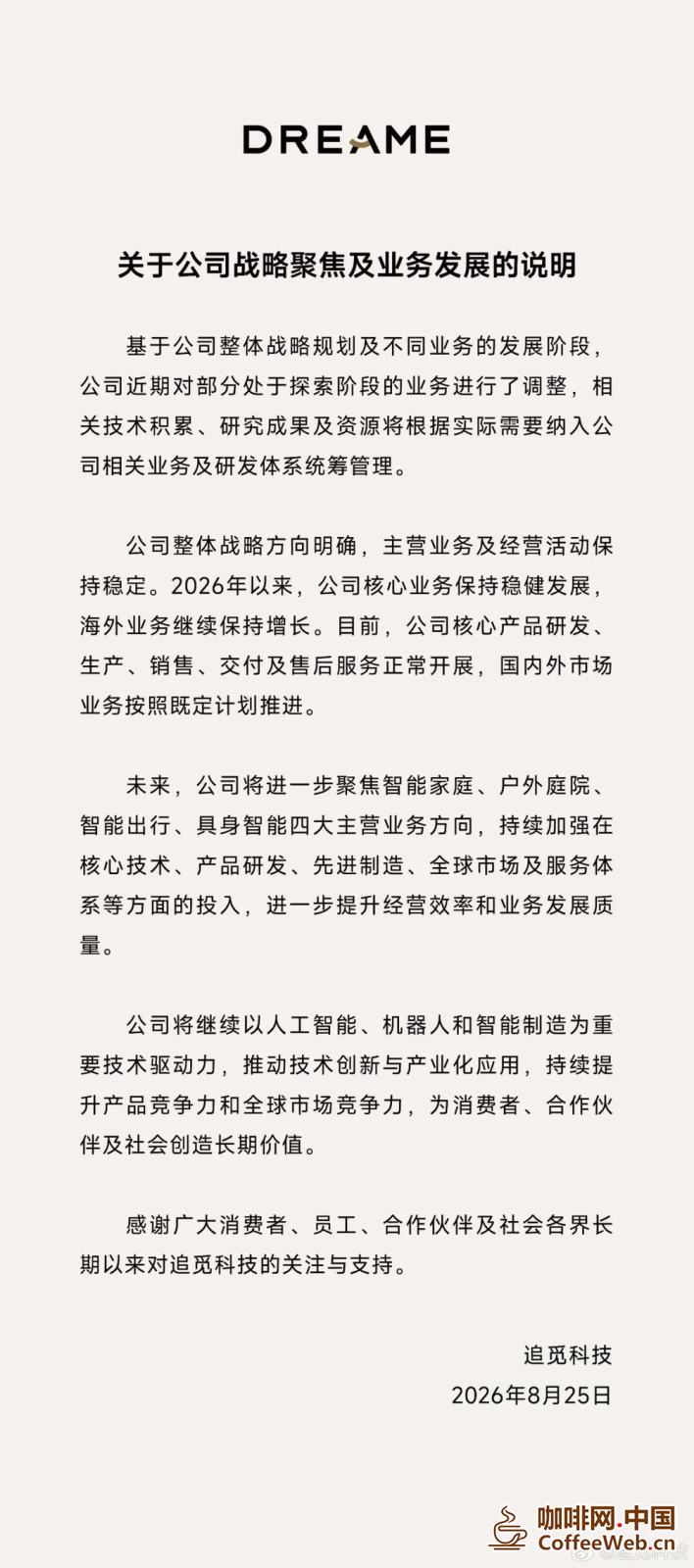
今年年中,追觅突然踩下急刹车,对各大业务单元进行大规模收缩与重组,最终整合为四大主营业务板块。8月25日,追觅正式发布《关于公司战略聚焦及业务发展的说明》,明确表态将资源全面收束至智能家庭、户外庭院、智能出行、具身智能四大方向。
这意味着,那些曾经被寄予厚望的跨界消费品牌,已被正式划入“非核心业务”的清退名单。而脱离了母体的供养,这些品牌的未来走向也将画上一个大大的问号。
一杯精品咖啡的不同命运
DM CAFE的坠落,自然与母公司的战略收缩直接相关。但把DM CAFE放回行业坐标,精品咖啡赛道同样正在经历一场残酷的洗牌。
成立于2012年的精品咖啡品牌Seesaw,是国内早期精品连锁咖啡的代表品牌,奉行“一店一设计”的全直营大店模式。巅峰时期门店规模超160家,并先后拿到三轮融资,估值一度达到10亿元。但从2023年开始,品牌门店不断收缩,如今在营门店不足30家。今年年中,Seesaw被申请破产清算。
另一国内精品咖啡代表品牌M Stand,目前拥有650余家门店。但自2024年来,其放缓了拓张步伐,并推出了汉堡、小吃、文创等产品开拓增长曲线。
2022年进入中国内地的蓝瓶咖啡,如今仅在上海、深圳、杭州开设14家门店,今年瑞幸大股东大钲资本还从雀巢手中收购了蓝瓶咖啡。被视作精品咖啡“祖师爷”的皮爷咖啡,以及日本精品咖啡品牌%Arabica,拓张速度同样放缓,并相继关闭了多家高人气门店。
但这些品牌的收缩与克制,并不意味着精品咖啡的故事走向终点。另一边,依然有一批精品咖啡品牌在稳步扩张,以各自的方式找到了穿越周期的路径。
Manner坚持“小店+高性价比精品咖啡”的商业模式,以15-20元的定价、自带杯减5元的环保理念,精准切入了“精品平价”的市场空白。截至目前,Manner全国直营门店已突破2600家,覆盖上海、北京、深圳、广州等核心城市,成为精品咖啡赛道唯一迈过千店门槛的品牌。
同样是跨界而来的Grid Coffee,2021年由猿辅导孵化,专注全系单一产地咖啡,坚持直营。2025年提速扩张至今,全国门店规模已突破150家。其选址聚焦高线城市核心商圈,成为近两年赛道加速扩张的代表。
综合来看,精品咖啡品牌发展分化揭示了一个朴素的道理:咖啡终究是一门需要精耕细作的生意,而不是靠资本和叙事就能速成的故事。
DM CAFE带来的启示或许在于:跨界从来不是问题,问题是用什么样的姿态跨界。带着对行业的敬畏、对单店模型的尊重、对长期主义的坚持,任何一个赛道都值得进入;但如果只是把它当作资本叙事的配角、宏大版图上的一块拼图,那它崩塌的速度,往往比崛起时更快。
This article is from WeChat official account: CEO Brand Observation, written by Wang Wan
From high-profile entry, to the ambitious "Thousand Store Plan", and then to the closure of multiple stores, DM CAFE, a coffee brand under Zhumi, has experienced a rollercoaster like turning point in just three years.
Entering with the halo of a technology company
Zhuimi Coffee was founded in June 2023, entering the market with the halo of a technology company to make premium coffee, with the brand concept of "One Cup, One World".
In September 2024, the brand's first store DREAME CAFE Pro landed at the Shanghai West Bund Dream Center, inviting renowned architect Qing Shan Zhouping to design the space and create three main theme spaces: "Gallery", "Theater", and "Park", balancing brand image display and immersive consumer experience. The store's sales exceeded 5000 cups within three days of opening, with a monthly revenue of 350000 yuan, making it an unparalleled success.
Afterwards, Zhumi Coffee steadily expanded its dual store strategy of "DREAME CAFE Pro" and "DREAME CAFE Young". The former is located in urban landmarks and high-end commercial districts, while the latter targets dynamic commercial districts where young people gather and high traffic areas such as office buildings. At the same time, the brand has also launched fast pickup stores in densely populated areas, focusing on the convenient experience of "buy and go".
In June 2025, Zhumi Coffee began franchising and launched the "Thousand Store Plan". In just four months, the number of signed stores nationwide has reached nearly 200. However, this round of expansion did not last long.
In August of this year, several DM CAFE stores were shut down due to explosions, causing widespread attention. According to the official DM CAFE mini program, there are currently 30 stores listed nationwide, covering 15 cities including Changchun, Suzhou, Hangzhou, and Shenzhen. However, many stores display the status as "busy", "closed" or "temporarily closed", with only 23 stores available for placing orders. In the former core stronghold of DM CAFE in Shanghai, the brand once opened 8 stores, but now only the Shanghai West Bund Dream Center store is still in operation.
The person in charge of DM CAFE responded to the media by stating that the brand is currently optimizing and adjusting its store layout in the Shanghai area through overall strategic planning and market evaluation. The first store of Shanghai West Bund Dream Center is still operating normally.
But the more crucial signal is that there is no longer a direct equity relationship between DM CAFE and Zhuimi Technology - as early as 2025, its operating entity was renamed from "Zhuimi Coffee (Suzhou) Co., Ltd." to "Leqian Coffee (Suzhou) Co., Ltd.", and the original shareholder "Zhuimi Entrepreneurship Incubator" withdrew, and was fully taken over by "Leqian Coffee (Shanghai) Co., Ltd. Further tracing the equity structure, the ultimate target is "Sky Wuji Intelligent Technology (Suzhou) Co., Ltd.", with actual controller Bai Meifang holding 99.99% of the shares. Meanwhile, Bai Meifang holds 2.2865% of the shares of Zhuimi's parent company, Zhuimi Technology (Suzhou) Co., Ltd., and is the core agent and operator of Zhuimi's non technology projects.
A brand that once carried the ambition of "global coffee+lifestyle" is now being spun off by its parent company. Even though the brand revealed that the Beijing Daxing Airport store is currently under renovation and there are plans for other new stores in Shanghai, the story seems difficult to tell anymore.
From Boundless Expansion to Strategic Contraction
The fate of DM CAFE is not an isolated case, but a part of the overall strategic contraction in pursuit.
As the fastest unicorn in the field of intelligent cleaning in China, Zhuimi Technology's total revenue will exceed 40 billion yuan in 2025, with a continuous growth rate of over 100% for six years. Overseas revenue accounts for nearly 80%, and the sweeping robot has won the double first place in global sales and revenue.
But this company is clearly not satisfied with this. In recent years, Zhumi has rapidly expanded its presence to various fields such as coffee, AI wearables, trendy toys, automobiles, mobile phones, tea drinks, hot pot, and more. Last March, Zhumi announced that it would become a boundaryless ecological enterprise.
Driven by this grand narrative, Zhumi has intensively established various cross-border brands - the tea beverage brand "Shanyemi Tea" was founded in 2024, and the first batch of stores opened in Suzhou and Nanjing in April 2025. Currently, it has more than 40 stores nationwide; The hotpot brand "Boiling Point Plan" was founded in 2025, based on Shanye hotpot and deeply integrating AI technology. Currently, it has opened 11 stores in 9 cities; The trendy gaming industry has also launched brands such as "DREAME MART" (which has already exited the market) and "MOMOTOY".
These brands, like DM CAFE, are mostly indirectly owned by Zhumi Technology through its incubators, or actually controlled by Baimei Fang through multiple layers of company chains. Essentially, it is using capital leverage to leverage traffic and narrative, rather than entering every track through deep industry cultivation.
The high-speed expansion of multiple parallel lines is quietly accumulating hidden dangers.
In the middle of this year, Zhumi suddenly stepped on the emergency brake and carried out large-scale contraction and restructuring of various business units, ultimately integrating into four main business segments. On August 25th, Zhumi officially released a statement on the company's strategic focus and business development, clearly stating that resources will be fully focused on four directions: smart homes, outdoor courtyards, intelligent travel, and embodied intelligence.
This means that cross-border consumer brands that were once highly anticipated have been officially included in the list of "non core businesses" for clearance. And without the support of their mother, the future direction of these brands will also be marked with a big question mark.
The different fates of a cup of premium coffee
The fall of DM CAFE is directly related to the strategic contraction of the parent company. But putting DM CAFE back into the industry coordinates, the specialty coffee track is also undergoing a brutal reshuffle.
Seesaw, a boutique coffee brand founded in 2012, is a representative brand of early boutique chain coffee in China, adhering to a fully direct operated large store model of "one store, one design". At its peak, the store scale exceeded 160 and received three rounds of financing, with a valuation of up to 1 billion yuan at one point. But starting from 2023, the brand's stores will continue to shrink, and now there are less than 30 operating stores. In the middle of this year, Seesaw was filed for bankruptcy liquidation.
Another representative domestic specialty coffee brand, M Stand, currently has over 650 stores. But since 2024, it has slowed down its expansion pace and launched products such as hamburgers, snacks, and cultural and creative industries to explore growth curves.
Blue Bottle Coffee, which entered mainland China in 2022, now only has 14 stores in Shanghai, Shenzhen, and Hangzhou. This year, Luckin Coffee's major shareholder, Dazheng Capital, also acquired Blue Bottle Coffee from Nestle. Piye Coffee, regarded as the "ancestor" of boutique coffee, and Japanese boutique coffee brand% Arabica have also slowed down their expansion speed and closed several popular stores one after another.
But the contraction and restraint of these brands do not mean that the story of boutique coffee is coming to an end. On the other hand, there is still a group of boutique coffee brands steadily expanding, finding their own way through the cycle.
Manner adheres to the business model of "small shop+high cost-effective boutique coffee", and precisely enters the market gap of "boutique and affordable" with the environmental concept of pricing 15-20 yuan and reducing 5 yuan by bringing your own cup. As of now, Manner has surpassed 2600 directly operated stores nationwide, covering core cities such as Shanghai, Beijing, Shenzhen, and Guangzhou, becoming the only brand in the boutique coffee industry to surpass the threshold of thousands of stores.
Grid Coffee, also a cross-border coffee brand, was incubated by Yuanfudao in 2021, focusing on single origin coffee across the entire range and adhering to direct sales. Since the accelerated expansion in 2025, the scale of stores nationwide has exceeded 150. Its location focuses on the core business districts of high tier cities, becoming a representative of the accelerated expansion of the track in the past two years.
Overall, the development differentiation of premium coffee brands reveals a simple truth: coffee is ultimately a business that requires meticulous cultivation, rather than a story that can be quickly solved by capital and narrative.
The inspiration brought by DM CAFE may lie in the fact that cross-border has never been a problem, the question is what kind of posture to use for cross-border. With reverence for the industry, respect for the single store model, and persistence in long termism, any track is worth entering; But if it is only regarded as a supporting role of capital narrative and a piece of puzzle on the grand map, it will collapse faster than it did when it rose.
Channel: Commercial Consumption