咖啡大战,烧向门店之外 Coffee Wars, Burning Outside the Store
Moving towards a new battlefield of shelves
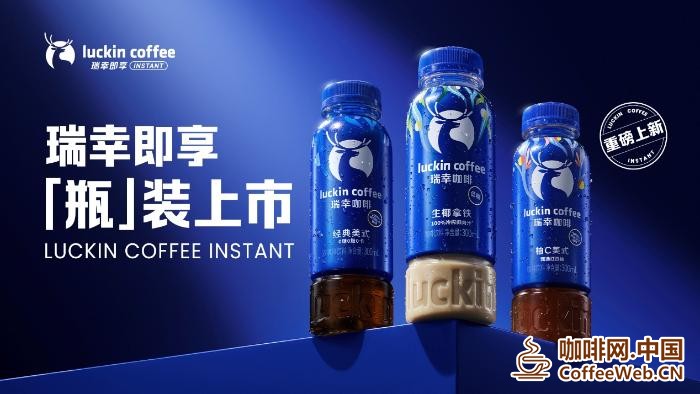
Recently, Luckin Coffee launched a new bottled ready to drink coffee and officially announced Wang Yibo as the global brand ambassador for Luckin Coffee.
The first batch of products to be launched includes three flavors: coconut latte, classic American, and grapefruit C American, with a retail price of about 6-7 yuan. Within 24 hours of listing, the online channel sales exceeded 1 million bottles, and the total category sales reached 18 million yuan.
This is not the first time Luckin Coffee has extended its freshly ground coffee business beyond its stores.
Luckin Coffee is a pre packaged coffee brand launched in July 2024, with products covering coffee liquid, bottled ready to drink coffee, instant coffee, coffee beans, capsule coffee, hanging ear coffee and other categories.
By 2025, Luckin Coffee's instant coffee products will sell over 400 million cups annually; The annual sales revenue of "other products" including coffee liquid, freeze-dried powder, etc. reached 2.32 billion yuan, accounting for 4.7% of the total revenue.
But compared to products such as coffee, ear drops, capsules, etc., bottled ready to drink is a larger attempt.
Bottled ready to drink beverages are closer to fast-moving consumer goods and require entry into high-frequency channels such as convenience stores, supermarkets, vending machines, and instant retail, competing with sugar free tea, functional beverages, and dairy beverages for the same shelf.
Similar actions did not only happen to Luckin.
Chen Hao, General Manager of Piye Coffee Retail, recently stated that in the past three years, the company has made packaging product business its core strategic focus. Currently, the revenue share of packaging product business has exceeded 30%, becoming the second growth curve after offline stores.
Manner、 Kudi and even Lucky Coffee have already launched freeze-dried and ear hanging retail products; Seesaw, a boutique coffee brand that emphasizes lifestyle, even extends its category to coffee utensils such as hand drawn kettles, grinders, and coffee machines.
Why do freshly ground coffee brands need to step out of their comfort zone, from coffee liquid to bottled ready to drink, from cup packaging in stores to retail on shelves?
one
New price band
Luckin Coffee's high-profile entry into bottled ready to drink beverages at this time is related to the changes in the stage of the freshly ground coffee industry itself.
On the one hand, store expansion is still ongoing, but the efficiency of traditional expansion models in driving growth is declining.
By the end of 2025, the total number of Luckin stores worldwide reached 31048, with a net increase of 8708 stores for the year. The average monthly number of trading customers for the whole year increased by 31.1% year-on-year to 94.15 million, and the cumulative number of trading users exceeded 450 million.
But in the fourth quarter, Luckin's net profit fell by about 39% year-on-year to 518 million yuan. The increase in delivery costs brought about by the increase in takeout orders has become one of the important factors that puts pressure on profits.
Stores and users remain Luckin's core assets, but as the store network continues to be encrypted and relies on new stores, delivery fulfillment, and low price subsidies to drive growth, marginal returns will gradually decrease.
On the other hand, the coffee price war is entering a new stage.
In February of this year, Kudi ended its nearly two-year "9.9 yuan all you can drink" campaign, retaining only some products for an unlimited supply of 9.9 yuan, while the rest of non discounted products are sold at retail price. This change is seen as one of the signs of the cooling down of low-priced competition in the industry.
But the ebb of the price war does not mean that the demand cultivated by low-priced coffee will disappear together.
In the past few years, low price subsidies and immediate fulfillment have objectively increased the frequency of coffee consumption.
When one or even multiple cups of coffee become a habit every day, coffee consumption will inevitably move beyond the store scene and spill over to periods such as home, office, commuting, and business travel.
The price war has to some extent amplified the functional consumption attributes of coffee. For some consumers, coffee is no longer just a spatial or social consumption, but is increasingly approaching high-frequency, low decision caffeine supplementation.
Luckin Coffee's bottled ready to drink coffee retail price this time is about 6-7 yuan, which is close to the mass price range of Meixue Ice City products and convenience store beverage shelves, and continues its strategy of entering the freshly ground coffee market at mass prices.
This fixed price has two meanings.
For in store coffee, the industry is trying to break free from excessive low price competition and reopen the price band of freshly made beverages;
For consumers who have already formed a high-frequency drinking habit, the demand for low threshold and high convenience coffee still exists. Ready to drink coffee caters to this demand for cost-effectiveness.
Luckin Coffee's selection of three flavors, namely coconut latte, classic American, and grapefruit C American, also conforms to this logic.
These products correspond to flavors that are already highly recognized in stores. Using mature and popular products to enter the shelves can reduce consumer decision-making costs and also shorten the education cycle for new products.
In fact, Luckin Coffee has already split into more segmented retail price bands around its signature product "Coconut Latte".
At present, Luckin Coffee has launched three products: coconut flavored cold brew coffee liquid, bottled ready to drink coffee, and Luckin Coconut Milk as a coffee companion.
In the Luckin Rewards membership center mini program, 2 boxes of 18 cups of 25ml bagged coconut flavored cold brew coffee are priced at 89 yuan, with a single cup costing nearly 5 yuan; In some bulk snack channels, the price of similar coffee liquids can be lowered to 3 yuan.
two
Above the shelves
Ready to drink coffee itself is not a market that can easily grow.
According to Euromonitor International data, the ready to drink coffee market in China has exceeded 10 billion yuan, but the compound annual growth rate from 2023 to 2025 is only 0.4%, significantly lower than the freshly brewed coffee market during the same period.
In the past, this market was mainly dominated by traditional fast-moving consumer goods brands and mature coffee brands.
Nestle has long held a high position, while Starbucks Costa、 Suntory and others are also competing in different price bands and channels. In recent years, traditional beverage players such as Nongfu Spring Charcoal and Dongpeng Coffee have also laid out coffee related products.
In recent years, Luckin Coffee and Kudi, who have dominated the freshly made beverage market, have shown little presence on the shelves.
The logic of shelf competition is different from that of freshly made tea and coffee shops.
The business of existing stores relies on location, fulfillment, new listings, and membership operations; Bottled beverages rely on stocking rates, display locations, channel profits, inventory turnover, and terminal repurchases. Consumers have a shorter decision-making process and more alternatives when making choices in front of convenience store shelves.
For bottled beverages, whether the channel is willing to continue stocking, restocking, and investing display resources often determines the product lifecycle more than the initial sales volume.
As a result, there are heavier channel costs, higher distribution difficulties, and profit margins that are divided by multi-level channels.
For newcomers, challenging the solidified channel profit network of giants often requires paying higher "entry fees".
For example, in the early days, Yuanqi Forest broke through the shelf and freezer blockade of traditional beverage giants, and one of its core weapons was higher channel distribution, and strengthened terminal reach through self built freezers.
Dongpeng Beverage has expanded from a regional brand to a national level and has long relied on digital marketing methods such as "One Yuan Enjoyment" and "Scan Code to Receive Red Envelopes" to convert expenses into incentives for end stores and consumers.
Therefore, tea beverage brands that attempted retail earlier have almost all given up on global distribution.
After restarting its bottled beverage strategy in the second half of 2025, Nayuki will place greater emphasis on customized co branding and exclusive exclusive distribution through membership channels such as Sam's; HEYTEA also relies on channels such as Sam's Club and Fat Donglai to launch bottled products such as Salted Cheese Tibetan Tea and Apple Milk Mo. This aims to improve conversion efficiency by targeting a more specific audience.
According to later reports, the purchase price of Luckin Coffee 300ml bottled American coffee is about 4 yuan/bottle, and distributors sell it to stores for about 4.6 yuan/bottle, with a terminal selling price of no less than 6 yuan/bottle. After adding rebates and promotions, the dealer's gross profit per box is about 15 yuan, and after deducting warehousing, logistics, and labor, the profit margin is about 10%.
In contrast, Starbucks 270ml bottled American coffee dealers purchase it for about 5.2 yuan per bottle, sell it to stores for about 7.2 yuan per bottle, and the terminal selling price is about 10 yuan per bottle; The dealer's gross profit per box is about 30 yuan, and the gross profit margin is nearly twice that of Luckin.
However, compared to traditional ready to drink coffee brands, Luckin Coffee's advantages still lie in its higher frequency of store outreach, faster iteration of new products, and a youthful taste mindset centered around popular products such as coconut latte.
In addition, mass pricing is also closer to the high-frequency consumer group educated by low-priced freshly ground coffee in the past few years, and helps Luckin Coffee to enter price sensitive channels such as bulk snacks and instant retail with high popularity.
Whether the recognition of popular products in the store can be transformed into sustained sales on the shelves will determine the true quality of Luckin's retail attempt.
This article is from the WeChat official account "All weather technology" (ID: iawtmt), written by Liu Yichen, edited by Songhe, and released by authorization.