


研究发现:天天喝咖啡,深度睡眠会大打折扣Research has found that drinking coffee every day can greatly reduce deep sleep
清晨一杯热咖啡驱散困意、午后续杯顶住工作疲惫,早已成为无数人的生活常态。
不少人自我安慰,只要不睡前饮用,咖啡因就不会打扰睡眠。
但一项系统性综述打破了这份侥幸:
哪怕白天正常喝咖啡,也会显著压缩深度睡眠时长,夜间睡眠质量肉眼可见下滑。
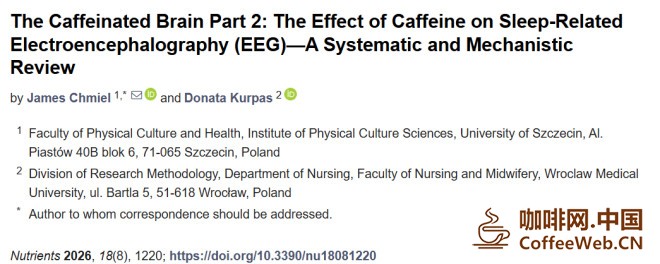
本次解读依托权威综述《The Caffeinated Brain Part 2: The Effect of Caffeine on Sleep-Related Electroencephalography (EEG)—A Systematic and Mechanistic Review》。
研究团队整合多项脑电图(EEG)监测数据,从脑电波层面拆解咖啡因蚕食优质睡眠的完整机制,结论跳出了“仅睡前喝咖啡伤身”的固有认知。
很多人误以为咖啡因只会延迟入睡时间,脑电图检测却给出了更精细的结果。
睡眠分为浅睡眠、深度慢波睡眠、快速眼动睡眠三个阶段,深度慢波睡眠负责身体修复、精力储能与记忆巩固,是决定睡醒后是否解乏的核心。

实验显示,日间规律摄入咖啡因的受试者,夜间深度睡眠脑电波振幅明显降低、持续时长大幅缩减,哪怕入睡时长没有变化,整晚睡眠也只是“假性睡着”。
从生理机理来看,咖啡因会竞争性绑定大脑腺苷受体。
腺苷是人体累积困意、触发深度睡眠的关键物质,受体被占据后,大脑接收不到疲惫信号,即便到了夜晚,神经依旧处于轻度亢奋状态,无法平稳切换至深度修复模式。
更值得警惕的是,咖啡因半衰期可达4–6小时,日间多次饮用,体内咖啡因会持续叠加,傍晚残留剂量依旧能干扰夜间脑电活动。

部分咖啡爱好者会出现“喝咖啡照样能睡着”的错觉,本质只是浅睡眠时长被动拉长,深层修复环节持续缺位。
长期如此会出现晨起疲惫、情绪烦躁、专注力衰退等连锁反应,白天只能依靠更多咖啡强行提神,陷入恶性循环。
不必彻底戒掉咖啡,调整饮用边界就能平衡需求:
每日控制1–2杯,下午3点后不再摄入,同时减少浓缩咖啡、能量饮料等高浓度咖啡因饮品。
提神与安眠本非对立,找对节奏,才能既留住咖啡的惬意,也守住整夜安稳的深度睡眠。
参考文献:
https://doi.org/10.3390/nu18081220
更多相关信息,可扫码+群,邀您进学术圈
原标题:《研究发现:天天喝咖啡,深度睡眠会大打折扣》
A cup of hot coffee in the morning to dispel drowsiness and a refill in the afternoon to withstand work fatigue have become the norm in the lives of countless people.
Many people console themselves that as long as they don't drink it before bedtime, caffeine won't disturb their sleep.
But a systematic review broke this lucky streak:
Even if you drink coffee normally during the day, it will significantly compress the duration of deep sleep, and the quality of nighttime sleep will visibly decline.
This interpretation is based on the authoritative review "The Caffeine Brain Part 2: The Effect of Caffeine on Sleep Related Electroencephalography (EEG) - A Systematic and Mechanical Review".
The research team integrated multiple electroencephalogram (EEG) monitoring data to dissect the complete mechanism by which caffeine erodes high-quality sleep from the level of brainwaves, and the conclusion breaks away from the inherent cognition that "drinking coffee before bedtime only harms the body".
Many people mistakenly believe that caffeine only delays bedtime, but EEG testing provides more detailed results.
Sleep is divided into three stages: light sleep, deep slow wave sleep, and rapid eye movement sleep. Deep slow wave sleep is responsible for body repair, energy storage, and memory consolidation, and is the core of determining whether to relieve fatigue after waking up.
Experiments have shown that subjects who regularly consume caffeine during the day experience a significant decrease in the amplitude and duration of deep sleep brain waves at night. Even if the duration of falling asleep does not change, the entire night's sleep is only a "false sleep".
From a physiological perspective, caffeine competitively binds to adenosine receptors in the brain.
Adenosine is a key substance in the human body that accumulates drowsiness and triggers deep sleep. After the receptor is occupied, the brain cannot receive signals of fatigue, and even at night, the nerves remain in a mildly excited state, unable to smoothly switch to deep repair mode.
What is even more alarming is that the half-life of caffeine can reach 4-6 hours. If consumed multiple times during the day, caffeine in the body will continue to accumulate, and residual doses in the evening can still interfere with nighttime EEG activity.
Some coffee enthusiasts may have the illusion that they can still fall asleep after drinking coffee, which is essentially a passive prolongation of shallow sleep duration and a continuous lack of deep repair processes.
Long term exposure to this can lead to chain reactions such as morning fatigue, emotional distress, and decreased focus. During the day, one can only rely on more coffee to forcefully refresh themselves, falling into a vicious cycle.
You don't need to completely quit coffee, adjusting your drinking boundaries can balance your needs:
Control 1-2 cups per day, no longer consume after 3pm, and reduce high concentration caffeine drinks such as espresso and energy drinks.
Refreshing and sleeping are not opposed to each other. Finding the right rhythm is the key to retaining the comfort of coffee and maintaining a peaceful deep sleep throughout the night.
References:
https://doi.org/10.3390/nu18081220
For more related information, you can scan the code and join the group to invite you into the academic circle
Original title: "Research finds that drinking coffee every day can greatly reduce deep sleep"