咖啡行业的资本游戏,到头了The capital game in the coffee industry has come to an end
作者|朝阳资本论 鼓风
到2027年,瑞幸就成立10周年了。
凭借一己之力,把咖啡消费从精品带向大众,瑞幸在咖啡消费上的平权功不可没。
截至5月底,瑞幸全球门店规模超过3.5万家。
这不由得让人想起,2022年成立的库迪曾在2025年2月份的媒体沟通会上的豪言:
“公司维持2025年底5万家门店终端的目标不变”。
一年多过去了,截至6月初,库迪门店峰值是1.6万家,距离5万家目标还差3.4万家。
暂且不表两家创始团队种种过往、也暂且不论咖啡是否还是门店规模取胜的生意,行业发展到2026年,已经感觉到很明显的寒意。
首当其冲的,就是资本的冷淡。
最巅峰的2021年,行业融资37次,总金额近69亿元(前瞻研究院数据)。
到了2026年,截至目前,真正融到钱的咖啡品牌,只有挪瓦,数亿元C轮。
至于咖爷科技,人家是做商用咖啡机的,融到了近4亿的B轮。
资本都是逐利的,不投资咖啡品牌,或许是因为,行业的确已经无利可图。
行业全面震荡,洗牌清出进行时
2026年的咖啡行业,实在动荡。
最难受的是Seesaw,这家曾在2017年作为首个资本加持的精品咖啡品牌,在今年6月正式进入破产清算,没有活过10年周期。
另一家精品蓝瓶,在今年3月被大钲资本(瑞幸背后大佬)以不足4亿美元接盘,较2017年雀巢收购时的7亿美元估值近乎腰斩。
此外,星巴克中国业务也在今年4月被出售,博裕资本接手60%控股权,星巴克自己保留40%,在中国市场也是独木难支了。
精品、高端咖啡如此,平价连锁也不好过。
去年是平均每天关店140家,全年总共超过5万家咖啡店关停(窄门餐眼数据)。
今年上半年,开店速度追不上关店速度。
据《中国现制茶饮及咖啡行业月度报告》显示,截至4月,国内50家头部茶咖品牌门店总量为23.08万家,年内整体增速约5.85%,其中3月、4月环比增速在1%左右
放到两年前,这个数字动辄两位数,瑞幸单季就能净增三千家店。
至于行业高端品牌标杆星巴克,在2026财年第二季度(截至3月29日),门店总数降至7991家,较上季度净减少20家,这是星巴克进入中国市场以来罕见的门店负增长。
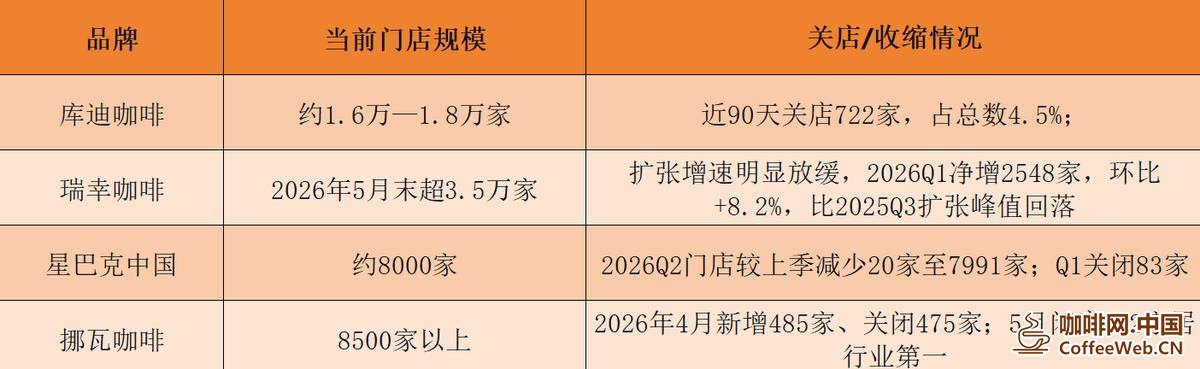
(上表为行业龙头公司门店数量以及关店变化,数据来源财报以及媒体披露)
关店是表象,不赚钱才是实质性伤害。
拿绝对龙头瑞幸来说,根据官方披露数据,2025年全年总净收入492.88亿元,同比增长43.0%,净利润36亿元,同比增长21.8%。
但是到了今年一季度,增收不增利明显,总净收入119.95亿元,同比增长35.3%,但净利润5.06亿元,同比下降3.6%。
而瑞幸的局面,已经是行业优等生的成绩了。
作为行业第二大连锁品牌,营销一直高举高打的库迪,今年的日子才更加难过,最直接的反馈,就是在加盟商层面。
加盟商向媒体爆料一批加一批,保底取消、补贴减少、社群拉新KPI低效严苛,内部掀起转让、闭店潮。
库迪加盟商有苦难言的同时,库迪仍旧大肆花钱做广告。从世界杯赞助阿根廷到签下黑马电影《给阿嬷的情书》女主李思潼出任品质推荐官,数亿元营销费用持续砸向品牌升级,但终端市场反应始终冷淡。
至于行业品牌标杆星巴克,也好不到哪里去,在中国市场的营收,目前已经被瑞幸赶超。
财报显示,星巴克中国2026财年Q2营收7.998亿美元(折合人民币约55.22亿,不及瑞幸五成),同比增长8%,但同店销售从Q1的7%骤降至0.5%,客单价由正转负至-1.6%,想要“下沉”的星巴克被价格战精准狙击。
资本为何集体退潮?
可以看到,2026年整个咖啡赛道都变得如履薄冰,为何?
原因还是在于咖啡连锁的商业模式、市场供需之中。
一直以来,咖啡赛道的盈利模式,不来自终端,来自供应链;不来自消费者,来自加盟商。
以库迪为例,从融资路径看,早期没有外部融资的库迪始终走“零融资+联营变现”的轻资产路线。
整个业务逻辑是以零融资撬动加盟商资金,以低价补贴换门店增速,以规模故事维持招商热度,在咖啡赛道窗口红利期完成极限扩张。
总部现金流来自向加盟商销售的设备、原料差价与毛利抽成。
据《Tech星球》报道,一位2022年底“第一批联盟商”的库迪加盟商,门店已经关闭的没剩两家了。老店续约被强制要求加咖啡机,生意不好还让加咖啡机,总部不考虑一线情况,只会要求买公司的设备。
这套机制让区域团队将开店速度作为核心KPI,选址审核宽松到“申报即通过”,最终出现加盟商反映的“一公里就有两到三家同行竞争”的极端内卷情况。
随着公司补贴退坡、保底政策取消,加盟商的生存空间被快速压缩。
特别是2025年推出“保底回收”政策吸引加盟商,当时的合作模式是,经营6至9个月未达预期,总部按折扣回收加盟商门店内的设备。
但2026年6月30日政策正式终止,背后原因也很现实。
随着亏损门店增多,总部回收的设备难以快速二次消化,资产减值压力持续上升,最终只能取消兜底,把风险完全交还给市场。
这直接导致大量加盟商赶在窗口期前集中转让,挂牌转让门店逃离亏损漩涡, 即便5-8月是传统消费旺季,也宁愿优先止损,生怕门店淡季更难出手。
加盟商不赚钱,本质上还是9.9的咖啡生意不好做。
一杯9.9元的美式,5.7元的原材料、1.5元的包材、1.9元的人工、1.8元的房租,加上0.2元的水电支出。
如果没有补贴,就是卖一杯亏一杯,和新能源汽车有的一拼。
在门店终端,加盟商的毛利被压缩到仅剩1.5至2.5元,日均低于100杯即陷入亏损。
而品牌方在这杯咖啡上的利润约1.3至2.2元,几乎与加盟商持平,却不承担任何门店固定风险。
这说明什么?
说明咖啡行业的利润并不来自终端零售,而是来自供应链端的“剪刀差”。
品牌方真正的赚钱逻辑,从来不是靠卖咖啡给消费者赚钱,而是靠向加盟商卖设备、卖原料、卖品牌授权赚钱。
加盟商每开一家店,先交一笔设备款和保证金;每个月进货,品牌方赚一道原料差价;每卖出一杯咖啡,品牌方再抽一笔营业额分成。
无论门店是盈是亏,这些收入都是刚性的。
加盟商是品牌方的“超级客户”——他们才是真正为品牌方贡献利润的人。
瑞幸通过规模化采购与自建烘焙工厂,将毛利率提升至63.8%,吃掉中间商利润;库迪本质上更像是一家咖啡供应链公司;挪瓦咖啡的收入也主要来源于供应链物料销售、加盟服务费、合作门店销售分成。
终端卖咖啡是“薄利”,供应链卖原料和设备才是“厚利”。
这也是资本近期开始投资咖啡专业设备制造商,放弃终端品牌商的根本原因。
比如2026年6月,商用全自动咖啡机品牌CAYE咖爷科技宣布完成接近4亿元人民币的B轮融资,精品咖啡供应链公司乐饮创新也完成亿元B+轮融资。
资本不再投“下一个瑞幸”,而是投“不管谁开店都得用的咖啡机和烘焙产能”。
下半场拼什么?
过去十年,咖啡赛道上半场的胜负手是速度,谁融资快、谁开店猛、谁营销狠,谁就能抢占先机。
下半场,胜负手只有两个:平价赛道拼供应链效率,高端赛道拼场景价值。
对平价赛道而言,供应链是唯一的护城河。
未来品牌商只有一个核心竞争力:把一杯咖啡的成本压到极致。
过去几年的教训已经足够深刻。
库迪如今的滞缓证明,光靠加盟商的钱撑规模、靠补贴拉单量,最终只会走向“开店越多、亏得越狠”的死胡同。
未来能活下来的平价品牌,必须具备二个条件:自建产能、数字化运营。
这方面,大家都心知肚明,集体开始拼产能强度。
瑞幸建了四座烘焙基地、总产能15.5万吨,自烘焙成本比外部采购低15%至20%;库迪在安徽布局36万平方米供应链基地;挪瓦咖啡自建烘焙工厂后原料成本下降5%、人工成本降低40%。
产能是生存底线。
没有自建供应链的品牌,在成本上永远比头部玩家贵15%到20%,这个差距,在微利时代就是生与死的距离。
至于数字化运营,则更为直白。
门店选址靠热力模型而非人工判断,定价随天气和时段动态调整,库存根据实时销量自动补货,营销通过私域精准触达,每一个环节的效率提升1%,叠加起来就是能力差。
至于高端赛道,需要考虑,当“第三空间”不再稀缺,品牌溢价从何而来?
星巴克给出的答案曾是空间社交价值,但门店越开越多,稀缺性消失;“一杯星巴克=三杯瑞幸”的心智一旦固化,品牌底座便开始松动。
破局点在于品牌分层:核心商圈旗舰店守住调性,写字楼社区店轻量化适配效率,下沉市场小店靠品牌势能竞争。
用同一块招牌覆盖不同场景,不打价格战也能活下去。
目前,精品咖啡的规模化故事已被证伪。
蓝瓶估值腰斩、Seesaw破产清算,揭示一个残酷规律:精品与规模天然矛盾。
坚持精品做不大,快速扩张则稀释调性。
未来活下来的精品店,不会是“下一个星巴克”,而是扎根社区、主理人IP化的小体量门店。
高端咖啡的本质,不是卖更好喝的咖啡,依然是卖空间、卖调性、卖身份认同。
长期看,咖啡依然是一门好生意,只是不再是一门容易的生意。
能穿越周期的,永远是那些尊重商业规律、为用户创造真实价值的玩家,而不是靠故事和杠杆堆砌的“纸面巨头”。
Author | Chaoyang Capital Blast
By 2027, Luckin Coffee will celebrate its 10th anniversary.
By relying solely on its own efforts, Luckin Coffee has brought coffee consumption from boutique to the public, and its equal rights in coffee consumption are indispensable.
As of the end of May, Luckin Coffee's global store scale exceeded 35000.
This inevitably reminds people of the bold words made by Kudi, founded in 2022, at a media communication conference in February 2025:
The company maintains its target of 50000 store terminals by the end of 2025 unchanged.
More than a year has passed, and as of early June, the peak number of Kudi stores was 16000, which is still 34000 short of the target of 50000.
Leaving aside the past experiences of the two founding teams and whether coffee or store scale wins the business, the industry is already feeling a clear chill as it develops to 2026.
The first and foremost issue is the coldness of capital.
At its peak in 2021, the industry raised 37 funds with a total amount of nearly 6.9 billion yuan (according to data from Forward looking Research Institute).
By 2026, as of now, the only coffee brand that has truly raised money is Novartis, with hundreds of millions of yuan in Series C.
As for Kaiye Technology, it is a commercial coffee machine that has raised nearly 400 million yuan in Series B.
Capital is profit driven, and not investing in coffee brands may be because the industry is indeed unprofitable.
The industry is experiencing a comprehensive shake up, and the reshuffle is underway
The coffee industry in 2026 is truly turbulent.
The most difficult thing is Seesaw, a boutique coffee brand that was first funded in 2017 and officially entered bankruptcy liquidation in June this year, without surviving the 10-year cycle.
Another boutique blue bottle was acquired by Dazheng Capital (the big shot behind Luckin Coffee) for less than $400 million in March this year, almost halving its valuation of $700 million when Nestle acquired it in 2017.
In addition, Starbucks' China business was also sold in April this year, with Boyu Capital taking over 60% of the controlling stake and Starbucks retaining 40%, making it difficult to survive in the Chinese market alone.
Fine and high-end coffee are like this, even low-priced chains are not doing well.
Last year, an average of 140 coffee shops closed every day, and a total of over 50000 coffee shops closed throughout the year (according to data from Narrow Gate Restaurant).
In the first half of this year, the speed of opening stores could not catch up with the speed of closing stores.
According to the monthly report on China's freshly made tea and coffee industry, as of April, the total number of top 50 tea and coffee brand stores in China was 230800, with an overall growth rate of about 5.85% for the year. The month on month growth rate in March and April was around 1%
Two years ago, this number was often in double digits, and Luckin could net an increase of 3000 stores in a single season.
As for the high-end brand benchmark Starbucks in the industry, in the second quarter of the 2026 fiscal year (as of March 29), the total number of stores decreased to 7991, a net decrease of 20 from the previous quarter, which is a rare negative growth in stores since Starbucks entered the Chinese market.
(The above table shows the number of stores and changes in store closures of industry-leading companies, sourced from financial reports and media disclosures)
Closing a store is superficial, not making money is the real harm.
Taking absolute leader Luckin Coffee as an example, according to official disclosed data, the total net revenue for the whole year of 2025 is 49.288 billion yuan, a year-on-year increase of 43.0%, and the net profit is 3.6 billion yuan, a year-on-year increase of 21.8%.
However, in the first quarter of this year, there was a significant increase in revenue without profit, with a total net income of 11.995 billion yuan, a year-on-year increase of 35.3%, but a net profit of 506 million yuan, a year-on-year decrease of 3.6%.
And Luckin's situation is already the result of being a top student in the industry.
As the second largest chain brand in the industry and a marketing expert, Kudi has been struggling even harder this year. The most direct feedback is at the level of franchisees.
Franchisees have revealed to the media that one batch after another, with guaranteed cancellations, reduced subsidies, and inefficient and strict KPIs for community recruitment, have sparked a wave of internal transfers and store closures.
While the franchisees of Kudi are struggling, Kudi still spends a lot of money on advertising. From sponsoring Argentina for the World Cup to signing the female lead of the dark horse movie "A Love Letter to Grandma", Li Sitong, as a quality recommendation officer, hundreds of millions of yuan in marketing expenses continue to be invested in brand upgrades, but the response from the end market has always been lukewarm.
As for the industry benchmark Starbucks, it's not much better. Its revenue in the Chinese market has already been surpassed by Luckin Coffee.
According to the financial report, Starbucks China's Q2 revenue for the 2026 fiscal year was 799.8 million US dollars (approximately 5.522 billion RMB, less than 50% of Luckin Coffee), a year-on-year increase of 8%. However, same store sales plummeted from 7% in Q1 to 0.5%, and the average order value turned from positive to negative to -1.6%. Starbucks, which wanted to "sink", was targeted by a price war.
Why is capital collectively declining?
It can be seen that by 2026, the entire coffee track will become like walking on thin ice. Why?
The reason still lies in the business model and market supply and demand of coffee chains.
The profit model of the coffee industry has always come not from the end, but from the supply chain; Not from consumers, from franchisees.
Taking Kudi as an example, from the perspective of financing path, Kudi, which had no external financing in the early days, always followed the light asset route of "zero financing+joint venture realization".
The entire business logic is to leverage franchisees' funds with zero financing, exchange low price subsidies for store growth, maintain investment attraction through scale stories, and achieve maximum expansion during the coffee track window dividend period.
The headquarters' cash flow comes from the price difference and gross profit margin of equipment and raw materials sold to franchisees.
According to Tech Planet, a Kudi franchisee who was among the "first batch of alliance partners" by the end of 2022, has closed only two stores. Old shops are forced to add coffee machines when renewing contracts, and even if business is not good, they are required to add coffee machines. The headquarters does not consider frontline situations and only requires the purchase of company equipment.
This mechanism allows regional teams to prioritize store opening speed as a core KPI, and the site selection review is relaxed to the point of "approval upon application", ultimately resulting in extreme internal competition reported by franchisees as "two to three peers competing within one kilometer".
With the company's subsidy reduction and the cancellation of the minimum guarantee policy, the survival space of franchisees has been rapidly compressed.
Especially with the introduction of the "guaranteed recycling" policy in 2025 to attract franchisees, the cooperation model at that time was that if the operation did not meet expectations for 6 to 9 months, the headquarters would recycle the equipment in the franchisee's store at a discount.
But the policy will officially terminate on June 30, 2026, and the reasons behind it are also very practical.
With the increase of loss making stores, the equipment recovered by the headquarters is difficult to quickly digest, and the pressure of asset impairment continues to rise. Ultimately, the only option is to cancel the bottom line and fully return the risk to the market.
This directly leads to a large number of franchisees rushing to sell before the window period, listing and selling stores to escape the vortex of losses. Even though May to August is the traditional peak consumption season, they would rather prioritize stop loss, fearing that it will be more difficult for stores to sell during the off-season.
Franchisees don't make money, essentially it's not easy to do a 9.9 coffee business.
A 9.9 yuan American style cup, 5.7 yuan for raw materials, 1.5 yuan for packaging materials, 1.9 yuan for labor, 1.8 yuan for rent, plus 0.2 yuan for water and electricity expenses.
If there is no subsidy, it means losing one cup at a time and competing with new energy vehicles.
At the store terminal, franchisees' gross profit is compressed to only 1.5 to 2.5 yuan, and if the daily average is less than 100 cups, they will fall into losses.
The brand's profit on this cup of coffee is about 1.3 to 2.2 yuan, almost on par with franchisees, but it does not bear any fixed store risks.
What does this mean?
The profit of the coffee industry does not come from terminal retail, but from the "scissors gap" at the supply chain end.
The true profit logic of brand owners has never been to make money by selling coffee to consumers, but by selling equipment, raw materials, and brand authorization to franchisees.
Franchisees pay a deposit and equipment fee for each store they open; Every month when purchasing goods, the brand earns a price difference in raw materials; For every cup of coffee sold, the brand will receive an additional revenue share.
Regardless of whether the store is profitable or unprofitable, these revenues are rigid.
Franchisees are the "super customers" of the brand - they are the ones who truly contribute profits to the brand.
Luckin Coffee has increased its gross profit margin to 63.8% through large-scale procurement and self built baking factories, eating up the profits of intermediaries; Kudi is essentially more like a coffee supply chain company; The revenue of Novacoffee mainly comes from the sales of supply chain materials, franchise service fees, and sales revenue from cooperative stores.
Selling coffee at the terminal is a 'low profit', while selling raw materials and equipment in the supply chain is a 'high profit'.
This is also the fundamental reason why capital has recently started investing in coffee specialty equipment manufacturers and abandoned terminal brand merchants.
For example, in June 2026, commercial fully automatic coffee machine brand CAYE Coffee Technology announced the completion of nearly 400 million yuan in Series B financing, and boutique coffee supply chain company Leyin Innovation also completed a billion yuan Series B+financing.
Capital is no longer investing in the 'next Luckin Coffee', but in the 'coffee machines and baking capacity that anyone who opens a shop must use'.
What to play in the second half?
In the past decade, the winner of the first half of the coffee track has been speed. Whoever raises funds quickly, opens stores aggressively, and has strong marketing strategies can seize the opportunity.
In the second half, there were only two winners: competing for supply chain efficiency on affordable tracks and competing for scene value on high-end tracks.
For the affordable track, the supply chain is the only moat.
Future brand owners have only one core competitiveness: pushing the cost of a cup of coffee to the extreme.
The lessons of the past few years are already profound enough.
Kudi's current sluggishness proves that relying solely on franchisees' money to support scale and subsidies to increase order volume will ultimately lead to a dead end of "opening more stores and losing more".
The affordable brands that can survive in the future must meet two conditions: self built production capacity and digital operation.
In this regard, everyone is well aware that the collective is starting to compete for production capacity intensity.
Luckin Coffee has built four baking bases with a total production capacity of 155000 tons, and the cost of self baking is 15% to 20% lower than external procurement; Kudi has established a 360000 square meter supply chain base in Anhui province; After building its own roasting factory, Novacoffee reduced raw material costs by 5% and labor costs by 40%.
Capacity is the bottom line for survival.
Brands without their own supply chain will always be 15% to 20% more expensive than top players in terms of cost, and this gap is like the distance between life and death in the era of low profits.
As for digital operations, it is even more straightforward.
Store location selection relies on thermal models rather than manual judgment, pricing is dynamically adjusted according to weather and time periods, inventory is automatically replenished based on real-time sales volume, and marketing is accurately reached through private domains. The efficiency of each link is improved by 1%, but when combined, it results in poor capability.
As for the high-end track, we need to consider where the brand premium comes from when the "third space" is no longer scarce?
The answer given by Starbucks used to be the social value of space, but as more stores opened, scarcity disappeared; Once the mindset of 'one Starbucks equals three Luckin Coffee' solidifies, the brand foundation begins to loosen.
The breakthrough point lies in brand stratification: flagship stores in core business districts maintain their tone, office and community stores adapt to lightweight efficiency, and small stores in sinking markets compete with brand momentum.
Covering different scenes with the same sign allows you to survive without engaging in price wars.
At present, the story of the scaling up of premium coffee has been debunked.
The halving of the valuation of Blue Bottle and the bankruptcy liquidation of Seesaw reveal a cruel law: the natural contradiction between quality and scale.
Persisting in producing high-quality products is not enough, and rapid expansion dilutes the tone.
The boutique stores that will survive in the future will not be the 'next Starbucks', but small scale stores rooted in the community and managed by IP.
The essence of high-end coffee is not to sell better coffee, but still to sell space, tonality, and identity.
In the long run, coffee remains a good business, but it is no longer an easy one.
Players who respect business laws and create real value for users will always be able to cross cycles, rather than "paper giants" built on stories and leverage.