在营门店900家,目标3年10万家,为了成为咖啡A股第一股小咖拼了We have 900 stores in operation and aim to reach 100000 within 3 years. In order to become the first small coffee company in the A-share market, we have been striving to become one of the top players in the coffee industry
A subsidy of 600 million yuan is being poured into stores, and Xiaoka Coffee's ambition to go public cannot be hidden.
On July 3rd, at the 9th anniversary celebration of Xiaoka Coffee, founder Zhu Baoju revealed that the company has completed 7 rounds of financing, with a total financing amount of 1.14 billion yuan, of which the latest round of financing is 340 million yuan. At the same time, it was revealed that the company plans to enter the capital market between 2026 and 2027. Its previous target has been the Hong Kong stock market, but this year it has added a Growth Enterprise Market option.
At the celebration, Xiaoka also proposed a more aggressive expansion goal of opening 100000 stores within 3 years.
For a brand that currently has only 898 stores in operation, this means that the store scale needs to grow more than 100 times in the next three years.
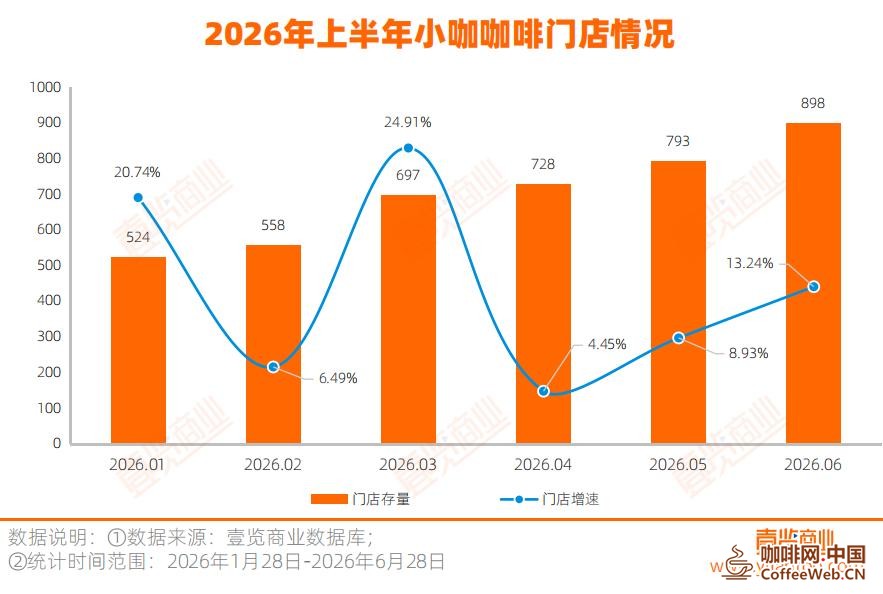
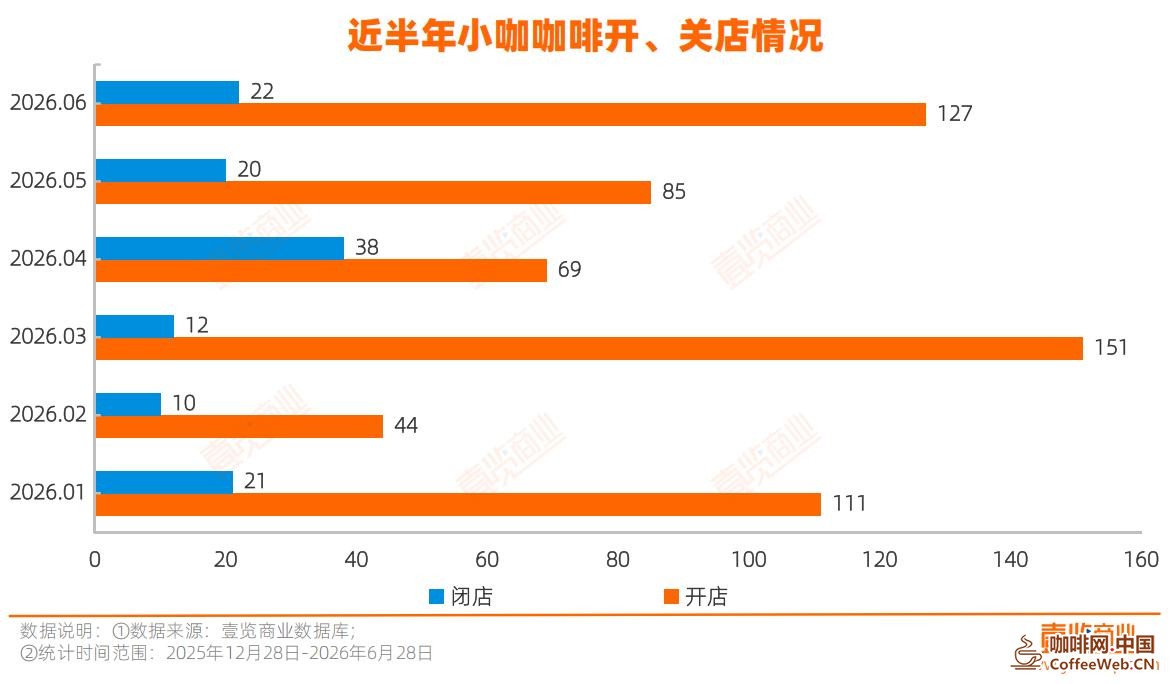
From the store data, Xiaoka has entered an accelerated expansion phase since this year. According to Yilan Business Data, from January to June, the number of small coffee shops increased from 524 to 898, an increase of 71.37%, almost ranking first in the industry in terms of growth rate. From the perspective of store expansion pace, March reached its peak in nearly half a year, with 151 new stores opened. In January and June, 111 and 127 new stores were opened respectively.
At the same time, except for the concentrated closure of 38 stores in April, the number of closed stores in other months remained between 10-20, indicating that Xiaoka Coffee is maintaining a relatively stable overall operation while maintaining high-speed expansion.
Compared to the number of stores, Xiaoka Coffee is more worth paying attention to the direction of opening stores.
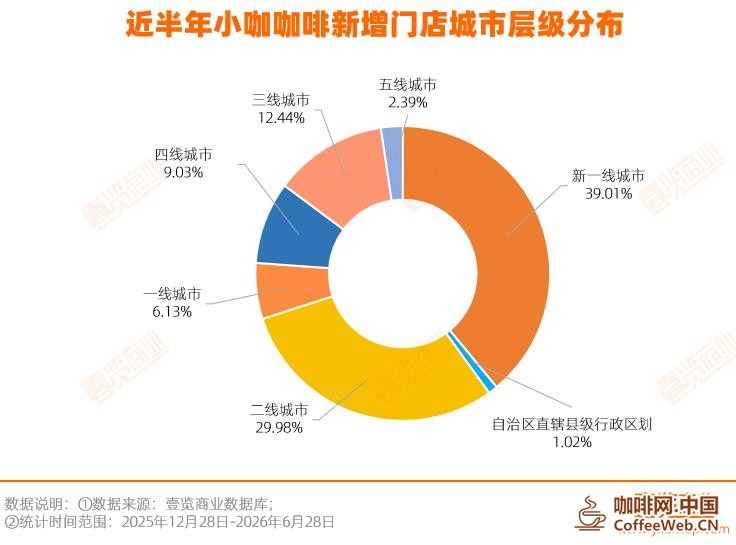
From the perspective of newly added stores, Xiaoka Coffee's expansion resources are fully tilted towards high tier cities. In the past six months, Xiaoka Coffee has opened 441 new stores in second tier and above cities, accounting for 75.13% of all new stores, and is deeply rooted in cities such as Wuhan, Qingdao, Taiyuan, and Chengdu.
Tea cafes have observed that the support for this round of expansion is not traditional franchise stores, but a store in store model called "light selection station". Among the 441 new stores opened in the past six months, 402 are light selection stations, accounting for a high proportion of 91.16%. The store has an area of only 2-5 square meters and operates within the convenience store without being open for franchise.
At present, Xiaoka Coffee has established formal cooperation with more than 30 of the top 100 convenience store chains in China, and has partnered with over 100 baking and lifestyle service brands. Among the newly added light selection station stores, Youtong Convenience Store has the largest number of cooperative stores, with a total of 84 stores, accounting for 20.90%.
The biggest advantage of this model is its replication efficiency. Convenience stores themselves already have mature locations, stable customer flow, and basic operating systems. Small businesses can quickly enter new cities and business districts without the need to search for new stores, renovate and build stores, and complete brand coverage at a lower cost.
However, the light selection site is more like a phased growth tool. Light selection stations are dependent on convenience store operations, and consumers are more likely to remember the convenience store when they enter it for consumption, rather than the small brand itself. The establishment of independent brand awareness is still limited.
More importantly, there is a capacity ceiling in the convenience store channel itself, and Novak Coffee, Kudi Coffee, and Tims Tianhao Coffee are all expanding their in store operations. Many convenience store brands also have their own coffee businesses.
As of the end of June, the number of light selection stations has reached 649, accounting for 72.27% of all stores. When the proportion of a single channel exceeds 70%, it also means that the brand's future growth may be constrained by channel resources. Once the cooperation strategy is adjusted or convenience stores introduce other coffee brands, the expansion pace of Xiaoka may also be affected.
Therefore, Xiaoka has begun to allocate more resources to independent and replicable fast food stores. By 2026, the brand will invest nearly 600 million yuan in brand marketing and store building subsidies.
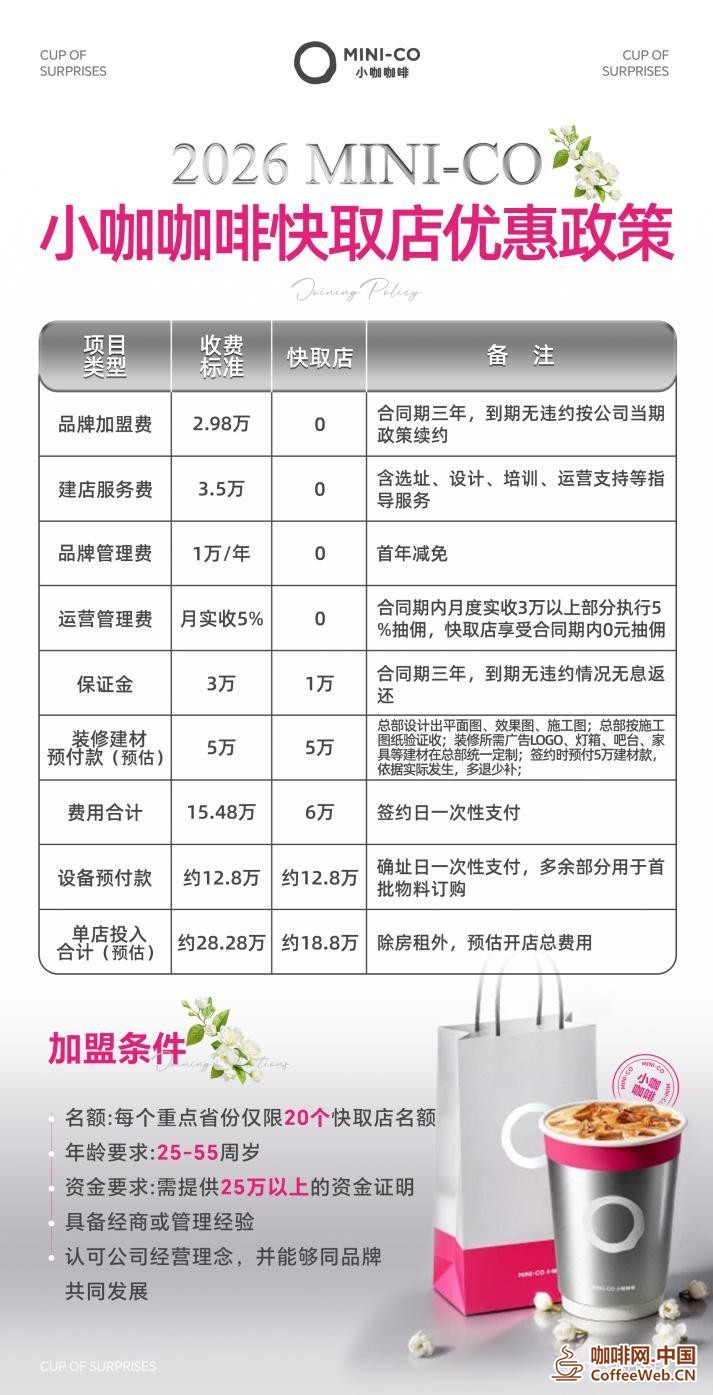
On the one hand, Xiaoka Coffee has introduced support policies such as waiving franchise fees, service fees, brand and operation management fees, reducing the initial investment for a single store to 188000 yuan. On the other hand, each key province is limited to only 20 express pickup store slots, hoping to reduce franchise costs while minimizing internal competition within the same brand.
Compared to light selection sites, the biggest significance of a fast pickup store lies in its ability to open up franchising and independent replication.
It is understood that the Quick Pick Shop is a small shop model of 20-30 square meters, which reduces rent, decoration, and personnel investment, and makes it easier to enter office buildings, industrial parks, universities, hospitals, and other scenes. At the same time, express delivery stores rely more on online ordering, self pickup, and food delivery, and are also more suitable for digital operation methods such as membership operation and community marketing.
Compared to relying on convenience store resources, the true test of a fast pickup store is the brand's own ability: whether there are franchisees willing to open a store, whether there is the ability to make franchisees continue to make money, and whether there is the ability to continuously bring foot traffic to the store. Only when all three questions are verified can Xiaoka truly prove that their franchise model has long-term replication ability.
Therefore, Xiaoka's subsequent series of investments essentially revolve around these three issues.
Firstly, in order to make franchisees willing to open stores, it is necessary to lower the operating threshold. After the opening of the fast pickup store franchise, the increase in the number of stores means that the difficulty of training, production, and personnel management has synchronously increased. If we still rely on manual production, not only will the replication speed be limited, but it will also be difficult to ensure product consistency.
To this end, Xiaoka has launched a self-developed fully automatic tea coffee machine. Official data shows that this device can improve meal efficiency by 50% and reduce training costs by 80%. Essentially, it is reducing the personnel dependence of franchisees, allowing more stores to complete standardized operations at lower labor costs, and providing a foundation for replicating the scale of fast food stores.
Secondly, franchisees need to make money. For express delivery stores, although the store area has shrunk, if the supply chain costs do not decrease synchronously, the profits of franchisees will still be squeezed, and the light asset model will still be difficult to sustain.
Therefore, Xiaoka is building a 45000 square meter industrial base in Caofeidian, covering equipment research and development, coffee bean roasting, and data centers, hoping to reduce procurement and production costs through self built supply chains, improve inventory turnover efficiency, and leave more profit margins for franchisees.
Finally, in order for franchisees to continue operating, it is necessary to ensure stable foot traffic in their stores. Therefore, Xiaoka plans to invest 200 million yuan in marketing budget in the second half of the year and sign contracts with super IPs and new generation idols. This marketing investment is not just about brand promotion, but also about helping new stores quickly complete consumer education, shorten the cultivation period, increase order density after opening, and thereby enhance franchisees' confidence in continuing to open stores.
It can be seen that the light selection station model is used by coffee makers to help brands quickly build the scale of main stores, and the cache stores mainly verify the model of franchise stores, while equipment, supply chain and marketing investment are complementary to the underlying capabilities of this model.
However, at present, the solution to the problem of quick opening is the light selection station, while the quick pickup store still needs to prove that it can be opened, earned, and replicated. With less than two years left until the planned launch in 2027, Xiaoka's verification window for themselves is not spacious. Whether a fast pickup store can run a mature single store model may be the key to determining whether it can enter the capital market.