
霸王茶姬“咖啡因仪表盘”上线 现制茶饮行业加速推进健康透明化落地Bawang Tea Lady's "Caffeine Dashboard" is launched, accelerating the implementation of health transparency in the freshly made tea beverage industry
央广网北京7月20日消息(记者 陈越) 打开霸王茶姬的点单小程序,细心的消费者会发现,最近菜单上的茶饮展示界面新增了“咖啡因仪表盘”的标示,浅绿、绿、黄、橙、红颜色区间在仪表盘上从左到右沿着弧形曲线顺次排开,仪表盘下方同时标有具体数字,清晰提示着该款茶饮标准出品的咖啡因含量。
这一微小的界面变化,正是当前现制茶饮行业加速推进健康透明化落地的一个缩影。
据了解,目前“咖啡因仪表盘”已在霸王茶姬点单小程序、外卖平台、门店等渠道同步上线。消费者在点单时只需简单扫视仪表盘,即可一目了然地掌握目标饮品的咖啡因含量特点。
在北京丰台某霸王茶姬门店,记者遇到了正在点单的消费者林女士。她表示,自己平时对咖啡因比较敏感,下午喝奶茶经常影响当晚睡眠。“以前下午只敢喝几口,点单只能盲选,现在咖啡因含量看菜单一眼就明白,省事多了。”林女士最终选择了一款标记为绿色的“轻因”产品。
据门店员工介绍:“咖啡因仪表盘”主要由具体茶饮名称及标准出品的咖啡因含量信息组成,其中咖啡因含量信息通过具体数字和对应的颜色区间来呈现。仪表盘分为5种颜色区间标识:0~50mg/杯的标识为浅绿,51~100mg/杯的标识为绿色,二者均归为“轻因”档,表示咖啡因含量较低,适合希望降低咖啡因摄入者选择;101~150mg/杯的标识为黄色,建议饮用者关注饮用时间和个人身体敏感度;151~200mg/杯的标识为橙色,建议饮用者在上午或午后较早时段饮用;大于200mg/杯的标识为红色,建议特殊人群慎选,尽量避免晚间饮用。
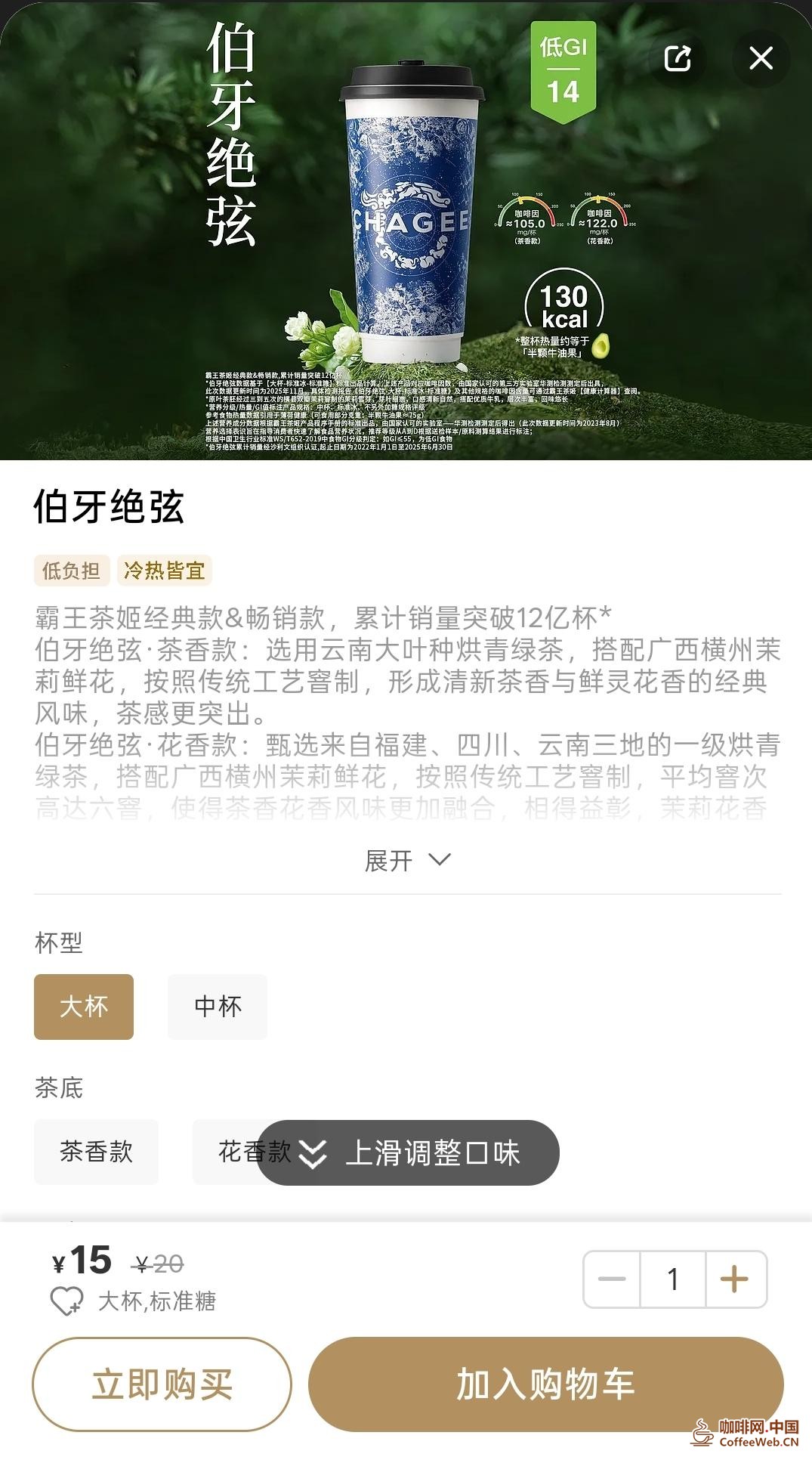
伯牙绝弦两款茶饮咖啡因含量分别为“茶香款105mg/杯”“花香款122mg/杯”(记者截图 央广网发)
盘古智库高级研究员江瀚表示:“此次‘咖啡因仪表盘’的推出,实质上是霸王茶姬解决市场信息不对称问题的关键一招。霸王茶姬通过红黄绿等颜色区间的直观划分,将复杂的理化指标转化为消费者易于理解的‘决策仪表盘’,这在一定程度上降低了消费者的决策成本,打破了长期以来困扰行业的内部人壁垒,让消费行为从‘感觉主导’转向‘数据主导’。”
据统计,2025年全国茶饮市场规模达1870亿元,同比增长6.4%,全国茶饮门店数达44.9万家,同比增长3.5%。与市场规模快速扩张同步推进的,是行业标准体系的持续完善。近年来,随着消费者健康意识不断提升,现制茶饮行业的信息披露正从热量、GI值等指标逐步延伸至更多维度。然而,一个不可忽视的现实是:目前我国尚无现制茶饮咖啡因强制标注规定,现有国标主要针对预包装茶饮料,现制茶饮领域尚处于标准覆盖之外。
2026年1月12日,中国连锁经营协会(CCFA)在上海召开三项团体标准启动会,正式启动《现制饮料营养成分图形化标示指南》的制订工作。星巴克、百胜中国、霸王茶姬、古茗、喜茶等30余家行业头部企业及专业机构代表参会。据悉,该标准聚焦营养信息规范化传递,借鉴国内外先进经验,涵盖标示范围、核心指标、设计规范等内容。核心讨论围绕三方面展开:一是明确能量、糖、咖啡因等指标的纳入范围;二是平衡图形化设计的专业性与通俗性,统一视觉规范;三是建立个性化饮品营养成分动态标示机制。
与此同时,霸王茶姬已参与制定中国连锁经营协会的《现制茶饮咖啡因含量分级标准》。该标准首次为“轻因茶”设定了明确含量阈值,即每杯咖啡因含量不高于50毫克,并计划配套统一标识。
一杯茶饮的咖啡因含量受多重因素共同影响——茶叶品种、冲泡浓度、萃取工艺、杯型大小、冰块用量等,都会导致最终含量的波动。不同产品之间差异较大,消费者难以从统一维度进行判断,此前常需凭经验或直觉点单。根据科信食品与健康信息交流中心《中国消费者咖啡因认知及态度调查(2023)》,近九成消费者希望了解饮品中的咖啡因含量,另有超过七成的消费者认为每天摄入的咖啡因量需要被控制。
霸王茶姬相关工作人员表示:“近年消费者对健康消费、透明消费的关注不断提升,这次霸王茶姬通过人们熟悉的仪表盘形式,将复杂的咖啡因计算展示得更加可视化、形象化。消费者在点单时可以更便捷地根据自身情况及需求进行更合理的消费决策。”
江瀚进一步认为,品牌开始主动建立营养分级、热量计算器乃至咖啡因仪表盘,这表明行业已升维至“服务体验”与“专业信任”的构建,标志着现制茶饮正逐步摆脱粗放式增长,迈向以消费者健康权益为核心的精细化运营新阶段,这对于整个产业的长期良性发展而言,无疑是一次积极的破局尝试。这种将隐性信息显性化、复杂标准通俗化的做法,不仅提升了品牌自身的护城河,更为行业建立透明、规范的信息披露体系提供了实践范本,促进整个产业链提升标准化水平。
Beijing, July 20th (Reporter Chen Yue) - Upon opening the ordering mini program of Bawang Tea Lady, observant consumers will notice that the tea drink display interface on the menu has recently added a "caffeine dashboard" label. The light green, green, yellow, orange, and red color ranges are arranged in a curved line from left to right on the dashboard, and specific numbers are also marked below the dashboard, clearly indicating the standard caffeine content of this tea drink.
This small interface change is a microcosm of the current acceleration of health transparency in the freshly brewed tea beverage industry.
It is reported that the "Caffeine Dashboard" has been launched simultaneously on channels such as the BaWang Tea Ji ordering mini program, food delivery platforms, and stores. Consumers can easily grasp the caffeine content characteristics of the target beverage by simply scanning the dashboard when placing an order.
At a Bawang Tea Lady store in Fengtai, Beijing, the reporter met Ms. Lin, a consumer who was placing an order. She said that she is usually sensitive to caffeine and drinking milk tea in the afternoon often affects her sleep that night. Previously, I only dared to take a few sips in the afternoon and could only blindly select orders. Now, the caffeine content can be understood at a glance from the menu, which is much easier. "Ms. Lin ultimately chose a" light factor "product marked in green.
According to store employees, the "caffeine dashboard" mainly consists of specific tea drink names and caffeine content information of standard products, where caffeine content information is presented through specific numbers and corresponding color ranges. The dashboard is divided into 5 color ranges for identification: light green for 0-50mg/cup and green for 51-100mg/cup, both of which are classified as "light", indicating low caffeine content and suitable for those who want to reduce caffeine intake; The label for 101-150mg/cup is yellow, and it is recommended that drinkers pay attention to their drinking time and personal physical sensitivity; The label for 151-200g/cup is orange, and it is recommended that drinkers consume it in the morning or early afternoon; Signs larger than 200mg/cup are marked in red, and special populations are advised to choose carefully and avoid drinking at night as much as possible.
The caffeine content of the two tea drinks from Boya Juexian is "Tea Fragrance 105mg/cup" and "Flower Fragrance 122mg/cup", respectively. (Reporter screenshot posted on China National Radio)
Jiang Han, a senior researcher at Pangu Think Tank, said, "The launch of the 'caffeine dashboard' is essentially a key move by BaWang Tea Ji to solve the problem of market information asymmetry. BaWang Tea Ji uses intuitive color ranges such as red, yellow, and green to transform complex physical and chemical indicators into a 'decision dashboard' that is easy for consumers to understand. This to some extent reduces consumers' decision-making costs, breaks down the internal barriers that have long plagued the industry, and shifts consumer behavior from 'feeling driven' to 'data-driven'
According to statistics, the size of the national tea beverage market will reach 187 billion yuan by 2025, a year-on-year increase of 6.4%, and the number of tea beverage stores nationwide will reach 449000, a year-on-year increase of 3.5%. Accompanying the rapid expansion of the market size is the continuous improvement of the industry standard system. In recent years, with the continuous improvement of consumer health awareness, the information disclosure of the freshly brewed tea beverage industry is gradually extending from indicators such as calories and GI values to more dimensions. However, an undeniable reality is that there are currently no mandatory labeling regulations for caffeine in freshly brewed tea drinks in China. The existing national standards mainly focus on pre packaged tea drinks, and the freshly brewed tea beverage industry is still outside the scope of standard coverage.
On January 12, 2026, the China Chain Store Association (CCFA) held a kickoff meeting for three group standards in Shanghai, officially launching the development of the "Guidelines for Graphic Labeling of Nutrients in Freshly Made Beverages". Representatives from over 30 leading companies and professional organizations in the industry, including Starbucks, Yum China, Bawang Tea, Guming, and Heytea, attended the conference. It is reported that the standard focuses on the standardized transmission of nutritional information, draws on advanced domestic and foreign experience, and covers content such as labeling scope, core indicators, and design specifications. The core discussion revolves around three aspects: firstly, clarifying the inclusion scope of indicators such as energy, sugar, caffeine, etc; The second is to balance the professionalism and popularity of graphic design, and unify visual standards; Thirdly, establish a dynamic labeling mechanism for personalized beverage nutritional components.
At the same time, Ba Wang Cha Ji has participated in the development of the "Grading Standards for Caffeine Content in Freshly Made Tea Beverages" by the China Chain Store Association. This standard sets a clear content threshold for "light tea" for the first time, that is, the caffeine content per cup should not exceed 50 milligrams, and plans to provide unified labeling.
The caffeine content of a cup of tea is influenced by multiple factors, including tea variety, brewing concentration, extraction process, cup size, and amount of ice used, all of which can lead to fluctuations in the final content. There are significant differences between different products, making it difficult for consumers to make judgments from a unified dimension. Previously, they often had to rely on experience or intuition to place orders. According to the "Chinese Consumer Caffeine Awareness and Attitude Survey (2023)" conducted by Kexin Food and Health Information Exchange Center, nearly 90% of consumers hope to know the caffeine content in beverages, and over 70% of consumers believe that the daily intake of caffeine needs to be controlled.
In recent years, consumers' attention to healthy and transparent consumption has been continuously increasing. This time, through the familiar dashboard format, BaWang Tea Ji has presented the complex caffeine calculation in a more visual and vivid way. Consumers can make more reasonable consumption decisions based on their own situation and needs more conveniently when placing orders
Jiang Han further believes that brands have begun to actively establish nutrition grading, calorie calculators, and even caffeine dashboards, indicating that the industry has upgraded to the construction of "service experience" and "professional trust". This marks that freshly brewed tea drinks are gradually breaking away from extensive growth and moving towards a new stage of refined operation with consumer health rights as the core. This is undoubtedly a positive attempt to break through the situation for the long-term healthy development of the entire industry. This approach of making implicit information explicit and complex standards popularized not only enhances the brand's own moat, but also provides a practical model for the industry to establish a transparent and standardized information disclosure system, promoting the standardization level of the entire industry chain.