一杯咖啡里的消费进阶Advanced consumption in a cup of coffee
海峡网
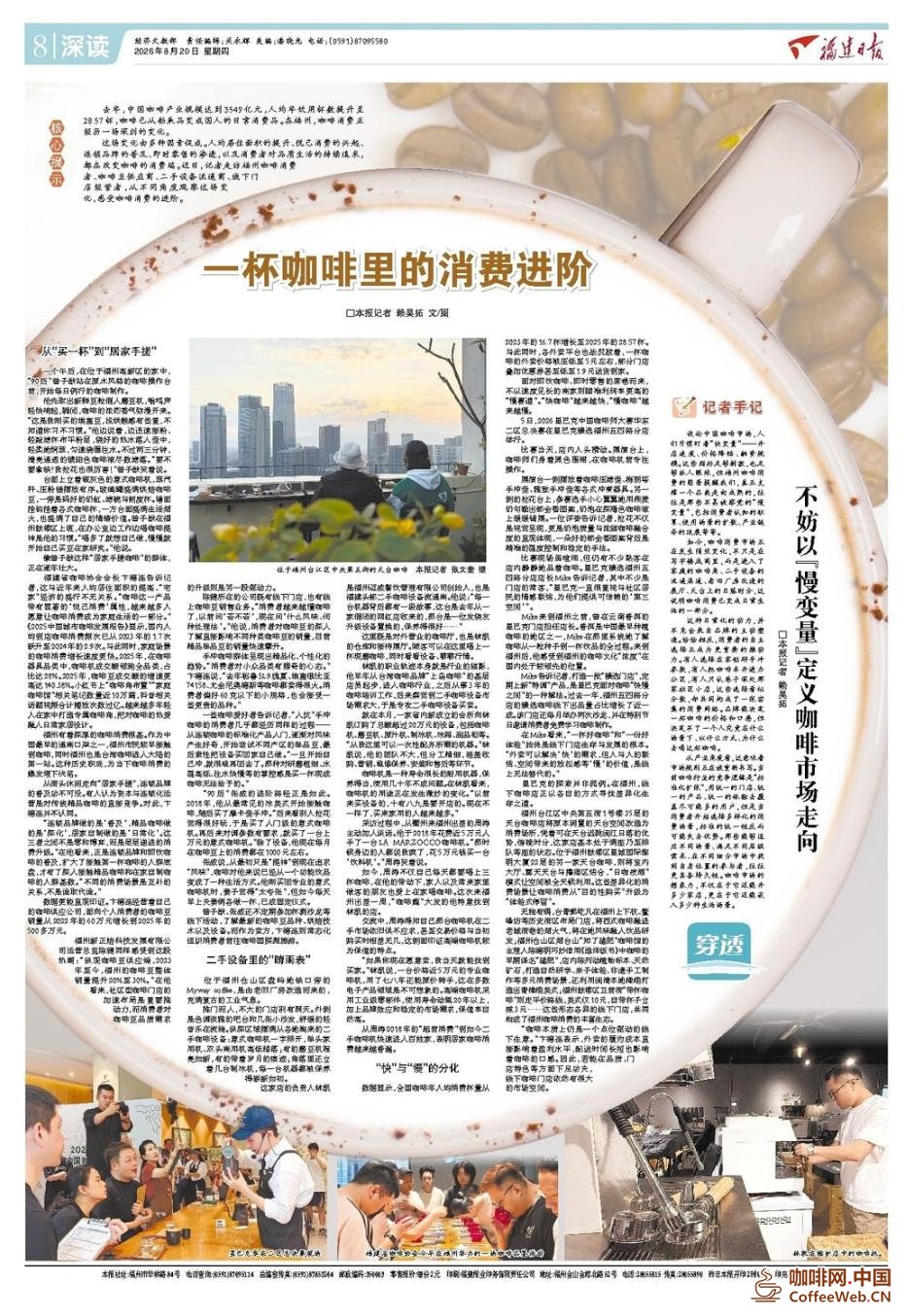
2026年8月20日《福建日报》第08版
核心提示
去年,中国咖啡产业规模达到3549亿元,人均年饮用杯数提升至28.57杯,咖啡已从舶来品变成国人的日常消费品。在福州,咖啡消费正经历一场深刻的变化。
这场变化由多种因素促成。人均居住面积的提升、悦己消费的兴起、连锁品牌的普及、即时零售的渗透,以及消费者对品质生活的持续追求,都在改变咖啡的消费端。近日,记者走访福州咖啡消费者、咖啡豆供应商、二手设备流通商、线下门店经营者,从不同角度观察这场变化,感受咖啡消费的进阶。
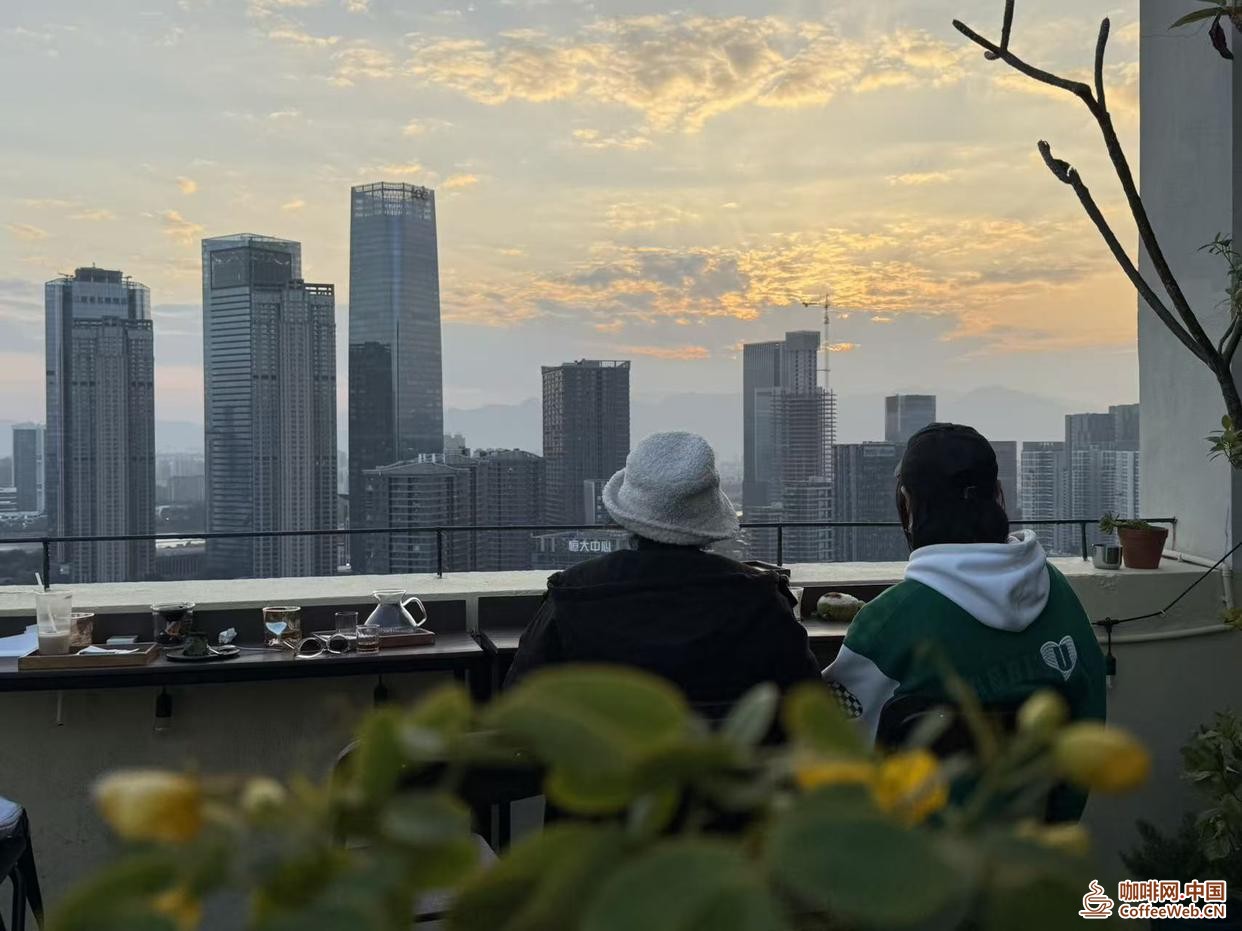
位于福州台江区中央第五街的天台咖啡 福建日报记者 张文奎 摄
从“买一杯”到“居家手搓”
一个午后,在位于福州高新区的家中,“90后”曾子猷站在原木风格的咖啡操作台前,开始每日例行的咖啡制作。
他先取出新鲜豆粒倒入磨豆机,嗡鸣声轻快响起,瞬间,咖啡的浓烈香气弥漫开来。“这是我刚买的埃塞豆,浅烘酸感有些重,不知道你习不习惯。”他边说着,边迅速接粉、轻敲滤杯布平粉层,烧好的热水落入壶中,轻柔地焖蒸,匀速绕圈注水。不过两三分钟,清亮通透的琥珀色咖啡液尽数滤落。“要不要拿铁?我拉花也很厉害!”曾子猷笑着说。
台面上立着银灰色的意式咖啡机,蒸汽杆、压粉锤摆放有序。玻璃罐盛满烘焙咖啡豆,一旁是码好的奶缸、滤碗与刻度杯。墙面挂钩挂着各式咖啡杯,—方台面盛满生活烟火,也盛满了自己的情绪价值。曾子猷在福州鼓楼区上班,在办公室边工作边喝咖啡提神是他的习惯。“喝多了就想自己做,慢慢就开始自己买豆在家研究。”他说。
像曾子猷这样“居家手搓咖啡”的群体,正在逐年壮大。
福建省咖啡协会会长卞德连告诉记者,这与近年来人均居住面积的提高、“宅家”经济的盛行不无关系。“咖啡这一产品带有显著的‘悦己消费’属性,越来越多人愿意让咖啡消费成为家庭生活的一部分。”《2025中国城市咖啡发展报告》显示,国内人均到店咖啡消费频次已从2023年的1.7次跃升至2024年的2.9次。与此同时,家庭场景的咖啡消费增长速度更快。2025年,在咖啡器具品类中,咖啡机成交额领跑全品类,占比达28%。2025年,咖啡豆成交额的增速更高达140.38%。小红书上“咖啡角布置”“家庭咖啡馆”相关笔记数量近10万篇,抖音相关话题视频合计播放次数过亿。越来越多年轻人在家中打造专属咖啡角,把对咖啡的热爱融入日常家居设计。
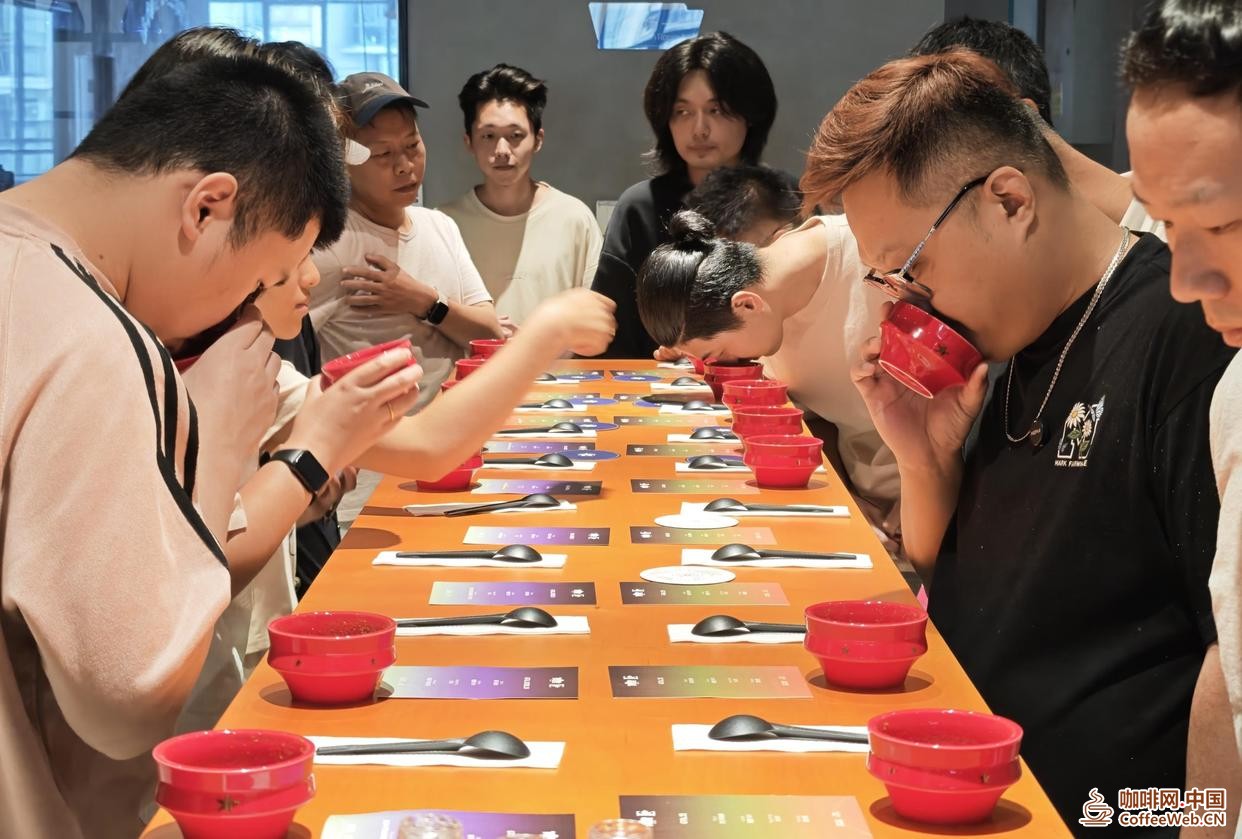
福建省咖啡协会今年在福州举办的一场咖啡品鉴活动。
福州有着深厚的咖啡消费根基。作为中国最早的通商口岸之一,福州市民较早接触到咖啡,同时福州也是台湾咖啡进入大陆的第一站。这种历史积淀,为当下咖啡消费的爆发埋下伏笔。
从街头休闲走向“居家手搓”,连锁品牌的普及功不可没。有人认为资本与连锁化运营是对传统精品咖啡的直接竞争。对此,卞德连并不认同。
“连锁品牌做的是‘普及’,精品咖啡做的是‘深化’,居家自制做的是‘日常化’。这三者之间不是零和博弈,而是层层递进的消费升级。”在他看来,正是连锁品牌和即饮咖啡的普及,扩大了接触第一杯咖啡的人群底盘,才有了深入接触精品咖啡和在家自制咖啡的人群基数。“不同的消费场景是互补的关系,不是谁取代谁。”
数据更能直观印证。卞德连经营着自己的咖啡供应公司,面向个人消费者的咖啡豆销量从2022年的60万元增长到2025年的500多万元。
福州新正焙科技发展有限公司运营总监陈健同样感受到这股热潮:“纵观咖啡豆供应端,2023年至今,福州的咖啡豆整体销量提升20%至30%。”在他看来,社区型咖啡门店的加速布局是重要推动力,而消费者对咖啡豆品质需求的升级则是另一股驱动力。
陈健所在的公司既有线下门店,也有线上咖啡豆销售业务。“消费者越来越懂咖啡了,以前问‘苦不苦’,现在问‘什么风味、何种处理法’。”他说,消费者对咖啡豆的深入了解直接影响不同种类咖啡豆的销量,目前精品单品豆的销量快速攀升。
手冲咖啡群体呈现出精品化、个性化的趋势。“消费者对小众品类有猎奇的心态。”卞德连说,“去年秘鲁SL9瑰夏、埃塞俄比亚74158、尤金尼奥德斯等咖啡都卖得很火。消费者偏好60克以下的小规格,也会接受一些更贵的品种。”
一些咖啡爱好者告诉记者,“入坑”手冲咖啡的消费者几乎都经历同样的过程——从连锁咖啡的标准化产品入门,逐渐对风味产生好奇,开始尝试不同产区的单品豆,最后索性把设备买回家自己做。“一旦开始自己冲,就很难再回去了。那种对研磨粗细、水温高低、注水快慢等的掌控感是买一杯现成咖啡无法给予的。”
“90后”张威的进阶路径正是如此。2018年,他从最常见的冰美式开始接触咖啡,随后买了摩卡壶手冲。“后来看别人拉花觉得很好玩,于是买了入门级的意式咖啡机。再后来对调参数有要求,就买了一台上万元的意式咖啡机。”除了设备,他现在每月在咖啡豆上的消费都在1000元左右。
张威说,从最初只是“提神”到现在追求“风味”,咖啡对他来说已经从一个功能饮品变成了一种生活方式。他刚买回专业的意式咖啡机时,妻子觉得“太夸张”,但如今每天早上夫妻俩各做一杯,已成固定仪式。
曾子猷、张威还不定期参加杯测沙龙等线下活动,了解最新的咖啡豆品种、烘焙技术以及设备。而作为卖方,卞德连则常态化组织消费者前往咖啡园探源旅游。
二手设备里的“晴雨表”
位于福州仓山区盘屿地铁口旁的Myway coffee,是由老旧厂房改造而来的,充满复古的工业气息。
推门而入,不大的门店别有洞天。外侧是色调淡雅的吧台和几张小沙发,舒缓的轻音乐在流淌。纵深区域摆满从各地淘来的二手咖啡设备:意式咖啡机一字排开,单头家用机、双头商用机高低错落;有的磨豆机锃亮如新,有的带着岁月的痕迹;角落里还立着几台制冰机,每一台机器都被保养得崭新如初。
这家店的负责人林凯是福州迈威餐饮管理有限公司创始人,也是福建头部二手咖啡设备流通商。他说:“每一台机器背后都有一段故事,这台是去年从一家倒闭的网红店收来的,那台是一位发烧友升级设备置换的,保养得很好……”
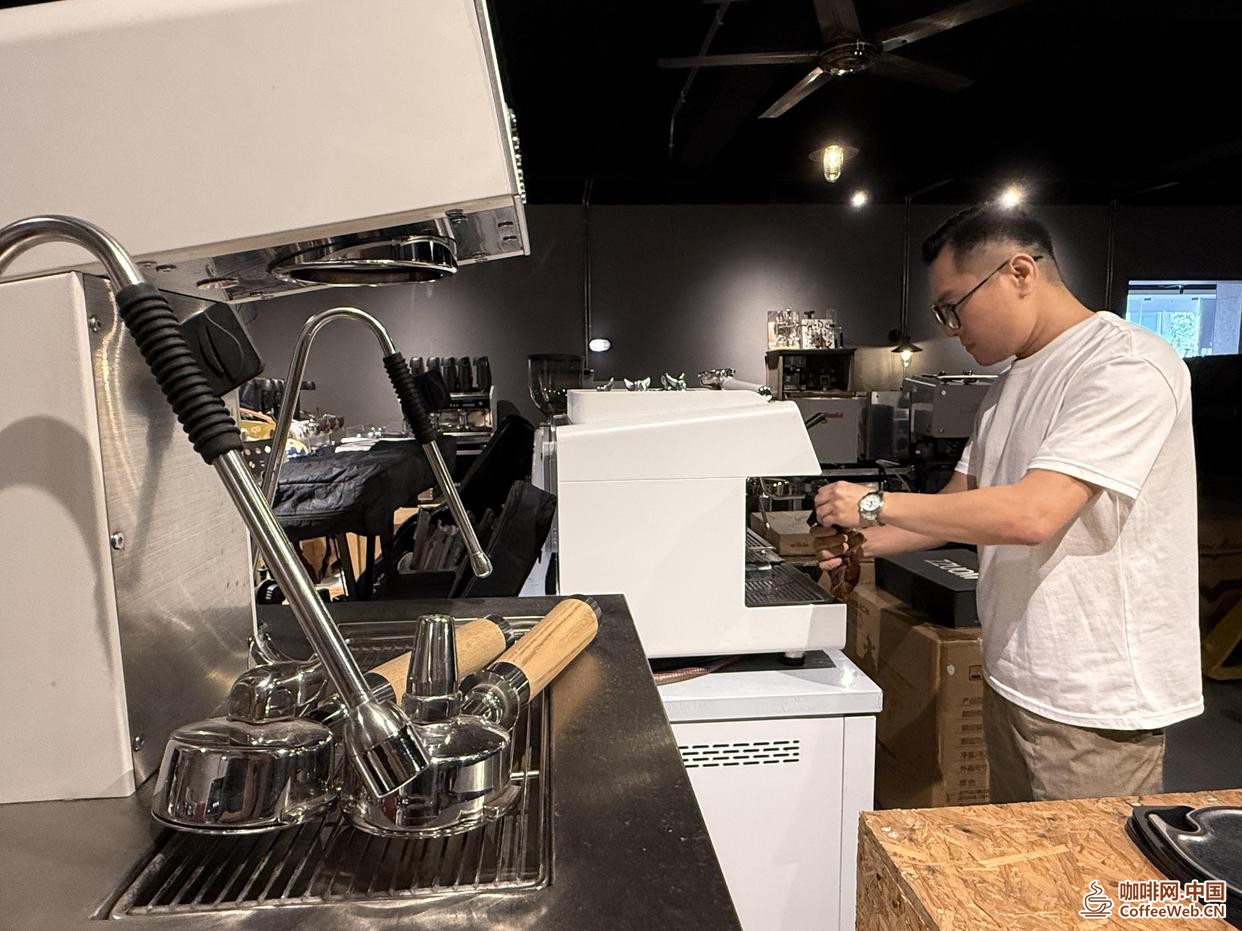
林凯在维护店中的咖啡机。
这里既是对外营业的咖啡厅,也是林凯的仓库和接待展厅。顾客可以在这里喝上一杯现磨咖啡,同时看看设备、聊聊行情。
林凯的职业轨迹本身就是行业的缩影,他早年从台湾咖啡品牌“上岛咖啡”的基层店员起步,进入咖啡行业,之后从事3年的咖啡培训工作,后来察觉到二手咖啡设备市场需求大,于是专攻二手咖啡设备买卖。
就在本月,一家省内新成立的会所向林凯订购了总额超过20万元的设备,包括咖啡机、磨豆机、原汁机、制冰机、冰箱、甜品柜等。“从我这里可以一次性配齐所需的机器。”林凯说,他的团队不大,但分工精细,涵盖收购、营销、维修保养、安装和售后等环节。
咖啡机是一种寿命很长的耐用机器,保养得当,使用几十年不成问题。在林凯看来,咖啡机的用途正在发生微妙的变化。“以前来买设备的,十有八九是要开店的。现在不一样了,买来家用的人越来越多。”
采访过程中,从衢州来福州出差的周涛主动加入谈话。他于2018年花费近5万元入手了一台LA MARZOCCO咖啡机。“那时候身边的人都说我疯了,花5万元钱买一台‘饮料机’。”周涛笑着说。
如今,周涛不仅自己每天都要喝上三杯咖啡,在他的带动下,家人以及常来家里做客的朋友也爱上在家喝咖啡。这次来福州出差一周,“咖啡瘾”大发的他特意找到林凯的店。
交流中,周涛得知自己那台咖啡机在二手市场依旧供不应求,甚至交易价格与当初购买时相差无几,这侧面印证高端咖啡机较为保值的特点。
“如果你现在愿意卖,我当天就能找到买家。”林凯说,一台价格近5万元的专业咖啡机,用了七八年还能原价转手,这在多数电子产品领域是不可想象的。高端咖啡机采用工业级零部件,使用寿命动辄20年以上,加上品牌效应和稳定的市场需求,保值率自然高。
从周涛2018年的“超前消费”到如今二手咖啡机快速进入百姓家,表明居家咖啡消费越来越普遍。
“快”与“慢”的分化
数据显示,全国咖啡年人均消费杯量从2023年的16.7杯增长至2025年的28.57杯。与此同时,各外卖平台也战况胶着,一杯咖啡的外卖价格被压低至5元左右,部分门店叠加优惠券甚至低至1.9元送货到家。
面对即饮咖啡、即时零售的席卷而来,不以速度见长的商家则瞄准利润率更高的“慢赛道”。“快咖啡”越来越快,“慢咖啡”越来越慢。
5日,2026星巴克中国咖啡师大赛华东二区总决赛在星巴克臻选福州五四路分店举行。
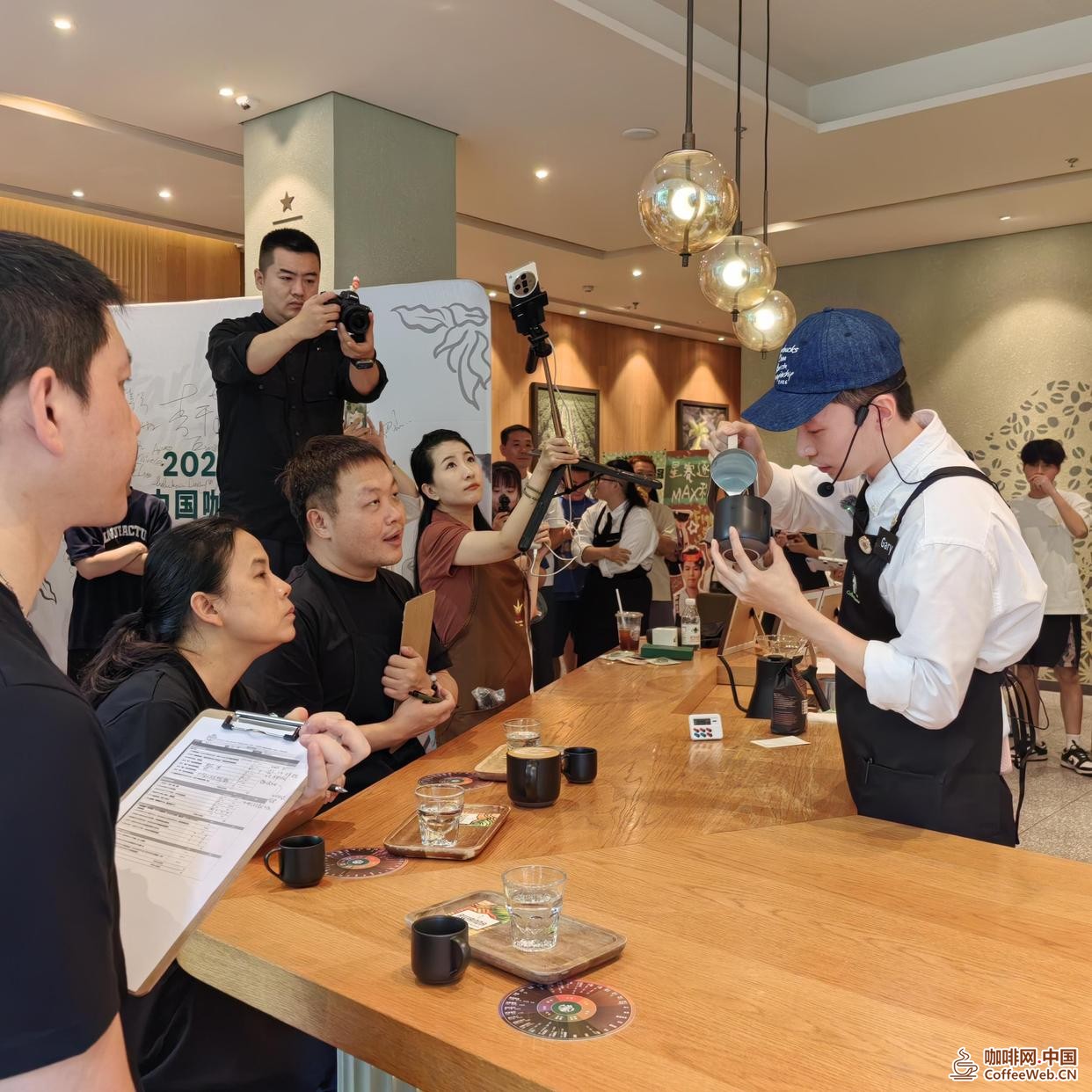
星巴克华东二区总决赛现场
比赛当天,店内人头攒动。展演台上,咖啡师们身着黑色围裙,在咖啡机前专注操作。
展演台一侧摆放着咖啡压滤壶、梅丽塔手冲壶、雅致手冲壶等各式冲煮器具。另一侧的拉花台上,参赛选手小心翼翼地用燕麦奶勾勒出郁金香图案,奶泡在深褐色咖啡液上缓缓铺展。一位评委告诉记者,拉花不仅是视觉呈现,更是奶泡质量与浓缩咖啡融合度的直观体现,一朵好的郁金香图案背后是精准的温度控制和稳定的手法。
比赛现场虽喧闹,但仍有不少熟客在店内静静地品着咖啡。星巴克臻选福州五四路分店店长Mike告诉记者,其中不少是门店的常客,“星巴克一直很重视与社区居民的情感联结,为他们提供可信赖的‘第三空间’”。
Mike来到福州之前,曾在云南普洱的星巴克门店担任店长。普洱是中国最早种植咖啡的地区之一,Mike在那里系统地了解咖啡从一粒种子到一杯饮品的全过程。来到福州后,他感受到福州的咖啡文化“浓度”在国内处于较领先的位置。
Mike告诉记者,打造一批“臻选门店”,定期上新“特调”产品,是星巴克面对咖啡“快慢之间”的一种解法。过去一年,福州五四路分店的臻选咖啡线下出品量占比增长了近一成。该门店还每月举办两次沙龙,并在特别节日邀请消费者免费学习咖啡制作。
在Mike看来,“一杯好咖啡”和“一份好体验”始终是线下门店生存与发展的根本。“外卖可以解决‘快’的需求,但人与人的联结、空间带来的放松感等‘慢’的价值,是线上无法替代的。”
星巴克的探索并非孤例。在福州,线下咖啡店正以各自的方式寻找差异化生存之道。
福州台江区中央第五街1号楼35层的天台咖啡店将原本闲置的天台空间改造为消费场所,凭着可在天台远眺闽江日落的优势,傍晚时分,这家店基本处于满座乃至排队等座的状态。位于福州鼓楼区星城国际黎明大厦22层的另一家天台咖啡,则将室内大厅、露天天台与撸猫区结合,“日咖夜酒”模式让空间被全天候利用。这些差异化的消费场景让咖啡消费从“目的性购买”升级为“体验式停留”。
无独有偶,台青郭屹凡在福州上下杭、鳌峰坊等历史街区布局门店,将西式咖啡融进老城街巷的烟火气,将在地风味融入饮品研发;福州仓山区烟台山“知了磕肥”咖啡馆的主理人陈德明巧妙借用《造洋饭书》中咖啡的早期译名“磕肥”,店内陈列动植物标本、天然矿石,打造自然研学、亲子体验、非遗手工制作等多元消费场景,还利用闽清本地橄榄打造出青橄榄美式;福州鼓楼区卫前街“带杯咖啡”则走平价路线,美式仅10元,自带杯子立减3元……这些形态各异的线下门店,共同构成了福州咖啡消费的丰富生态。
“咖啡本质上仍是一个点位驱动的线下生意。”卞德连表示,外卖的履约成本直接影响着盈利水平,配送时间长短也影响着咖啡的口感。因此,若能在品质、门店特色等方面下足功夫,线下咖啡门店依然有很大的市场空间。
记者手记
不妨以“慢变量”定义咖啡市场走向
谈论中国咖啡市场,人们习惯盯着“快变量”——开店速度、价格降幅、融资规模。这些指标足够刺激,也足够抓人眼球,但福州咖啡消费的图景提醒我们,真正支撑一个品类走向成熟的,往往是那些不易被察觉的“慢变量”,包括消费者认知的积累、使用场景的扩散、产业链条的延展等等。
如今,咖啡消费市场正在发生悄然变化,不只是在写字楼底商里,而是进入了家庭的咖啡角、二手设备的流通渠道、老旧厂房改造的展厅、天台上的日落时分,这说明咖啡消费已变成日常生活的一部分。
这种日常化的动力,并不完全来自品牌的主动塑造。恰恰相反,消费者的自主选择正成为更重要的推动力。有人选择在家钻研手冲参数,有人把咖啡车开进办公区,有人只认巷子深处那家社区小店,这些选择看似分散,却共同构成了一张密集的消费网络。品牌能决定一杯咖啡的价格和口感,但决定不了一个人究竟在什么场景下、以什么方式、为什么去喝这杯咖啡。
从产业角度看,这意味着市场规则正在被重新书写。当前咖啡行业的竞争逻辑是“标准化扩张”,用统一的门店、统一的产品、统一的体验去覆盖尽可能多的用户,但是当消费者开始选择多样化的消费场景,标准的统一性反而可能失去优势。那些能够适应不同场景、满足不同层级需求、在不同细分市场中找到自身位置的参与者,往往更具备持久性。咖啡市场的想象力,不仅在于它还能开多少家店,更在于它还能嵌入多少种生活场景。
Fujian Daily, August 20, 2026, Page 08
Core Tip
Last year, the scale of China's coffee industry reached 354.9 billion yuan, and the average annual number of cups consumed per capita increased to 28.57 cups. Coffee has transformed from an imported product into a daily consumer item for Chinese people. In Fuzhou, coffee consumption is undergoing a profound change.
This change is driven by multiple factors. The increase in per capita living space, the rise of self satisfied consumption, the popularity of chain brands, the penetration of instant retail, and consumers' continuous pursuit of quality life are all changing the consumption side of coffee. Recently, reporters visited coffee consumers, coffee bean suppliers, second-hand equipment distributors, and offline store operators in Fuzhou to observe this change from different perspectives and experience the advancement of coffee consumption.
Tiantai Coffee, located on Central Fifth Street in Taijiang District, Fuzhou. Photo by Zhang Wenkui, a reporter from Fujian Daily
From 'buying a cup' to 'hand rubbing at home'
One afternoon, at his home in Fuzhou High tech Zone, "90s generation" Zeng Ziyou stood in front of a wooden style coffee shop and began his daily routine of coffee making.
He first took out fresh beans and poured them into the grinder. The buzzing sound was light and lively, and in an instant, the strong aroma of coffee permeated. This is the Ethiopian bean I just bought. It feels a bit sour when lightly roasted. I don't know if you're used to it, "he said, quickly adding the flour and lightly tapping the filter cup to flatten the flour layer. The heated water falls into the pot and is gently steamed, with water added in circles at a constant speed. In just two or three minutes, the clear and transparent amber coffee liquid filtered out completely. Do you want a latte? I'm also very good at latte art! "Zeng Ziyou said with a smile.
On the table stands a silver gray Italian coffee machine, with steam rods and powder hammers arranged in an orderly manner. The glass jar is filled with roasted coffee beans, and next to it are a pre packaged milk tank, filter bowl, and graduated cup. Various coffee cups are hung on the wall hooks, and the square countertop is filled with daily life fireworks, as well as one's own emotional value. Zeng Ziyou works in Gulou District, Fuzhou, and it is his habit to drink coffee while working in the office to refresh himself. After drinking too much, I wanted to make it myself and slowly started buying beans to study at home, "he said.
The group of people like Zeng Ziyou who "make coffee by hand at home" is growing year by year.
Bian Delian, the president of Fujian Coffee Association, told reporters that this is not unrelated to the increase in per capita living space and the prevalence of "stay at home" economy in recent years. The coffee product has a significant 'self pleasing consumption' attribute, and more and more people are willing to make coffee consumption a part of their family life. The '2025 China Urban Coffee Development Report' shows that the frequency of coffee consumption per capita in China has jumped from 1.7 times in 2023 to 2.9 times in 2024. At the same time, coffee consumption in household settings is growing at a faster rate. By 2025, in the coffee appliance category, coffee machine sales will lead the entire category, accounting for 28%. In 2025, the growth rate of coffee bean transaction volume will be as high as 140.38%. There are nearly 100000 notes related to "coffee corner layout" and "family cafe" on the Little Red Book, and more than 100 million videos on Tiktok related topics have been played. More and more young people are creating exclusive coffee corners at home, integrating their love for coffee into their daily home design.
The Fujian Coffee Association held a coffee tasting event in Fuzhou this year.
Fuzhou has a strong foundation in coffee consumption. As one of the earliest trading ports in China, Fuzhou citizens were exposed to coffee earlier, and Fuzhou was also the first stop for Taiwanese coffee to enter the mainland. This historical accumulation has laid the foundation for the current explosion of coffee consumption.
The popularization of chain brands is indispensable for the transition from street leisure to "home hand massage". Some people believe that capital and chain operation are direct competition with traditional specialty coffee. Bian Delian does not agree with this.
In his view, it is the popularity of chain brands and ready to drink coffee that expands the base of people who come into contact with the first cup of coffee, and creates a deep base of people who come into contact with boutique coffee and homemade coffee at home. Different consumption scenarios are complementary relationships, not about who replaces whom
Data can provide more intuitive verification. Bian Delian runs his own coffee supply company, and the sales of coffee beans to individual consumers have increased from 600000 yuan in 2022 to over 5 million yuan in 2025.
Chen Jian, the Operations Director of Fuzhou Xinzheng Baking Technology Development Co., Ltd., also felt this trend: "Looking at the coffee bean supply side, the overall sales of coffee beans in Fuzhou have increased by 20% to 30% since 2023." In his opinion, the accelerated layout of community-based coffee stores is an important driving force, while the upgrading of consumer demand for coffee bean quality is another driving force.
Chen Jian's company has both offline stores and online coffee bean sales business. Consumers are becoming more and more familiar with coffee. They used to ask 'whether it's bitter or not,' but now they ask 'what flavor and processing method?' He said that consumers' in-depth understanding of coffee beans directly affects the sales of different types of coffee beans. Currently, the sales of premium single product beans are rapidly increasing.
The hand brewed coffee community is showing a trend towards refinement and personalization. Consumers have a curious attitude towards niche categories, "Bian Delian said." Last year, coffee brands such as Peru's SL9 Guixia, Ethiopia's 74158, and Eugenios sold very well. Consumers prefer small sizes below 60 grams and may also accept some more expensive varieties. ”
Some coffee enthusiasts told reporters that almost all consumers who "get into the pit" of hand brewed coffee go through the same process - starting from standardized products of chain coffee, gradually becoming curious about flavors, starting to try single beans from different production areas, and finally buying equipment to make their own. Once you start brewing on your own, it's difficult to go back. The sense of control over grinding thickness, water temperature, water injection speed, etc. cannot be given by buying a ready-made cup of coffee
The advanced path of Zhang Wei, born in the 1990s, is exactly like this. In 2018, he started playing coffee with the most common iced Americano and later bought a Mocha pot for hand brewing. Later on, when he saw others pulling flowers and found it very fun, he bought an entry-level Italian coffee machine. Later, when he had requirements for adjusting parameters, he bought an Italian coffee machine that cost over ten thousand yuan. Apart from the equipment, he now spends around 1000 yuan per month on coffee beans.
Zhang Wei said that from initially just "refreshing" to now pursuing "flavor", coffee has transformed from a functional beverage to a way of life for him. When he first bought a professional Italian coffee machine, his wife thought it was "too exaggerated", but now it has become a regular ritual for the couple to make a cup each morning.
Zeng Ziyou and Zhang Wei also regularly participate in offline activities such as cup testing salons to learn about the latest coffee bean varieties, roasting techniques, and equipment. As a seller, Bian Delian regularly organizes consumers to visit coffee gardens for exploration tours.
The 'barometer' in second-hand equipment
Myway Coffee, located next to the Panyu subway station in Cangshan District, Fuzhou, is a renovated old factory with a vintage industrial atmosphere.
Pushing open the door, the small store has its own secrets. On the outside are a lightly toned bar counter and several small sofas, with soothing light music flowing. The deep area is filled with second-hand coffee equipment sourced from various places: Italian coffee machines are arranged in a straight line, with single head household machines and double head commercial machines arranged in a staggered manner; Some bean grinders shine like new, while others bear the marks of time; There are also several ice makers standing in the corner, each of which has been maintained in a brand new condition.
The person in charge of this store, Lin Kai, is the founder of Fuzhou Maiwei Catering Management Co., Ltd. and also a leading second-hand coffee equipment distributor in Fujian. He said, "Behind every machine, there is a story. This one was collected from a bankrupt internet celebrity store last year, and that one was upgraded and replaced by an audiophile. It is well maintained
Lin Kai is maintaining the coffee machine in the store.
This is not only a coffee shop for external business, but also Lin Kai's warehouse and reception exhibition hall. Customers can enjoy a freshly ground coffee here, while checking the equipment and chatting about market trends.
Lin Kai's career trajectory itself is a microcosm of the industry. In his early years, he started as a grassroots store clerk for the Taiwanese coffee brand "Shangdao Coffee" and entered the coffee industry. He then worked in coffee training for three years. Later, he realized the high demand in the second-hand coffee equipment market and specialized in buying and selling second-hand coffee equipment.
Just this month, a newly established club in the province ordered equipment worth over 200000 yuan from Lin Kai, including coffee machines, bean grinders, juicers, ice makers, refrigerators, dessert cabinets, etc. I can provide all the necessary machines at once, "said Lin Kai. His team is not large, but the division of labor is fine, covering acquisition, marketing, maintenance, installation, and after-sales.
A coffee machine is a durable machine with a long lifespan, well maintained, and can be used for decades without any problems. In Lin Kai's view, the purpose of coffee machines is undergoing subtle changes. In the past, most people who came to buy equipment had to open a store. Now it's different, more and more people are buying it for home use
During the interview, Zhou Tao, who was on a business trip from Quzhou to Fuzhou, took the initiative to join the conversation. He spent nearly 50000 yuan to purchase a LA MARZOCCO coffee machine in 2018. At that time, people around me said I was crazy and spent 50000 yuan to buy a 'beverage machine,' "Zhou Tao said with a smile.
Nowadays, not only does Zhou Tao drink three cups of coffee every day, but under his guidance, his family and friends who often visit his home also fall in love with drinking coffee at home. He came to Fuzhou for a week on a business trip this time, and his "coffee addiction" was so strong that he specifically found Lin Kai's shop.
During the conversation, Zhou Tao learned that his coffee machine is still in high demand in the second-hand market, and the transaction price is almost the same as when he first purchased it, which indirectly confirms the characteristic of high-end coffee machines being more valuable.
If you are willing to sell now, I can find a buyer on the same day, "Lin Kai said. A professional coffee machine priced at nearly 50000 yuan can be resold at its original price after seven or eight years of use, which is unimaginable in most electronic product fields. High end coffee machines use industrial grade components with a service life of over 20 years. Coupled with brand influence and stable market demand, the resale value is naturally high.
From Zhou Tao's "advanced consumption" in 2018 to the rapid entry of second-hand coffee machines into people's homes today, it indicates that home coffee consumption is becoming increasingly common.
The differentiation between "fast" and "slow"
Data shows that the annual per capita consumption of coffee in China has increased from 16.7 cups in 2023 to 28.57 cups in 2025. At the same time, various food delivery platforms are also in a stalemate, with the price of a cup of coffee being lowered to around 5 yuan, and some stores even offering coupons as low as 1.9 yuan for home delivery.
Faced with the wave of ready to drink coffee and instant retail, businesses that are not known for speed are targeting the "slow track" with higher profit margins. Fast coffee is getting faster and slow coffee is getting slower.
On the 5th, the final of the 2026 Starbucks China Barista Competition East China Zone 2 was held at the Starbucks Zhenxuan Fuzhou Wusi Road branch.
Starbucks East China Zone 2 Finals Live
On the day of the competition, the store was crowded with people. On the exhibition stage, baristas dressed in black aprons were focused on operating the coffee machine.
On one side of the exhibition stage, there are various brewing utensils such as coffee filter presses, Melita hand brews, and elegant hand brews. On the other side of the latte stand, contestants carefully outline tulip patterns with oat milk, which slowly spreads out on dark brown coffee grounds. A judge told reporters that latte art is not only a visual presentation, but also a direct reflection of the quality of milk foam and the fusion of espresso. Behind a good tulip pattern is precise temperature control and stable techniques.
Although the competition venue is noisy, there are still many regular customers quietly sipping coffee in the store. Mike, the manager of Starbucks Zhenxuan Fuzhou Wusi Road branch, told reporters that many of them are regular customers of the store. "Starbucks has always attached great importance to emotional connection with community residents and provided them with a reliable 'third space'.
Before coming to Fuzhou, Mike worked as a store manager at a Starbucks store in Pu'er, Yunnan. Pu'er is one of the earliest regions in China to cultivate coffee, where Mike systematically learned about the entire process of coffee from a seed to a cup of beverage. After arriving in Fuzhou, he felt that the coffee culture in Fuzhou had a relatively leading concentration in China.
Mike told reporters that creating a batch of "premium stores" and regularly introducing new "special" products is Starbucks' solution to the "fast slow" coffee market. In the past year, the offline production volume of Zhenxuan Coffee at the Wusi Road branch in Fuzhou has increased by nearly 10%. The store also holds salons twice a month and invites consumers to learn coffee making for free during special holidays.
In Mike's opinion, "a good cup of coffee" and "a good experience" have always been the foundation for the survival and development of offline stores. Takeout can solve the need for 'fast', but the value of 'slow' such as the connection between people and the relaxation brought by space cannot be replaced online
Starbucks' exploration is not an isolated case. In Fuzhou, offline coffee shops are seeking differentiated ways of survival in their own ways.
The rooftop coffee shop on the 35th floor of Building 1, Central Fifth Street, Taijiang District, Fuzhou has transformed the previously unused rooftop space into a consumption venue. With the advantage of overlooking the sunset of the Minjiang River from the rooftop, the shop is basically fully booked or even waiting in line in the evening. Another rooftop coffee shop located on the 22nd floor of Xingcheng International Dawn Building in Gulou District, Fuzhou, combines an indoor lobby, an outdoor rooftop, and a cat grooming area. The "day coffee and night wine" mode allows the space to be utilized 24/7. These differentiated consumption scenarios have upgraded coffee consumption from "purposeful purchases" to "experiential stays".
Coincidentally, Taiqing Guo Yifan has set up stores in historical districts such as Shangxiahang and Aofengfang in Fuzhou, integrating Western style coffee into the bustling streets and alleys of the old city, and incorporating local flavors into beverage research and development; Chen Deming, the owner of the "Zhi Zhi Ke Fei" coffee shop in Yantai Mountain, Cangshan District, Fuzhou, cleverly borrowed the early translated name of coffee "Ke Fei" from "Zao Yang Fan Shu". The shop displays animal and plant specimens, natural ores, and creates diverse consumption scenarios such as natural learning, parent-child experience, and intangible cultural heritage handmade production. It also uses local olives from Minqing to create a green olive American style; The "Bring a Cup Coffee" in Weiqian Street, Gulou District, Fuzhou, takes the affordable route, with American style coffee priced at only 10 yuan and a 3 yuan discount for bringing your own cup... These various offline stores together form a rich ecology of coffee consumption in Fuzhou.
Coffee is essentially a point driven offline business, "Bian Delian said. The fulfillment cost of takeaway directly affects profitability, and the delivery time also affects the taste of coffee. Therefore, if sufficient efforts can be made in terms of quality and store characteristics, offline coffee shops still have a lot of market space.
Journalist's note
Can we define the direction of the coffee market as a 'slow variable'
When it comes to the Chinese coffee market, people tend to focus on "fast variables" - opening speed, price reduction, and financing scale. These indicators are stimulating and eye-catching enough, but the picture of coffee consumption in Fuzhou reminds us that what truly supports a category's maturity is often the "slow variables" that are not easily detected, including the accumulation of consumer cognition, the diffusion of usage scenarios, the extension of the industry chain, and so on.
Nowadays, the coffee consumption market is undergoing a quiet change, not just in the underground shops of office buildings, but also in the coffee corners of households, the circulation channels of second-hand equipment, the exhibition halls renovated from old factories, and the sunset on rooftops. This indicates that coffee consumption has become a part of daily life.
This daily driving force does not solely come from the active shaping of the brand. On the contrary, consumers' autonomous choices are becoming a more important driving force. Some people choose to study the parameters of hand washing at home, some drive their coffee carts into the office area, and some only recognize the small community shop deep in the alley. These choices may seem scattered, but together they form a dense consumer network. A brand can determine the price and taste of a cup of coffee, but it cannot determine in what context, in what way, or why a person drinks that cup of coffee.
From an industrial perspective, this means that market rules are being rewritten. The current competitive logic in the coffee industry is "standardized expansion", covering as many users as possible with unified stores, products, and experiences. However, when consumers begin to choose diverse consumption scenarios, the uniformity of standards may actually lose its advantage. Participants who can adapt to different scenarios, meet different levels of needs, and find their own position in different segmented markets often have more persistence. The imagination of the coffee market lies not only in how many stores it can open, but also in how many life scenarios it can embed.