2026世界机器人大会|咖啡机器人有了“人情味”2026 World Robot Conference - Coffee robots have a 'human touch'
开栏的话:提起机器人,很多人最先想到的是工厂产线、硬核研发。而在2026世界机器人大会上,越来越多机器人走出工厂车间,走进日常消费与家庭生活场景,成为便民新伙伴。陪伴交互、家政清洁、康养助老、零售服务……机器人持续迭代,从概念展品变为可触可感的消费品,但同时也带来成本、安全等新课题。本栏目将以大会为窗口,聚焦机器人在居家、文旅、养老等生活化场景中的新应用,观察科技如何适配普通人的真实需求,解码机器人产业从实验室走向消费市场的变革之路,探寻智能产品融入日常生活的机遇与挑战,描绘人机相伴的新生活图景。
透明作业舱内,六轴仿生机械臂完成从磨豆、压粉、萃取、打奶到拉花的全套工序,动作一气呵成,意式浓缩咖啡28秒出杯、卡布奇诺38秒出杯、一杯带有拉花图案的精品咖啡也仅需58秒——这是记者此前在2026世界机器人大会上见到的场景。
咖啡机器人并非新鲜事物,早在2018年前后就已有相关产品亮相。但早期产品大多是“机械臂+自动咖啡机”的简单组合,技术成熟度有限,并未大规模走进人们的日常生活。近年来随着产品不断迭代升级,咖啡机器人逐渐进驻机场、景区、商圈、学校、地铁等公共空间。那么,新一代咖啡机器人到底发生了哪些质变?
从“能做出咖啡”到“打败”咖啡师
“机器人已经不再像过去的机械臂那样,只依靠定制咖啡机制作饮品,而是像人一样学习新的技能,并与人积极互动。”智平方(深圳)科技有限公司(以下简称“智平方”)创始人郭彦东一语道出了变化。
记者在北京朝阳公园看到,落地于此的“智魔方”咖啡机器人可以制作浓缩咖啡、拉花拿铁等多款饮品,单杯出餐耗时1至2分钟左右。和过去只会机械重复动作的设备不同,这台机器人的“手”和“嘴”都没闲着:一边有条不紊地完成整套制作工序,一边和消费者互动聊天,机身屏幕上还有动态表情反馈,趣味的互动时常引得现场消费者开怀大笑。
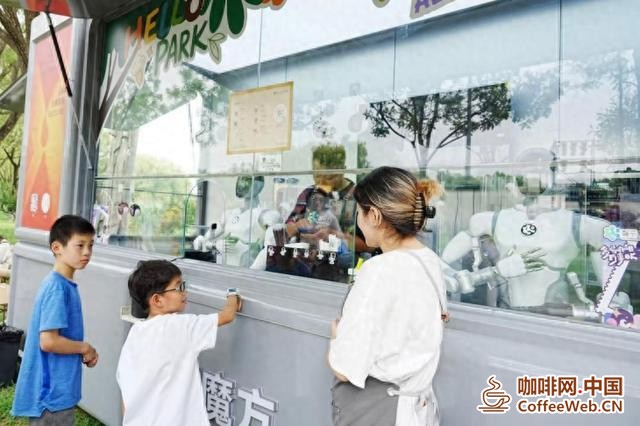
图为小朋友正在和机器人互动。
互动之外,品类增多是更直观的变化。智平方品牌负责人关珊告诉记者:“企业研发的通用机器人搭载自研的具身大模型,能够快速学习市场上的热门饮品做法,品类也从单一咖啡扩展至冰淇淋、鸡尾酒、啤酒、奶茶。”
随着可制作的饮品清单不断丰富,制作的精度也有了明显提升。“受制于硬件水平,早期设备很难完成细腻的奶泡造型。现在我们的机器人可以做到正负0.03毫米的重复定位精度,做出来的拉花图案更精美了。”安诺机器人(深圳)有限公司销售负责人王蓉介绍道,为满足消费者的个性化需求,拉花的图案还可以自行上传或借助AIGC生成。
上海氦豚机器人科技有限公司运营经理张先生说,今年5月,在上海首届机器人咖啡大赛上,该公司第七代“COFE+咖啡机器人”与咖啡师同台竞技,最终以快人工近1.5倍的制作速度、高3倍的出品精度胜出。
规模化落地仍需“人机协同”兜底
如今咖啡机器人已经实现跨区域规模化落地,张先生表示,企业早在8年前就开启相关布局,产品现已投放全球70多个国家、数千个地标,迭代至第7代。安诺机器人则覆盖80多个国家、上百座城市,落地场景遍布景区、机场、校园、商圈、医院等。
咖啡机器人从展台走向日常生活场景,离不开制作效率与运营成本的平衡。记者了解到,不同机型出杯速度各有差异:普通美式咖啡耗时1分钟以内,定制拉花咖啡需要1至2分钟,单机每日稳定产出数百杯,部分机型甚至可以日产千杯。
如果说制作效率决定了咖啡机器人“能跑多快”,那么采购成本与回本周期则决定了它“能跑多远”。记者采访得知,商用咖啡机器人采购成本大多集中在10万元至40万元之间,价格根据配置不同浮动。王蓉给记者算了笔成本和收益账:如果一杯美式咖啡定价9.9元、拉花拿铁定价15元至20元,销售点若日均销量稳定在80杯至100杯之间,大约七八个月即可回本;经营状况优异的点位,年营业额可达四五十万元甚至五六十万元。
不过,要想持续盈利,光靠机器还不够,因为其背后的运维保障终究离不开“人”。目前,行业普遍采用“人机协同”的运营模式。关珊解释:“机器人负责点单之后的整套饮品制作及把成品交付给顾客;而原料补给、每日深度清洁、设备故障处理等依旧依赖人工处理。”王蓉进一步补充道:“一些机器人搭载了传感模块,缺料、故障信息可通过微信、邮件等方式发送提醒,一名运维人员可以同时看管7至10个分散点位的设备,不需要长期驻场值守。”
然而,深入消费端会发现,“人机协同”不仅是运维层面的成本考量,更是产品体验和品质保障的现实需要。消费者戴女士在体验后坦言:“如果可以选择的话,我还是会购买人工制作的产品,因为我喜欢喝鲜榨的橙汁、气泡水之类的饮品。机器人制作的产品价格虽然比较友好,但是种类还不够丰富。”
有从业者指出更深刻的问题:像咖啡豆是否受潮、奶浆是否新鲜这类细节仍然需要人的触觉和嗅觉来判断,现阶段机器人还难以做到如此细微的分辨。记者在走访中也发现,当前的咖啡机器人更多是填补人工无法完全覆盖的空白场景,如大规模景区、深夜时段的商圈和写字楼等,而部分设备在操作方面依旧容易发生故障,需要人工监控、维修,必要时仍然需要人为“兜底”。
跳出单一赛道 走向多元交互场景
记者观察到,当前市面上的咖啡机器人一类是以机械臂为主的专用饮品设备,侧重高效零售;另一类是通用人形机器人,制作咖啡等饮品只是其众多应用场景中的一项。业内人士分析,当产品技术、商业模式已经得到市场验证之后,行业的发展将更多体现在通用机器人多场景拓展潜力上。
当前,多家企业正在践行“一个机器人大脑,多个落地场景”的研发模式。关珊打了个比方:“通俗地说,我们的机器人可能今天制作咖啡、明天制作冰淇淋、后天调酒,但都是同一个本体,通过小样本数据训练后即可胜任不同任务。”这也意味着,机器人可能不再是台只会做咖啡的专用机,而是具备了“泛化能力”的通用终端。
优理奇机器人科技(苏州)有限公司(UniX AI)的三代机器人正是这一思路的具象体现——既能泡茶、烤面包、调沙拉,也能铺床叠衣、画水墨画、演奏乐器。其工作人员冯先生告诉记者:“以上行为一个机器人都能做,本体硬件配置基本一样,区别在于软件算法包。我们的逻辑就是先把本体造出来,然后再去探索不同的场景,这大幅降低了场景切换的边际成本。”
可见,咖啡制作更像是通用机器人走进大众生活的一个切口,就像智平方在深圳已经尝试用机器人售卖彩票,放眼未来,同一台机器人除了制作咖啡、冰淇淋,还有望承接酒店客房服务、写字楼夜间巡检、接待讲解等多元任务。
除了场景边界的拓展,人机之间的关系也正在被重新定义,情绪价值成为产品竞争中新的发力点。王蓉说:“制作咖啡的机械臂只具备功能价值,未来我们准备向人形机器人方向发展,让其在制作饮品的同时与消费者聊天、互动,赋予消费过程更多趣味,那样就有了情绪价值。”
“具身智能的发展一定不是冷冰冰的,而是和人不断共生、互动,创造价值和惊喜。我们希望把消费从‘买一杯咖啡’变成‘一次有趣的交互体验’,让智能服务更有温度和烟火气。”她说。
文|摄 记者 胡 静 □ 陈跃佳
【来源:消费日报】
When it comes to robots, many people first think of factory production lines and hardcore research and development. At the 2026 World Robot Conference, more and more robots are stepping out of factory workshops and into daily consumer and household life scenarios, becoming convenient new partners. Accompanying interaction, household cleaning, elderly care assistance, retail services... Robots continue to iterate, transforming from conceptual exhibits to tangible consumer goods, but at the same time, they also bring new issues such as cost and safety. This column will use the conference as a window to focus on the new applications of robots in daily life scenarios such as home, cultural tourism, and elderly care. It will observe how technology adapts to the real needs of ordinary people, decode the transformation path of the robot industry from the laboratory to the consumer market, explore the opportunities and challenges of integrating intelligent products into daily life, and depict a new life scene of human-machine companionship.
In the transparent operation cabin, a six axis bionic robotic arm completes the entire process from grinding beans, pressing powder, extracting, milking to latte art, with seamless movements. Italian espresso can be brewed in 28 seconds, cappuccino can be brewed in 38 seconds, and a premium coffee with latte art can be brewed in just 58 seconds - this is the scene that the reporter saw earlier at the 2026 World Robot Conference.
Coffee robots are not a new thing, and related products have been introduced since around 2018. But early products were mostly simple combinations of "robotic arms+automatic coffee machines", with limited technological maturity, and did not enter people's daily lives on a large scale. In recent years, with the continuous iteration and upgrading of products, coffee robots have gradually entered public spaces such as airports, scenic spots, commercial districts, schools, and subways. So, what qualitative changes have occurred in the new generation of coffee robots?
From 'being able to make coffee' to 'defeating' baristas
Robots are no longer just relying on customized coffee machines to make drinks like traditional robotic arms, but learning new skills and actively interacting with humans, "said Guo Yandong, founder of Zhifang (Shenzhen) Technology Co., Ltd.
The reporter saw in Chaoyang Park, Beijing that the "Smart Magic Cube" coffee robot landed here can make various drinks such as espresso and latte, and it takes about 1 to 2 minutes to serve a single cup. Unlike devices in the past that only mechanically repeat actions, this robot's "hands" and "mouth" are not idle: while completing the entire production process in an orderly manner, it interacts and chats with consumers. There are also dynamic facial expressions feedback on the body screen, and interesting interactions often make on-site consumers laugh heartily.
The picture shows a child interacting with a robot.
Besides interaction, the increase in categories is a more intuitive change. The general robot developed by the company is equipped with a self-developed body model, which can quickly learn popular beverage methods in the market. The category has also expanded from coffee to ice cream, cocktails, beer, and milk tea, "said Guan Shan, the brand manager of Zhifang
With the continuous enrichment of the list of beverages that can be made, the precision of production has also significantly improved. Due to hardware limitations, it was difficult for early devices to achieve delicate milk foam shapes. Now our robots can achieve a repeated positioning accuracy of plus or minus 0.03 millimeters, and the floral patterns produced are even more exquisite, "said Wang Rong, the sales manager of Anno Robotics (Shenzhen) Co., Ltd. To meet the personalized needs of consumers, floral patterns can also be uploaded by themselves or generated with the help of AIGC.
Mr. Zhang, the Operations Manager of Shanghai He Bao Robot Technology Co., Ltd., said that in May of this year, at the first Robot Coffee Competition in Shanghai, the company's seventh generation "COFE+Coffee Robot" competed with baristas on the same stage and ultimately won with a production speed nearly 1.5 times faster than manual labor and a production accuracy three times higher.
Large scale implementation still requires "human-machine collaboration" as a backup
Nowadays, coffee robots have achieved cross regional scale implementation. Mr. Zhang said that the company started related layout as early as 8 years ago, and the products have been launched in more than 70 countries and thousands of landmarks around the world, iterating to the 7th generation. Anno robots cover over 80 countries and hundreds of cities, with landing scenes spread across scenic spots, airports, campuses, commercial districts, hospitals, and more.
The transition of coffee robots from exhibition booths to daily life scenarios is inseparable from the balance between production efficiency and operating costs. The reporter learned that different models have different cup making speeds: regular American coffee takes less than 1 minute, customized latte coffee takes 1 to 2 minutes, a single machine can stably produce hundreds of cups per day, and some models can even produce thousands of cups per day.
If production efficiency determines how fast a coffee robot can run, then procurement cost and payback period determine how far it can run. The reporter learned from the interview that the procurement cost of commercial coffee robots is mostly concentrated between 100000 yuan and 400000 yuan, and the price fluctuates according to different configurations. Wang Rong calculated the cost and profit account for the reporter: if a cup of American coffee is priced at 9.9 yuan and a latte is priced at 15 yuan to 20 yuan, and the daily sales at the sales point remain stable between 80 and 100 cups, it will take about seven to eight months to recoup the cost; A location with excellent business performance can achieve an annual turnover of four to five hundred thousand yuan or even five to six hundred thousand yuan.
However, in order to sustain profitability, relying solely on machines is not enough, as the operational support behind them ultimately relies on "people". At present, the industry generally adopts the operation mode of "human-machine collaboration". Guan Shan explained, "Robots are responsible for the entire beverage production and delivery of finished products to customers after ordering, while raw material supply, daily deep cleaning, and equipment failure handling still rely on manual processing." Wang Rong further added, "Some robots are equipped with sensing modules, and shortage and failure information can be sent reminders through WeChat, email, and other methods. One operation and maintenance personnel can simultaneously monitor equipment at 7 to 10 dispersed locations without the need for long-term on-site monitoring
However, upon delving into the consumer end, it will be found that "human-machine collaboration" is not only a cost consideration at the operational level, but also a practical need for product experience and quality assurance. Ms. Dai, a consumer, admitted after experiencing it, "If given the choice, I would still buy handmade products because I like to drink freshly squeezed orange juice, sparkling water and other beverages. Although robot made products are relatively affordable, the variety is not yet rich enough
Some practitioners have pointed out deeper issues: details such as whether coffee beans are damp or whether milk is fresh still require human touch and smell to judge, and robots are currently unable to achieve such subtle distinctions. During the visit, the reporter also found that the current coffee robots are mostly used to fill the gaps that cannot be fully covered by human labor, such as large-scale scenic spots, late night commercial districts, and office buildings. However, some equipment is still prone to malfunctions in operation, requiring manual monitoring, maintenance, and if necessary, human "backup".
Breaking away from a single track and moving towards diverse interactive scenarios
The reporter observed that the current coffee robots on the market are specialized beverage equipment mainly composed of robotic arms, focusing on efficient retail; The other type is general-purpose humanoid robots, and making coffee and other beverages is just one of their many application scenarios. Industry insiders analyze that once product technology and business models have been validated in the market, the development of the industry will be more reflected in the potential for multi scenario expansion of general robots.
Currently, multiple companies are practicing the research and development model of "one robot brain, multiple landing scenarios". Guan Shan gave an analogy: "Simply put, our robot may make coffee today, ice cream tomorrow, and cocktails the day after tomorrow, but they are all the same entity that can be trained on small sample data to perform different tasks." This also means that the robot may no longer be a specialized machine that only knows how to make coffee, but a universal terminal with "generalization ability".
UniX AI's third-generation robots are a concrete manifestation of this idea - they can not only brew tea, bake bread, mix salads, but also make beds, fold clothes, draw ink paintings, and play musical instruments. Mr. Feng, a staff member, told reporters, "Any robot can do the above behaviors. The hardware configuration of the ontology is basically the same, but the difference is the software algorithm package. Our logic is to first create the ontology and then explore different scenarios, which greatly reduces the marginal cost of scene switching
It can be seen that coffee making is more like a gateway for general robots to enter people's lives, just like Zhifang has already tried to sell lottery tickets with robots in Shenzhen. Looking ahead, the same robot is expected to not only make coffee and ice cream, but also undertake diverse tasks such as hotel room service, office building night inspections, and reception explanations.
In addition to the expansion of scene boundaries, the relationship between humans and machines is also being redefined, and emotional value has become a new driving force in product competition. Wang Rong said, "The robotic arm used to make coffee only has functional value. In the future, we plan to develop it towards humanoid robots, allowing them to chat and interact with consumers while making drinks, giving the consumption process more fun and emotional value
The development of embodied intelligence is definitely not cold and indifferent, but constantly coexists and interacts with people, creating value and surprises. We hope to transform consumption from 'buying a cup of coffee' to 'an interesting interactive experience', making intelligent services more warm and exciting, "she said.
Article | Reporter Hu Jing □ Chen Yuejia
【 Source: Consumer Daily 】